Fundamental theorem of calculus
ID: fundamental-theorem-of-calculus

The fundamental theorem of calculus says that accumulation and local change undo one another, under appropriate regularity conditions. If is a continuous function on andthen is differentiable for and . Conversely, if is an antiderivative of on this interval, continuous at its endpoints, thenThe first statement turns an integral into a function with a known derivative; the second turns an entire accumulation into two endpoint values.
For , accumulation from zero gives . At , its derivative is , exactly the current value . The accumulated value there is , and by it has reached . The accumulated quantity and its rate are different functions, linked by differentiation.
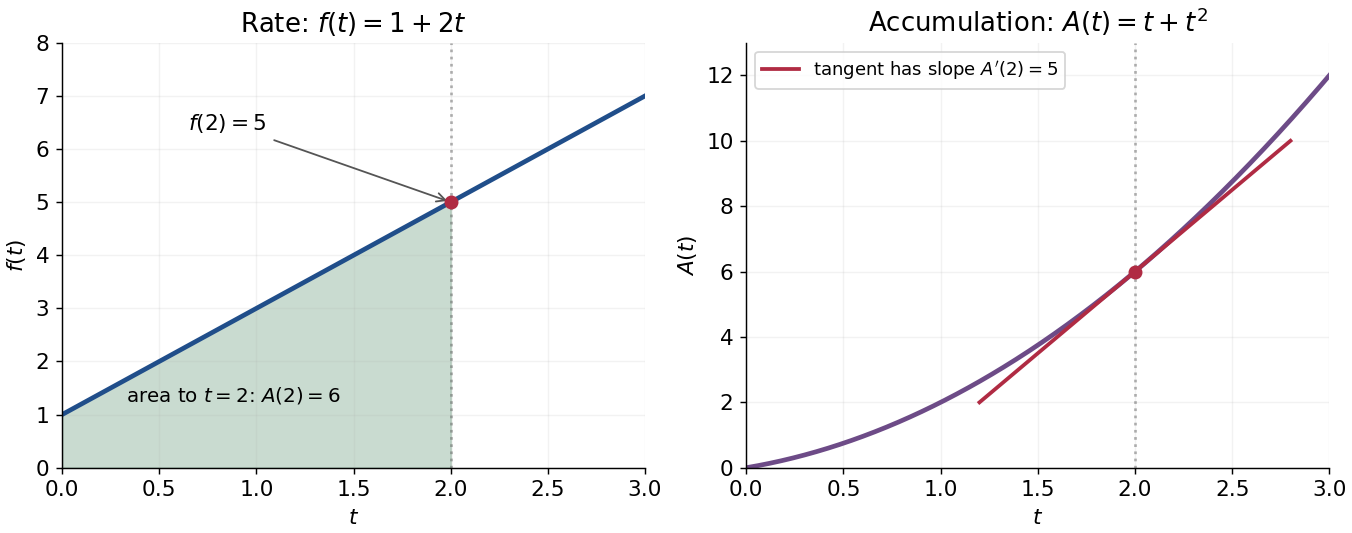
This connection makes the theorem useful far beyond geometric area. It recovers displacement from velocity, gives a probability from a probability density function, and converts many differential equations into integral equations. The striking economy is that information spread across a whole interval can sometimes be recovered from an antiderivative at its two boundaries.
A short explanation of the first part is thatis the local average of . Continuity makes this average approach . For the second part, has zero derivative and is constant by the mean value theorem. These are the ideas behind the proof; the endpoint and regularity conditions make them valid.
An early geometric form of this connection appears in Isaac Barrow's Lectiones geometricae (1670), Lecture X, Proposition 11. The original volume is catalogued by CESIMA, and Michael Nauenberg's historical research reproduces and examines the geometric argument.[ref]
https://cesimadigital.pucsp.br/handle/bcd/3675. Isaac Barrow, Lectiones geometricae, 1670
[ref]https://arxiv.org/abs/1111.6145. Michael Nauenberg, Barrow and Leibniz on the fundamental theorem of the calculus, 2011




There are unlisted articles, also show them or only show them.
New to topics? Read the docs here!