
Subset of ImageNet. About 167.62 GB in size according to www.kaggle.com/competitions/imagenet-object-localization-challenge/data.
Contains 1,281,167 images and exactly 1k categories which is why this dataset is also known as ImageNet1k: datascience.stackexchange.com/questions/47458/what-is-the-difference-between-imagenet-and-imagenet1k-how-to-download-it
www.kaggle.com/competitions/imagenet-object-localization-challenge/overview clarifies a bit further how the categories are inter-related according to WordNet relationships:
The 1000 object categories contain both internal nodes and leaf nodes of ImageNet, but do not overlap with each other.
image-net.org/challenges/LSVRC/2012/browse-synsets.php lists all 1k labels with their WordNet IDs.There is a bug on that page however towards the middle:and there is one missing label if we ignore that dummy
n02119789: kit fox, Vulpes macrotis
n02100735: English setter
n02096294: Australian terriern03255030: dumbbell
href="ht:
n02102040: English springer, English springer spanielhref= line. A thinkg of beauty!Also the lines are not sorted by synset, if we do then the first three lines are:
n01440764: tench, Tinca tinca
n01443537: goldfish, Carassius auratus
n01484850: great white shark, white shark, man-eater, man-eating shark, Carcharodon carcharias
gist.github.com/aaronpolhamus/964a4411c0906315deb9f4a3723aac57 has lines of type:therefore numbered on the exact same order as image-net.org/challenges/LSVRC/2012/browse-synsets.php
n02119789 1 kit_fox
n02100735 2 English_setter
n02110185 3 Siberian_huskygist.github.com/yrevar/942d3a0ac09ec9e5eb3a lists all 1k labels as a plaintext file with their benchmark IDs.therefore numbered on sorted order of image-net.org/challenges/LSVRC/2012/browse-synsets.php
{0: 'tench, Tinca tinca',
 1: 'goldfish, Carassius auratus',
2: 'great white shark, white shark, man-eater, man-eating shark, Carcharodon carcharias',The official line numbering in-benchmark-data can be seen at
LOC_synset_mapping.txt, e.g. www.kaggle.com/competitions/imagenet-object-localization-challenge/data?select=LOC_synset_mapping.txtn01440764 tench, Tinca tinca
n01443537 goldfish, Carassius auratus
n01484850 great white shark, white shark, man-eater, man-eating shark, Carcharodon carchariasThe best open source implementation as of 2020 seems to be: Mozilla rr.
Non-POSIX only here.
Oh but there are usually 2 trees: local and remote.
So you also have to learn how to observe and modify and sync with the remote tree!
But basically:to update the remote tree. And then you can use it exactly like any other branch, except you prefix them with the remote (usually
git fetchorigin/*), e.g.:origin/masteris the latest fetch of the remote version ofmasterorigin/my-featureis the latest fetch of the remote version ofmy-feature
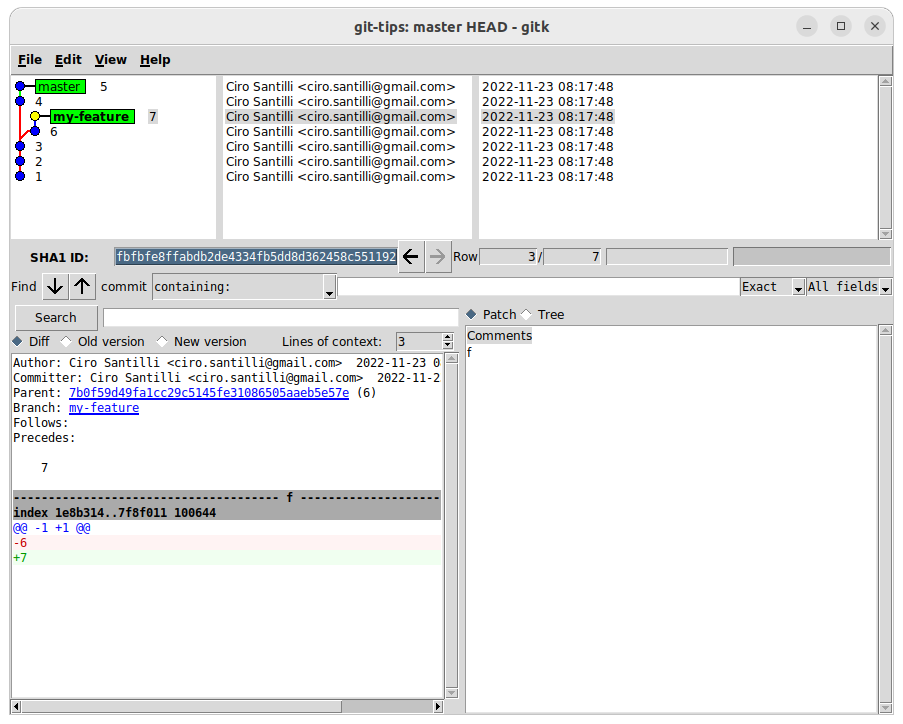
Generate a minimal test repo. You should get in the habit of doing this to test stuff out.
#!/usr/bin/env bash

mkdir git-tips
cd git-tips
git init

for i in 1 2 3 4 5; do
  echo $i > f
  git add f
  git commit -m $i
done

git checkout HEAD~2
git checkout -b my-feature

for i in 6 7; do
  echo $i > f
  git add f
  git commit -m $i
doneSome people like merges, but they are ugly and stupid. Rebase instead and keep linear history.
Linear history:
5 master
|
4
|
3
|
2
|
1 first commit
Branched history:
7   master
|\
| \
6  \
|\  \
| |  |
3 4  5
| |  |
| /  /
|/  /
2  /
| /
1/ first commitWhich type of tree do you think will be easier to understand and maintain?
????
????????????
You may disconnect now if you still like branched history.
But not every directed acyclic graph is a tree.
Example of a tree (and therefore also a DAG):Convention in this presentation: arrows implicitly point up, just like in a
5
|
4 7
| |
3 6
|/
2
|
1git log, i.e.:and so on. There are unlisted articles, also show them or only show them.