Alexander Y. Tetelbaum
Independent Researcher.
alex.tetelbaum@gmail.com
----------------------------------
Independent Researcher.
alex.tetelbaum@gmail.com
----------------------------------
Abstract
This paper introduces the concept of the Speed of Life — a normalized, fuzzy measure of experiential life velocity across the human lifespan — and demonstrates that three mutually contradictory theories of its behavior can each be rigorously justified, mathematically formalized, and rendered internally consistent using the same set of observations, considerations, and starting assumptions. Theory 1 holds that the Speed of Life increases monotonically from birth to death. Theory 2 holds the exact opposite: that it decreases monotonically from birth to death. Theory 3 proposes an inverted U-shaped trajectory, accelerating from birth to a peak in middle age and decelerating thereafter. We argue that the coexistence of three contradictory yet defensible theories is not a failure of analysis but a feature of fuzzy, subjectively defined variables — and that this methodological observation has broad implications for how we evaluate theories built on loosely defined constructs in psychology, social science, and philosophy.
Keywords: Speed of Life, time perception, subjective time, fuzzy logic, temporal experience, lifespan psychology, life velocity, mathematical modeling
1. Introduction
Time is the one resource distributed with perfect equality. Every human being receives exactly twenty-four hours per day, from birth to death, without exception. And yet the experience of time — its subjective velocity, its felt passage, its qualitative texture — varies enormously across individuals, circumstances, and stages of life.
Children waiting for a birthday report that the hours crawl. Adults reflecting on a passed decade report that the years flew. The elderly frequently observe that life accelerates with age. But careful observation also reveals the opposite: that the very young live with maximum experiential intensity, that retirement slows the daily pace to a crawl, and that the frantic middle years represent a peak of temporal compression from which life descends into gradual deceleration.
Which of these observations is correct? All of them. And that is precisely the problem.
This paper introduces a formal — if deliberately fuzzy — definition of the Speed of Life and uses it to construct three mutually contradictory mathematical theories of how life speed evolves across the human lifespan. Each theory is internally consistent. Each is supported by plausible observations and reasoning. Each contradicts the other two. And all three can be derived from essentially the same set of starting considerations, depending on which factors are weighted and how the core construct is defined.
The goal is not to determine which theory is correct. The goal is to demonstrate that when a variable is loosely defined — when it is fuzzy in the technical sense — contradictory conclusions can be rigorously derived from the same premises. This observation has implications well beyond temporal perception, touching on the epistemological foundations of any science that relies on subjectively defined constructs.
Let denote normalized age, where represents birth and represents death. The normalization maps any individual lifespan, regardless of its actual duration, onto the unit interval.
Let denote the Speed of Life at normalized age , where represents complete temporal stillness and represents maximum life speed.
The Speed of Life is defined as the normalized density of meaningful activities, obligations, experiences, and demands per unit of chronological time, relative to the maximum such density observed across the individual lifespan.
Formally:
Where is the activity density function
This definition is deliberately and necessarily fuzzy. "Meaningful activities," "obligations," and "experiences" resist precise operationalization. It is precisely this fuzziness that enables the contradictions that follow.
A newborn enters the world with zero obligations, zero commitments, and zero responsibilities. By the definition above, and therefore .
As the child grows, activity density increases. School imposes schedule. Friendships require cultivation. Adolescence brings examinations, social obligations, and the first experiences of time pressure. Young adulthood adds career, partnership, and financial responsibility. Each decade compounds the accumulation.
Crucially, the subjective experience of time passing accelerates with age. William James observed in 1890 that "the same space of time seems shorter as we grow older." The ratio of any given year to total life experience decreases monotonically: a year at age five represents 20% of all experienced life; a year at age fifty represents approximately 2%. As this ratio decreases, subjective time accelerates.
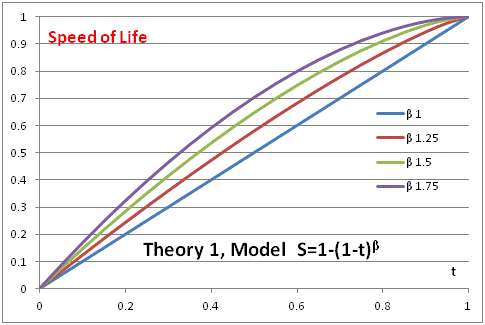
By this reasoning, is monotonically increasing, approaching its maximum at the moment of death.
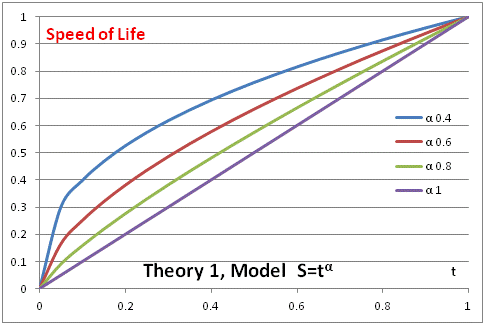
For :
Properties:
- ✓
- ✓
- for all ✓ (monotonically increasing)
- for (decelerating rate of increase)
- ✓
- for all ✓ (monotonically increasing)
- for (decelerating rate of increase)
The same newborn, viewed through a different lens, is not idle — they are maximally engaged. Every sensation is novel. Every experience requires full conscious processing. The infant brain forms approximately one million new neural connections per second. By any neurological measure, the infant is living at maximum Speed of Life, so .
As routines develop, novelty depletes. With each passing year, a larger fraction of daily life is managed by automaticity rather than conscious engagement — reducing experienced life density even as clock-time obligations increase.
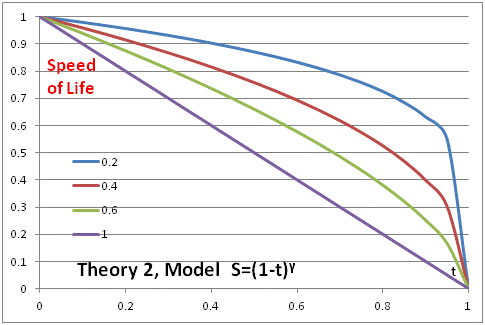
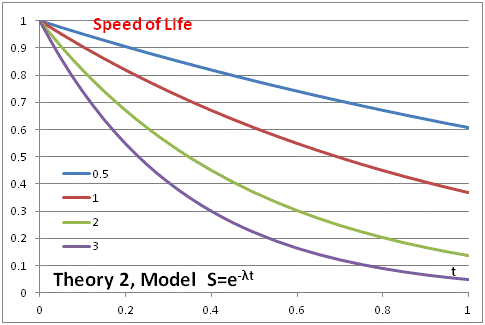
By retirement, obligations have dissolved. Time stretches. The elderly person who reports that "the days are long but the years are short" is describing a Speed of Life that has declined to near its starting asymptote. At death, .
Properties:
- ✓
- ✓
- for all ✓ (monotonically decreasing)
- for (decelerating rate of decrease)
- ✓
- for all ✓ (monotonically decreasing)
- for (decelerating rate of decrease)
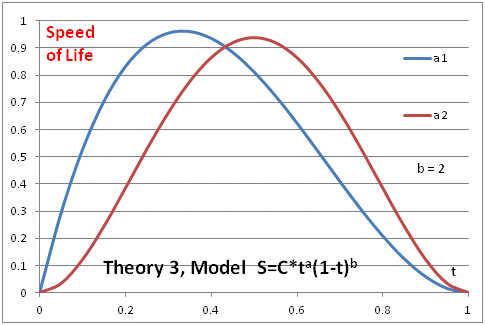
Theory 3 reconciles Theories 1 and 2 by observing that both are partially correct — each describing a different phase of the same inverted U-shaped trajectory.
The ascending phase: from birth through young adulthood, activity density increases as the individual acquires obligations, relationships, and responsibilities. rises.
The peak: in middle age — roughly when career demands, parenting obligations, household responsibilities, and care for aging parents simultaneously converge — activity density reaches its maximum. .
The descending phase: from peak midlife through old age and death, obligations dissolve, novelty depletes, and activity density declines. falls back toward zero.
Properties:
- ✓
- ✓
- ✓ (peak at midlife)
- , zero at ✓
- (concave everywhere)
- ✓
- ✓ (peak at midlife)
- , zero at ✓
- (concave everywhere)
For asymmetric peak placement at :
6. The Epistemological Point
The coexistence of three contradictory yet internally consistent theories is not an accident of careless analysis. It is a direct consequence of the fuzziness of the central construct.
- Subjective time perception (Theory 1's domain)
- Cognitive engagement intensity (Theory 2's domain)
- Obligation and activity density (Theory 3's domain)
- Cognitive engagement intensity (Theory 2's domain)
- Obligation and activity density (Theory 3's domain)
Each is real. Each is measurable in principle. And each yields a different theory when treated as the definition of Speed of Life.
This observation generalizes. Wherever a construct in psychology, social science, or philosophy admits multiple reasonable operationalizations, contradictory theories can be built on the same empirical foundation. The contradiction is not between the theories — it is between the hidden definitional choices embedded in each.
7. Conclusion
We have introduced the Speed of Life as a normalized fuzzy measure of experiential life velocity and derived three mutually contradictory mathematical theories of its behavior across the human lifespan. Each theory is internally consistent, empirically motivated, and mathematically well-formed. Each contradicts the other two. And all three emerge from essentially the same starting observations.
This is not a paradox. It is a demonstration. When a variable is sufficiently loosely defined, the conclusions that follow are determined less by the evidence than by the definitional choices made before the analysis begins.
The Speed of Life accelerates from birth to death. It decelerates from birth to death. It peaks at midlife and decelerates thereafter. All of these are true, in the sense that each can be rigorously derived. None of them is true in the sense that none is uniquely forced by the evidence.
It would be remiss not to acknowledge that this paper is, in part, a deliberate provocation. The Speed of Life is not a variable anyone has measured, and the three theories presented here are not competing empirical claims. They are demonstrations. What they demonstrate is that mathematical rigor is a necessary but insufficient condition for truth — that a proof is only as sound as the definition on which it rests. When that definition is fuzzy, almost anything can be proved. This paper has proved three contradictory things. The reader is invited to draw their own conclusions.
One final admission: this is, at heart, a playful paper. But its playfulness carries a serious point. Given a sufficiently loose definition, a mathematician can prove almost anything — rigorously, elegantly, and wrongly. The Speed of Life is the proof of that proof.
Conflicts of interest: None declared.
References
- James, W. (1890). The Principles of Psychology. Henry Holt and Company.
- Eagleman, D. (2011). Incognito: The Secret Lives of the Brain. Pantheon Books.
- Friedman, W. J., & Janssen, S. M. J. (2010). Aging and the speed of time. Acta Psychologica, 134 (2), 130–141.
- Wittmann, M., & Lehnhoff, S. (2005). Age effects in perception of time. Psychological Reports, 97 (3), 921–935.
- Langer, E. J. (1989). Mindfulness. Addison-Wesley.
- Modigliani, F. (1966). The life cycle hypothesis of saving. Social Research, 33 (2), 160–217.
- Zadeh, L. A. (1965). Fuzzy sets. Information and Control, 8 (3), 338–353.
- Ornstein, R. E. (1969). On the Experience of Time. Penguin Books.
- James, W. (1890). The Principles of Psychology. Henry Holt and Company.
- Eagleman, D. (2011). Incognito: The Secret Lives of the Brain. Pantheon Books.
- Friedman, W. J., & Janssen, S. M. J. (2010). Aging and the speed of time. Acta Psychologica, 134 (2), 130–141.
- Wittmann, M., & Lehnhoff, S. (2005). Age effects in perception of time. Psychological Reports, 97 (3), 921–935.
- Langer, E. J. (1989). Mindfulness. Addison-Wesley.
- Modigliani, F. (1966). The life cycle hypothesis of saving. Social Research, 33 (2), 160–217.
- Zadeh, L. A. (1965). Fuzzy sets. Information and Control, 8 (3), 338–353.
- Ornstein, R. E. (1969). On the Experience of Time. Penguin Books.
Articles by others on the same topic
There are currently no matching articles.