Ciro Santilli @cirosantilli 40
Joined 2022-11-02 Message

Incoming links: CIA 2010 covert communication websites Comms reconstruction
CIA 2010 covert communication websites Updated 2026-11-29
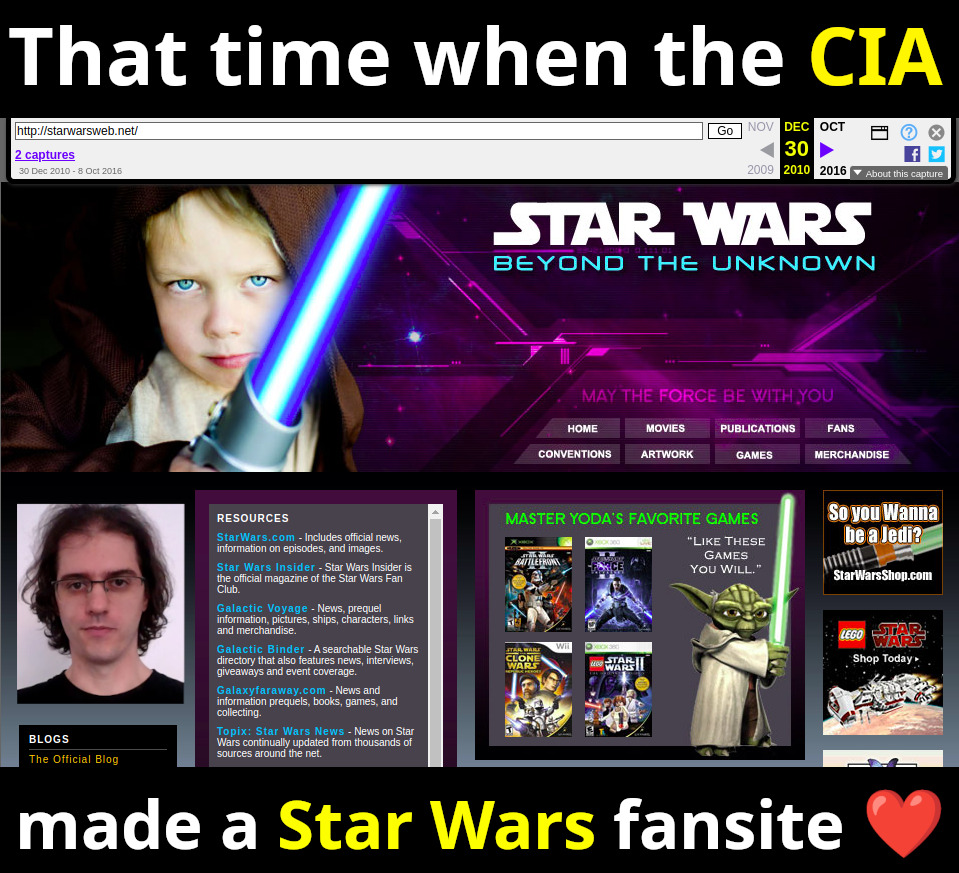
This article is about covert agent communication channel (COVCOM) websites used by the CIA in many countries from the mid 2000s until the early 2010s, when they were uncovered by counter intelligence of some of the targeted countries, notably Iran and China, circa 2010-2013.
This article uses publicly available information[ref]
Anonymous data source 1. Except for Anonymous data source 1, which was obtained for free by good will of the source, but is not publicly available. However, we did manage to find most domains and IP ranges before that source came up.
to publicly disclose for the first time a few hundred of what we feel are extremely likely candidate sites of the network. The starting point for this research was the September 2022 Reuters article "America’s Throwaway Spies" which for the first time gave nine example websites, and their analyst from Citizenlabs claims to have found 885 websites in total, but did not publicly disclose them. Starting from only the nine disclosed websites, we were then able to find a few hundred websites that share so many similarities with them, i.e. a common fingerprint, that we believe makes them beyond reasonable doubt part of the same network.If you enjoy this article, consider dropping some Monero at: 4A1KK4uyLQX7EBgN7uFgUeGt6PPksi91e87xobNq7bT2j4V6LqZHKnkGJTUuCC7TjDNnKpxDd8b9DeNBpSxim8wpSczQvzf so I can waste it on my foolish attempts to improve higher education. Other sponsorship methods: Section "Sponsor Ciro Santilli's work on OurBigBook.com".
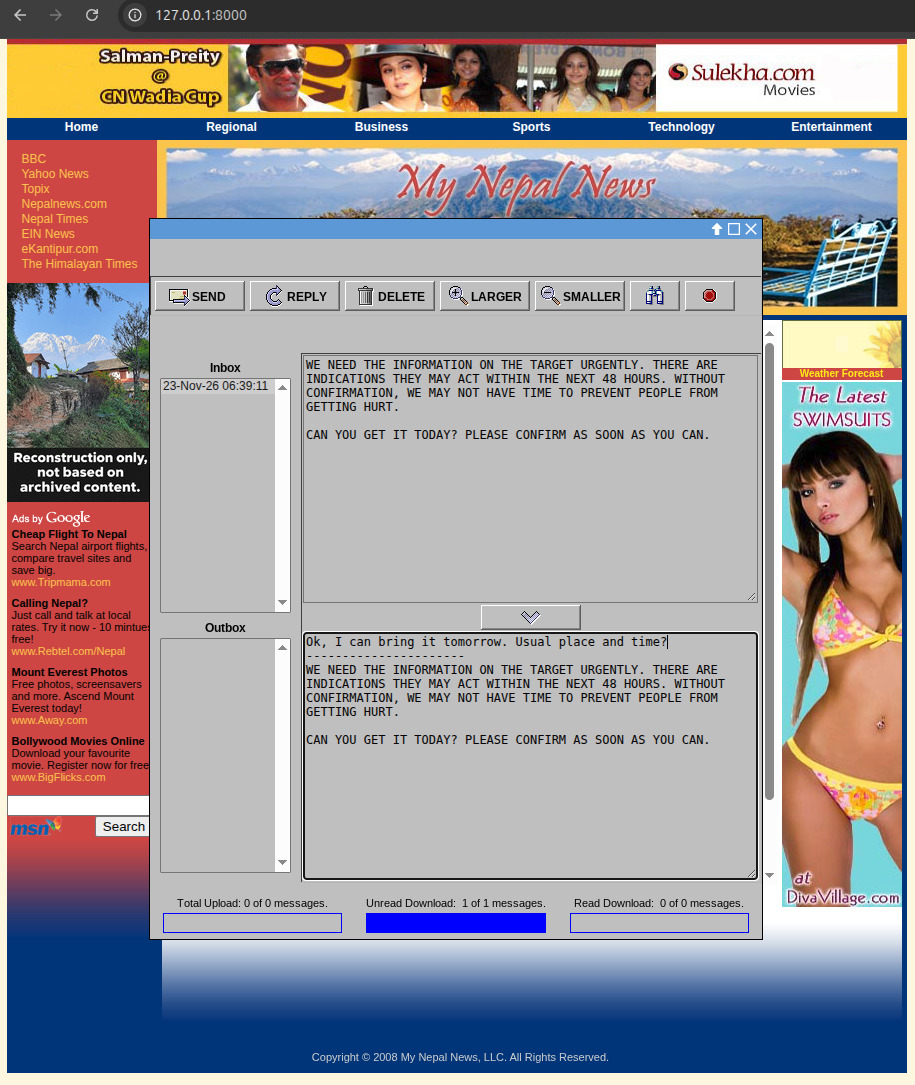
Comms reconstruction of mynepalnews.com showing the messaging interface
. We believe this to be a realistic reconstruction of how the JAR slideshow comms interface looked like, based on minimally patched frontend files archived on Wayback Machine and a Codex reconstructed backend server compatible with their frontend requirements. Details.


The discovery of these websites by Iranian and Chinese counterintelligence led to the imprisonment and execution of several assets in those countries, and subsequent shutdown of the channel by the CIA when they noticed that things had gone wrong. This is likely a Wikipedia page that talks about the disastrous outcome of the websites being found out: 2010–2012 killing of CIA sources in China, although it contained no mention of websites before Ciro Santilli edited it in.
Of particular interest is that based on their language and content, certain of the websites seem to have targeted other democracies such as Germany, France, Spain and Brazil.
If anyone can find others websites, or has better techniques feel free to contact Ciro Santilli at: Section "How to contact Ciro Santilli". Contributions will be clearly attributed if desired. Some of the techniques used so far have been very heuristic, and that added to the limited amount of data makes it almost certain that some websites have been missed. Broadly speaking, there are two types of contributions that would be possible:
- finding new IP ranges: harder and more exiting, and potentially requires more intelligence
- better IP to domain name databases to fill in known gaps in existing IP ranges
The fact that citizenlabs reported exactly 885 websites being found makes it feel like they might have found find a better fingerprint which we have not managed to find yet. We have not yet had to pay for our data. If someone wants to donate to the research, some ideas include:
- dump $400 on WhoisXMLAPI to dump whois history of all known hits and search for other matches. Small discoveries were made like this in the past and we'd expect a few more to be left. We don't expect huge breakthroughs from this, but at only $400 it is not so bad
- dump a lot more ($15k+? needs confirmation as opaque pricing) on DomainTools. We are not certain that they have any superior data since there is no free trial of any kind, but it would be interesting to test the quality of the data they acquired from Farsight DNSDB if you are really loaded
Disclaimers:
- the network fell in 2013, followed by fully public disclosures in 2018 and 2022, so we believe that the benefit of giving the public this broader historic understanding outweighs the risks that agents could be found so many years later by sloppy secret services
- Ciro Santilli's political bias is strongly pro-democracy and anti-dictatorship, but with a good pinch of skepticism about the morality US foreign policy in the last century
This UI style contains just a password box, no username, suggesting each domain was intended for a single agent at a time.
Sample domain: europeannewsflash.com.
Reverse engineered code: github.com/cirosantilli/media/blob/master/cia-2010-covert-communication-websites/comms-reverse/jar/password-only
We have noticed that we don't know the IP range for most websites which use this UI style are, suggesting that they are possibly older and predate a massive later IP range rollout.
The server endpoint for this type of comms is
/cgi-bin/*.cgi, e.g. http://www.europeannewsflash.com/cgi-bin/home.cgi, except for technologypresstoday.com which uses /cgi/technology.cgi.Client code contains it's own litle RSA public key cryptography implementation. It uses it to establish a shared key, and encrypts further communication with AES. The exact same algorithm is used for JS comms, suggesting a shared design.
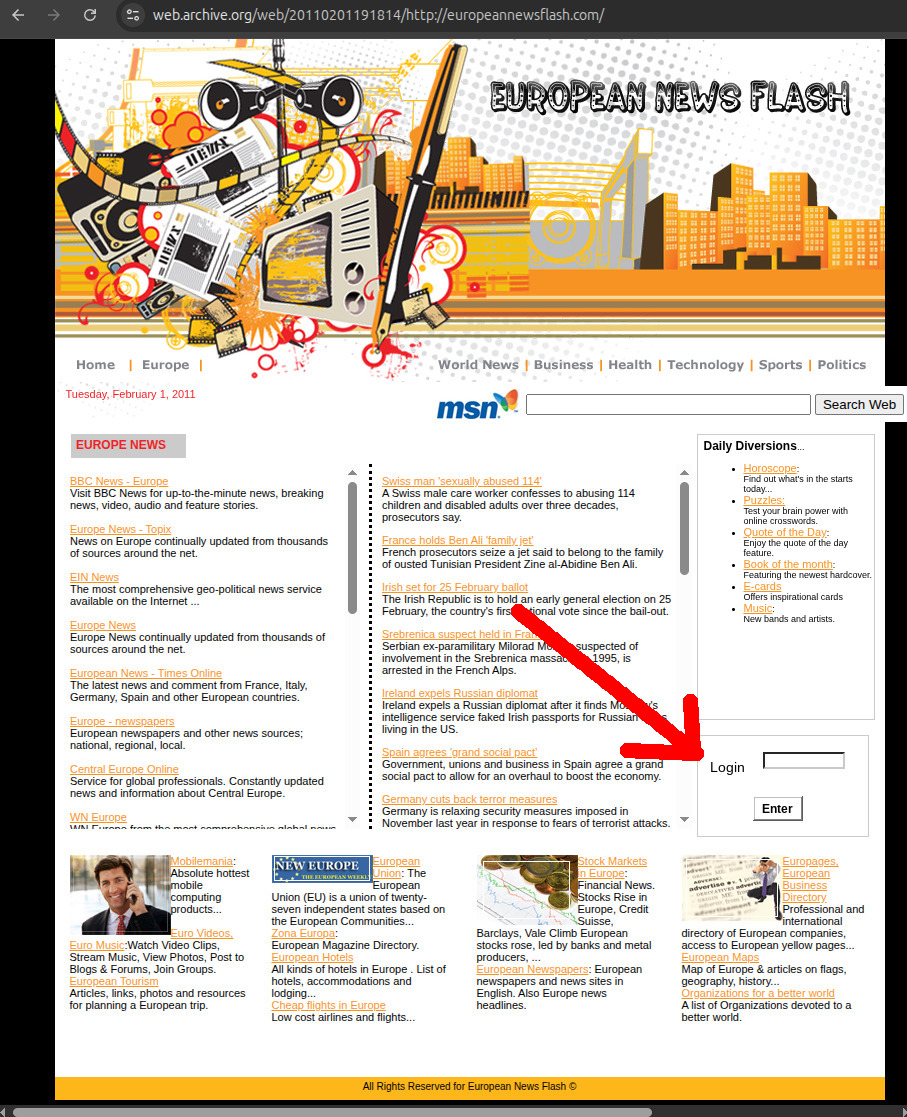
2011 Wayback Machine archive of europeannewsflash.com on Chromium 156 with CheerpJ enabled and login prompt highlighted
. With CheerpJ extension it is possible to see the password field directly on the Wayback Machine without the need for the server reconstruction. The MSN Web Search going out of bounds is just some incompatibility between old web and Chromium 156. Firefox 158 shows it better. But the CherrpJ extension is not available on Firefox. Details.
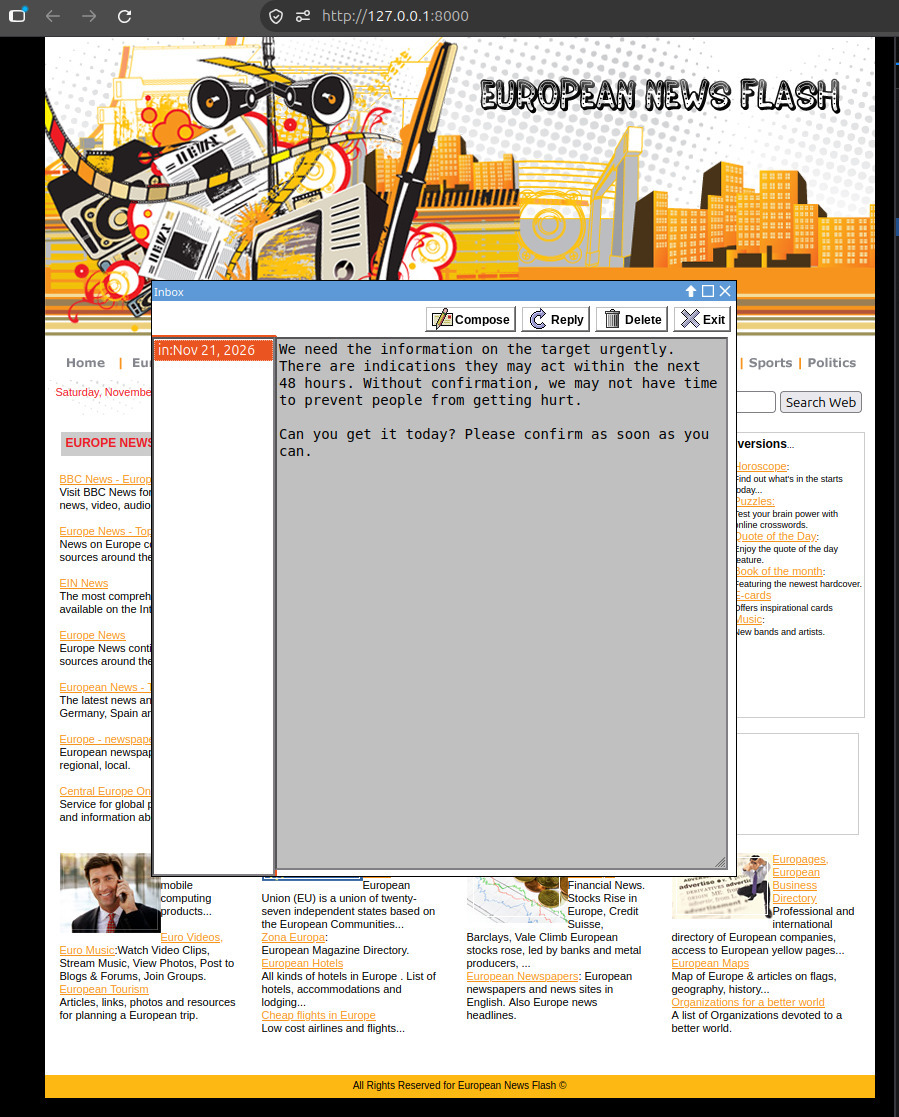
Comms reconstruction of europeannewsflash.com showing the messaging interface
. Details.
Actually opening up the comms interface requires of course the server to reply, so this is only possible in reconstruction.
There was no live refresh, you'd need to refresh the page and re-login to see your handler messages.
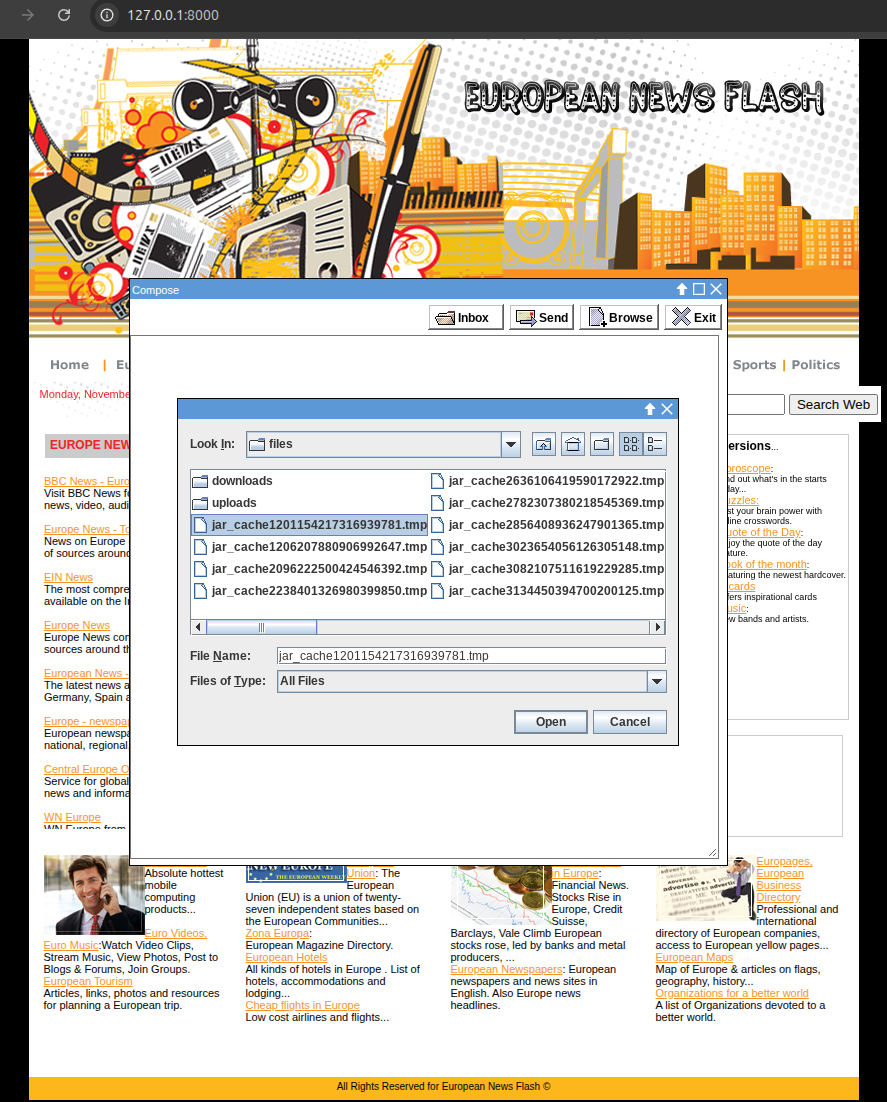
Comms reconstruction of europeannewsflash.com showing the file selector UI
. Nice feature! Very handy to upload those top secret PDFs back to the CIA. Note that in our comms reconstruction, file upload only works if you run CheerpJ as the browser extension, --cheerpj injection does not work well for it. Details.
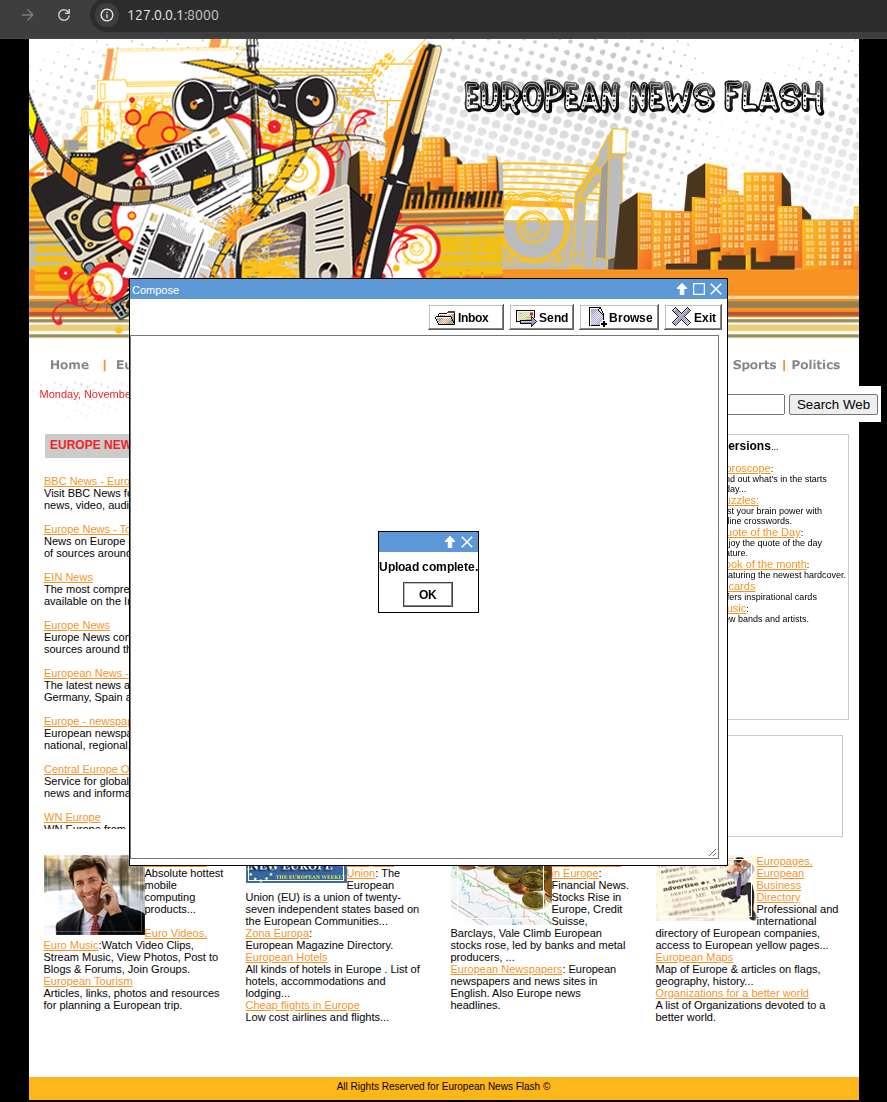
Comms reconstruction of europeannewsflash.com showing the "Upload complete" message
. This message shows up after you finish either sending a message or making a file upload. Details.

Comms reconstruction of europeannewsflash.com showing the "Bad login. Refresh the page to try again" message
. This message shows if your stupid asset puts the wrong password in the password box. Details.
This is a small variant of JAR slideshow. Rather than a slideshow of images, it just shows one scrolling message. Other than that, the UI is identical: click applet, harcoded first char, hardcoded hashed password, hardcoded last char, then identical login prompt and UI opens.
Sample domain: 2011.
Reverse engineered code: factored out with JAR slideshow under: github.com/cirosantilli/media/blob/master/cia-2010-covert-communication-websites/comms-reverse/jar/slideshow
Comms reconstruction of inews-today.com showing the JAR scroller
. Sample domain: mynepalnews.com.
Reverse engineered code: github.com/cirosantilli/media/blob/master/cia-2010-covert-communication-websites/comms-reverse/jar/slideshow

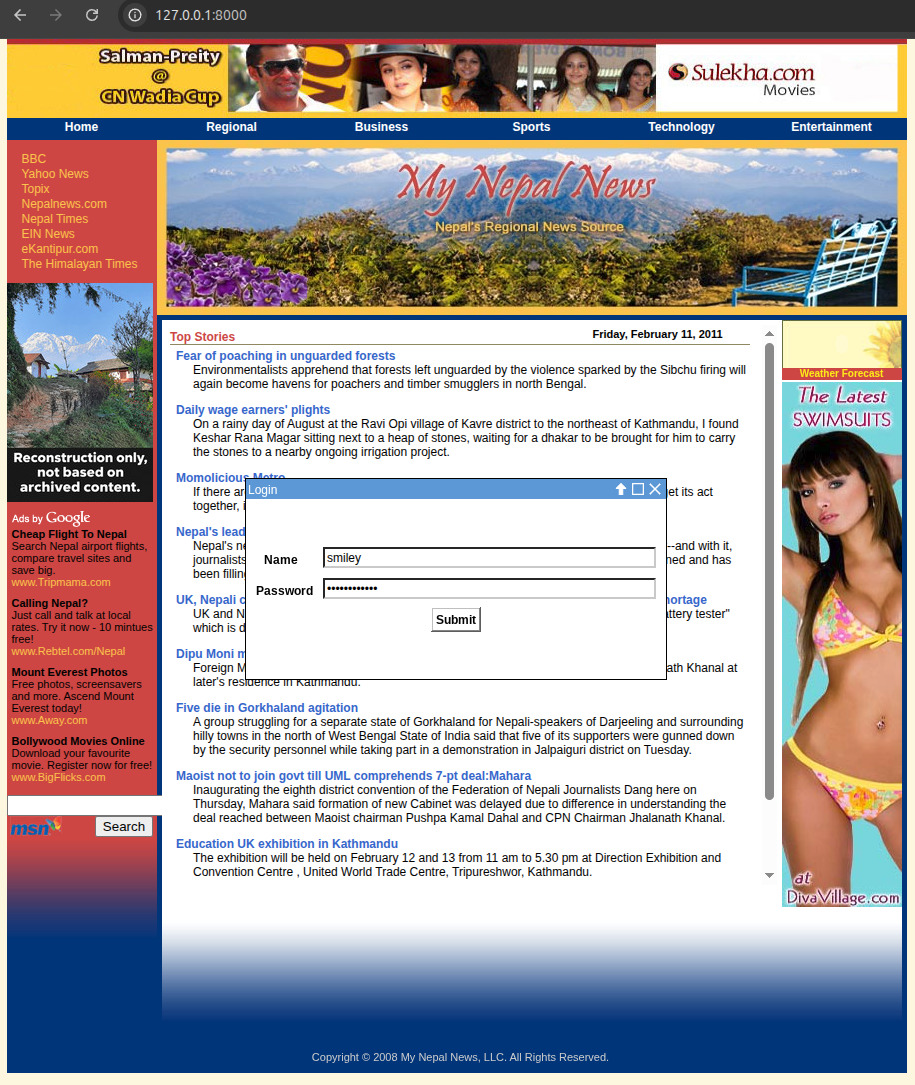
Comms reconstruction of mynepalnews.com showing the login prompt
. For this particular page, it opens after the user enters q, azsx and p. Codex managed to brute force reverse the azsx password for this one from it hash embedded in the archived JAR, so we are certain this is the actual sequence the asset would have entered. Such "geometric QWERTY keyboard mnemonics" were common. Details.
Comms reconstruction of mynepalnews.com showing the messaging interface
. This UI style had some cute elements, such as progress meters and the font size selectors. Despite progress meters, Codex' reverse engineering suggests it could not live load replies, you'd still have to refresh the page and re-login to see messages. Details.The first image is present in the JAR and is accurate. Further images would have been sent from the server and have been lost to time. We have picked random-on-theme images for our comms reconstructions of some sites, while on the rest the server just keeps sending the same archived image so you don't see anything move.
The login fields are not visible in this type of UI, and require specific sequence of keypresses to be revealed. It's a cute piece of spycraft. The sequence is as follows, hardcoded and different for each JAR:The password cannot contain the start of finish characters.
- click the applet with the mouse to give it focus. Focus seems to be given by default when you open the page on most cases, but can be lost if you click elsewhere.
- enter one start character stored plaintext in the JAR
- enter a usually short UI-reveal password. This is stored hashed in the JAR for the majority of JARs. But because they are so short Codex manged to brute-force guess many of them correctly, we maintain a list at jar-activation-sequences.json.
- the finish key is stored in plaintext in the JAR
Once the correct sequence is entered, the login UI opens after about 10 seconds on our default reconstruction settings. This slowness is a result of the fact that according to Codex' reverse engineering, the UI open speed is be tied to the speed at which the slideshow switches slides. The server tells the client for how long each slide should show. Therefore this speed can be configured by a server sent parameter, exposed as
--jar-slideshow-interval on our reconstruction.py CLI, but our default felt like a reasonable slideshow update rate.This UI seems not to open directly on Wayback Machine even with the CheerpJ browser extension with due to some browser incompatibility issues which increased browser security measures.
The slideshow works by the app sending POST requests to
/servlet/release on the server each time it wants a new slide. The server then replies by sending back an application/octet-stream which sends back a Java-specific object serialization format as bytes. Therefore it is overwhelminly likely that this type of server was written in Java.The following command:produces a quick list of the currently known UI reveal passwords with a classification by Codex:
jq -r 'map(select(.sequence != "")) | group_by(.mnemonic_type)[] | (.[0].mnemonic_type | if . == "" then "unknown" else . end), (group_by([.domain, .sequence])[] | " \((.[0].domain + (" " * 34))[:34])\(.[0].sequence)\(if length > 1 then " (\(length) captures)" else "" end)"), ""' jar-activation-sequences.json (blank)
cellar-notes.com uknh
first-tee-golf.com csi
hydradraco.com ile
newsandsportscentral.com lac
the-news-scene.com mar
world-news-online.net adrlatlcc
domain_fragment
golf-on-holiday.com golf
half-court.net court
rastadirect.net rasta
geometric
awfaoi.org bnm
dk-dcinvestment.com oiu
echessnews.com vbg
inews-today.com zxcv
mynepalnews.com azsx
segomonews.com poki
sunrise-news.com njki
zafernews.com asd
number
azerinews.org 5768
lesummumdelafinance.com 346
newsintheworld-ru.com 63274
willtoworship.com 0818
number_pattern
fightwithoutrules.com 384756
lanoticiasdehoyelinforme.com 234
sixty2media.com 135
stara-turistick.com 864579
repeated_key
avoilurefixe.com 000
newsandweathersource.com sss (2 captures)
word_en
bcenews.com begin
dayenews.com tree
everythingcricket.org ball
financial-crisis-news.com start
icwb-news.com bill
mynewscheck.com football
news-and-sports.com lotus
newsresolution.net start
ride-captain.com tuna
stickshiftnews.com cars
theentertainbiz.com airforce
themvconnection.com fruit
whirlybirdinflight.com helo
word_es
surya-brahma.com chequeThe server endpoint path for this type of website is of the form
/servlet/*, e.g. /servlet/release for mynepalnews.com.Much like for JAR password-only , this setup also uses public key encryption, but it instead uses Diffie-Hellman key exchange and then encrypt further communcation with International Data Encryption Algorithm.
Four of the 78 known slideshow domains have 376 classes: especialesmonedas.com, half-court.net, inkfreenews.com, and segomonews.com. These four use literal activation sequences. The other 74 use hashed sequences.
This is the only type of JS comms which we are able to properly do a usable comms reconstruction of, because it contains all the client UI code nicely archived. The other types, JS polling XML and JS polling TXT receive their UI from the server, so we will never know how they looked like exactly.
Sample domain in English: classymotors.net.
Sample domain with an archived login button: iranfootballsource.com. This is the only domain so far which has an archived login OK button image, here a world cup. We see from this that the button is was intended to be just an image. Other archives so far just show the
img alt fallback value as text, but it is just an archival limitation.This type of JS comms uses the exact same encryption algorithm as JAR password-only , embedded into the JAR itself. Furthermore, it also has the same type of URL path for server endpoints
/cgi-bin/*.cgi, e.g. http://www.classymotors.net/cgi-bin/car_rate.cgi. This strongly suggests a shared origin.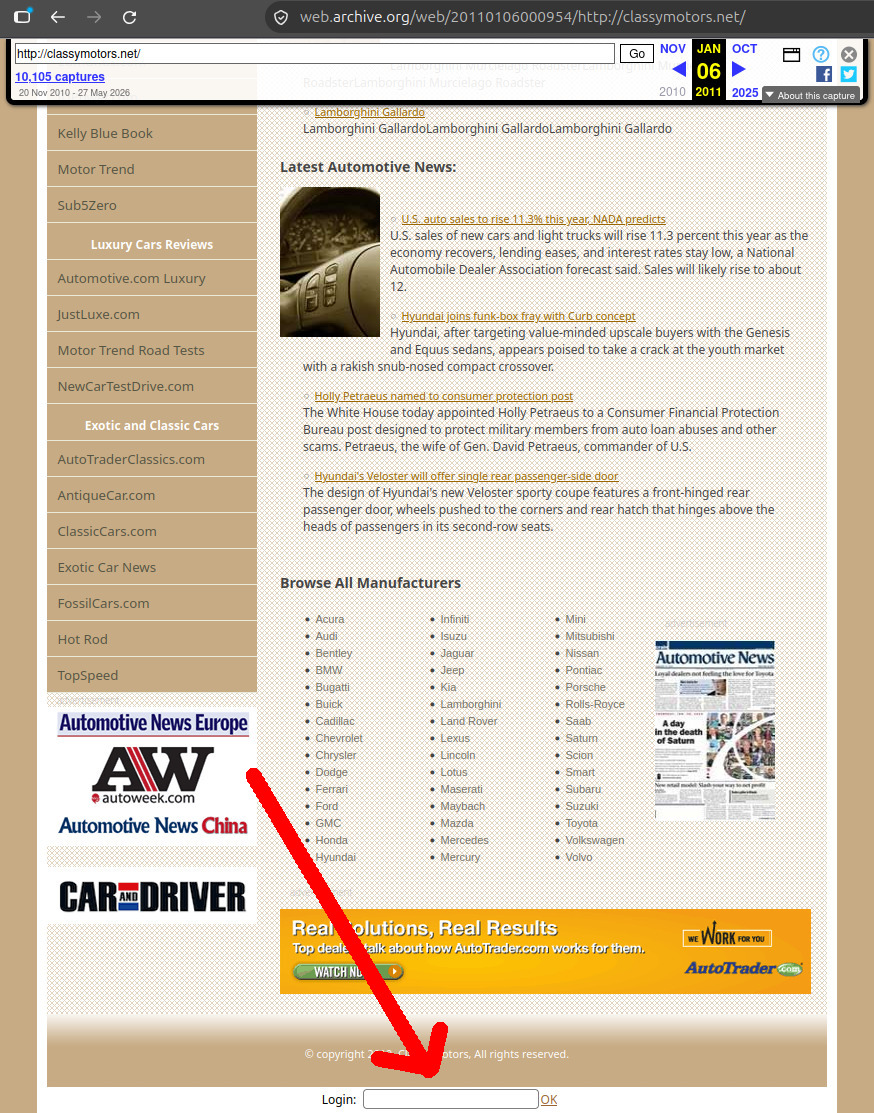

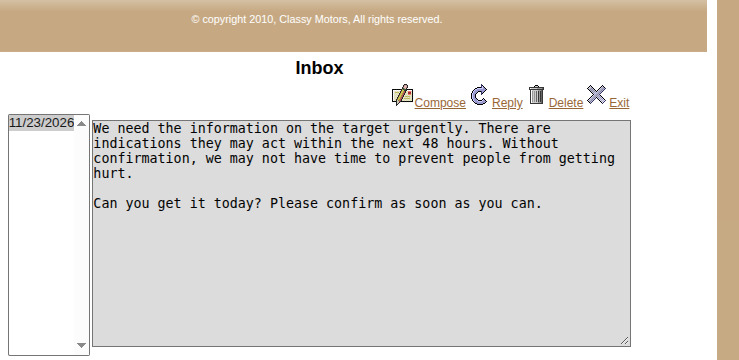
Comms reconstruction of classymotors.net showing the messaging UI
. This UI shows up after you submit the correct password. It is is remarkably similar to the JAR password-only UI, except there was no file upload. That would be asking way too much of 2010's JS capabilities! Details.
Updates Codex-powered comms reconstructions 2026-11-29
We've used Codex' supreme reverse engineering superpowers to reconstruct how a few of the comms would look like.
We believe that the reconstructions are very realistic. Front-end assets are used as archived from the Wayback Machine or with minor patching, with Codex having coded mostly a compatible backend server to make them happy enough to load.
We've also asked Codex to further reverse engineer and classify different comms types. We now understand more clearly that there were several JAR and JS subtypes for example.
Also, not all the comms types are reconstructible, as some unfortunately relied heavily on server-provided UI elements for the comms UI. This includes some JAR, JS and all SWF comms types.
2011 Wayback Machine archive of europeannewsflash.com on Chromium 156 with CheerpJ enabled and JAR password-only login prompt highlighted
. Details. Comms reconstruction of europeannewsflash.com showing the JAR password-only "Upload complete" message
. Details. Comms reconstruction of europeannewsflash.com showing the JAR password-only "Bad login. Refresh the page to try again" message
. Details. 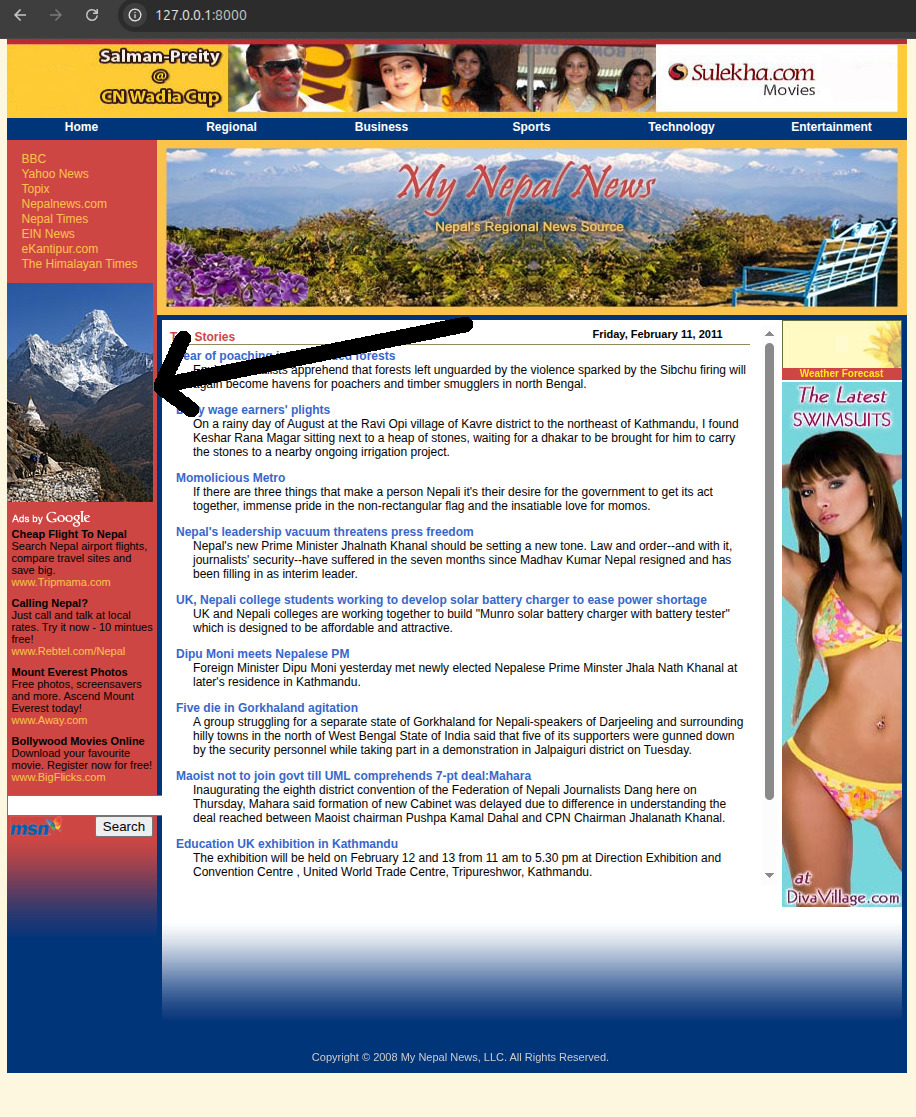
Comms reconstruction of mynepalnews.com showing the JAR slideshow initial Java applet slideshow image
. Details. Comms reconstruction of inews-today.com showing the JAR scroller
. 
2011 Wayback Machine archive of familyhealthonline.net indicating "FORUM" login page link to the CGI comms login page
. Details. 
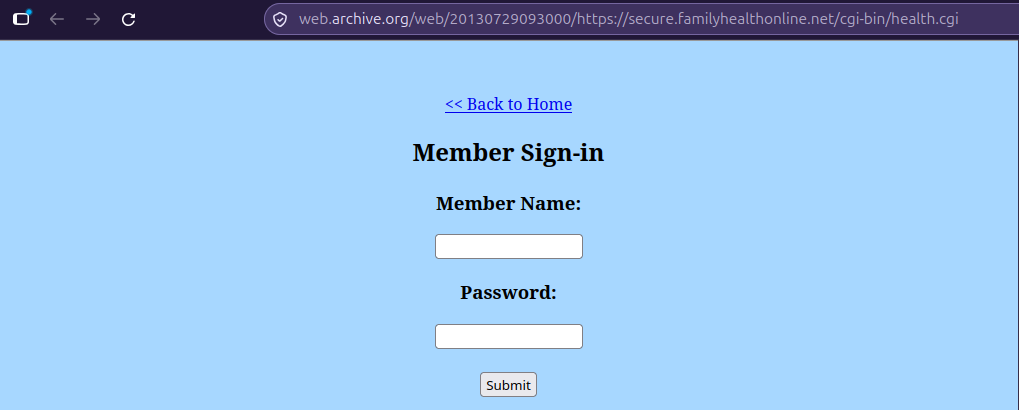
2013 Wayback Machine archive of secure.familyhealthonline.net/cgi-bin/health.cgi CGI comms login page
. Details. 