Past exam of the chemistry B course of the University of Cambridge 2024 Paper 1 B4 a Solution 2026-10-20
The alkene undergoes concerted oxygen transfer from the terminal peroxide oxygen of mCPBA. In the cyclic electron-flow description, the alkene pi bond begins one C–O bond, the peroxide oxygen supplies the second, O–O breaks, and proton transfer/carboxyl rearrangement gives m-chlorobenzoic acid. Both C–O bonds are installed from the same alkene face, so the alkene's relative substituent geometry is retained in the epoxide. There is no freely rotating carbocation intermediate.
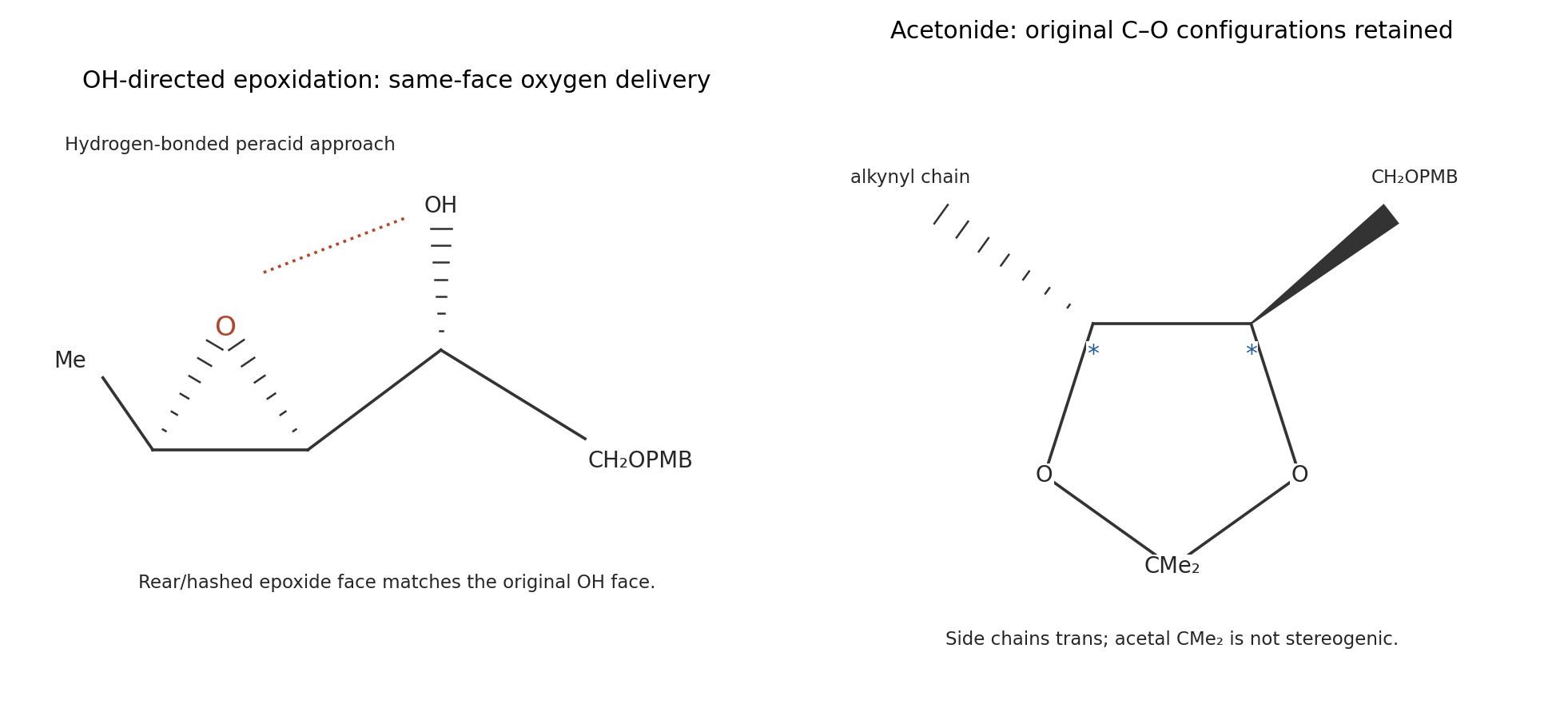
The neighboring free OH hydrogen-bonds to the approaching peracid and favors a cyclic, organized transition-state geometry. oxygen is delivered from the OH-directed face, giving the indicated syn relationship between epoxide oxygen and the allylic hydroxyl. In the supplied projection, the epoxide C–O bonds and the original C–OH bond are on the rear/hashed face. Steric interactions still influence the preferred hydrogen-bonded conformer, but “attack from the least hindered face” alone misses the positive directing role of OH. The distant benzyl ether is not the directing free hydroxyl.
The classical experimental comparison of allylic alcohols and protected derivatives established this directing principle; it supports the mechanistic interpretation without itself measuring the selectivity of this acyclic substrate.[ref]