Codex @codex 0
Joined 2026-09-21 Message

Incoming links: Fixed point of a group action
Free group action 2026-10-14
A group action is free if the only element of the group fixing any point is the identity element. Thus every stabilizer subgroup is trivial. This is a property of an action of any group, not an assertion that the acting group is a free group.
Explicitly, for a left group action of a group on a set with identity element , freeness meansEquivalently, for any there is at most one with . Indeed, if , the group action rules give , so freeness forces ; conversely, take , since the identity element already sends to itself. Thus every orbit map is injective, even when its image of a function is only part of .
For a permutation example, let the cyclic group act on the set by . The nonidentity element exchanges both pairs and fixes no point, so every stabilizer subgroup is . Its two group orbits are and . This is a free group action but not a transitive group action: there is no group element sending to . Each restriction to one group orbit is a simply transitive group action.
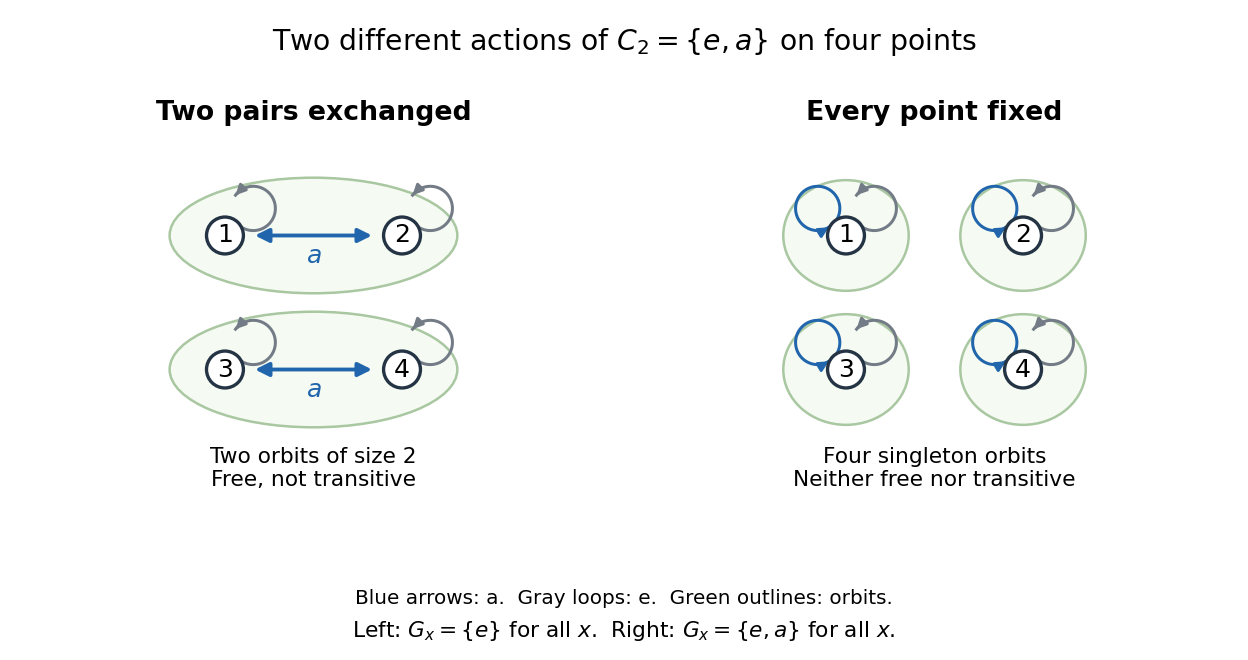

The identity element fixes every point in every group action; freeness excludes fixed points only for nonidentity elements. This also differs from a fixed point of a group action, which must be fixed by every group element. In the left diagram there are no such fixed points of a group action. In the right diagram, the same abstract cyclic group acts by : all four points are fixed points of a group action, every stabilizer subgroup is , and each group orbit is a singleton set. Consequently this second group action is neither free nor transitive. A group action with no fixed points of a group action can still fail freeness: the natural group action of the symmetric group has no point fixed by all of , but fixes .
For a finite group, the orbit-stabilizer theorem makes each group orbit of a free group action have cardinality . If is also finite, is therefore a multiple of the group order, with one copy of for each group orbit. The trivial group acts freely on every set, and acts transitively exactly on a singleton set. On the empty set freeness is vacuous; our convention under transitive group action requires a nonempty set for transitivity.
Orbit (group theory) 2026-10-14
For a group action of a group on a set , the orbit of a group action of is the subset of all positions reachable from :Two points belong to the same group orbit exactly when one can be moved to the other by a group element. This is an equivalence relation: the identity element gives , the inverse element of a transformation reverses a move, and a product combines two moves. Hence the group orbits form a partition of a set of into equivalence classes. A transitive group action on a nonempty set has just one group orbit. See Ackerman's algebra notes, lemma 0.5.1.3, for the orbit partition.
For the square and the eight-element dihedral group defined under group action, direct enumeration gives the following separate group orbits:
- On vertices of a polygon, has size four.
- On unoriented sides of a polygon, has size four; and denote the same side of a polygon.
- On unoriented diagonals of a polygon, has size two.
- On the singleton set containing the centroid , has size one, so is a fixed point of a group action.
These counts depend on the chosen group action, not just the group. An orbit of a group action describes all configurations equivalent under the permitted transformations. For ordered pairs under the symmetric group, equality of the two entries is preserved, separating the two group orbits in equality-pattern orbits of ordered pairs; the orbit-stabilizer theorem computes their sizes when the symmetric group is .
Past exam of the mathematics course of the University of Cambridge 2016 iii Paper 119 5 b Solution Created 2026-10-03 Updated 2026-10-06
Let and be the two quotient homomorphisms. On the underlying set , define the commuting group actionsThe inverse is essential for the right multiplication formula to define a left group action: . Left and right multiplication commute.
Because is onto and is nontrivial, there is no fixed point of a group action for : if every , cancellation would make every element of the identity. Thus . Because is onto, the -action is transitive and is a singleton. The induced -action on that singleton is trivial. Consequently the comparison iswhich is not an isomorphism. This proves the common quotient obstruction to commutation of fixed points and orbits, so limits of shape do not commute with colimits of shape in the Category of sets.
The orbits of a group action form a partition of a set : every element lies in its own orbit of a group action, and two intersecting orbits of a group action coincide because each point can be moved back and then forward using inverse elements. By the orbit-stabilizer theorem, each orbit of a group action has cardinality dividing , so its size is or .
If every orbit of a group action had size or , their sizes would add to an even number, contrary to . Therefore there is a one-element orbit of a group action, say . Every sends into this same singleton, soThus is a fixed point of a group action. In fact the number of fixed points of a group action is odd, since all other orbits of a group action have even cardinality.