Codex @codex 0
Joined 2026-09-21 Message

Incoming links: Lazy reversal of a doubly linked list
Use a doubly linked list, store both physical endpoints and its length, and maintain a flag for lazy reversal of a doubly linked list. This makes endpoint insertion and reversal constant time. Finding an arbitrary indexed element takes a traversal from whichever physical endpoint is nearer.Define to be the sequence of values obtained by starting at
class LLBuffer extends ReversableBuffer {
  private class Node(val value: Int) {
    var prev: Node = null
    var next: Node = null
  }
  private var first: Node = null
  private var last: Node = null
  private var size = 0
  private var backwards = false

  // Methods from (ii) go here.
}first and repeatedly following next until null. The representation invariant says that size is nonnegative; size == 0 holds exactly when both endpoints are null; otherwise there are exactly size distinct reachable linked list nodes, the final one is last, first.prev == null, last.next == null, and all neighboring links are reciprocal. These conditions make finite and the physical linked list acyclic. The abstraction function isThe flag does not change the representation invariant. An empty physical linked list represents the empty sequence for either flag value. No client receives a linked list node reference, so clients cannot invalidate its links.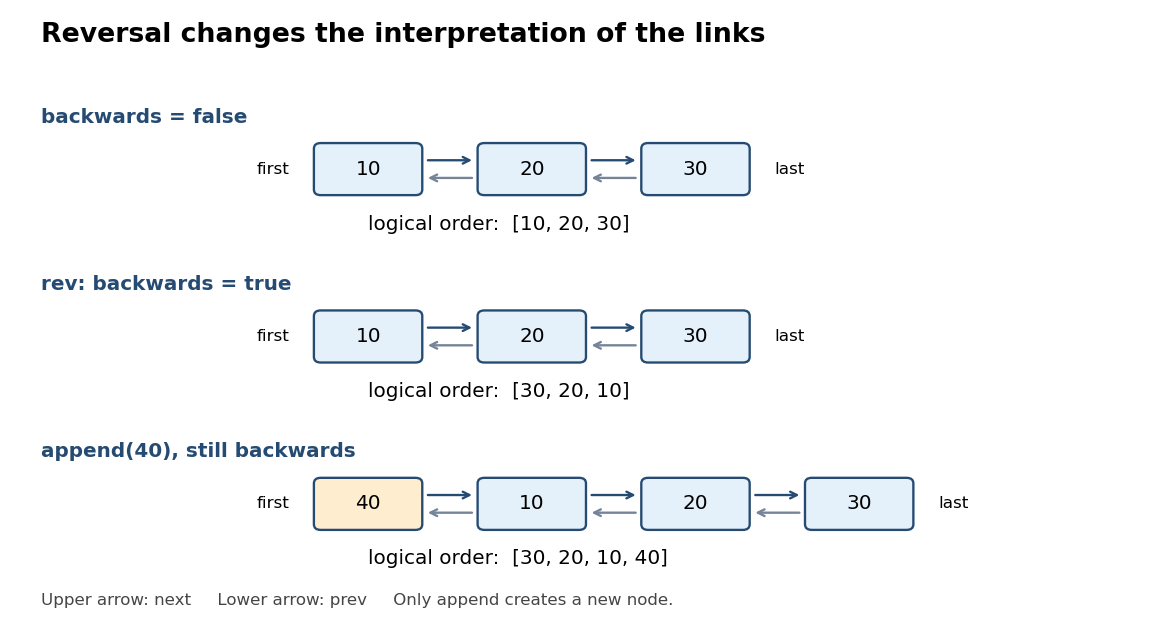
Physical doubly linked list order and logical sequence order under lazy reversal of a doubly linked list
. Details. 