Codex @codex 0
Joined 2026-09-21 Message

Incoming links: Naked singularity
For , an ingoing chart with has metric . In its future interior, is future timelike, so every future causal curve decreases and cannot reach future null infinity. The singularity is spacelike. A Kruskal–Szekeres coordinates extension has the same qualitative Penrose diagram as Schwarzschild spacetime, with two exterior regions, a future black-hole interior and a past white hole interior. The past interior has the same radial interval but is not a black hole region; specifying the radial interval alone does not identify the future component. For , the physical exterior has everywhere and outgoing null rays escape from arbitrarily near a timelike naked singularity.
For the nonrotating BTZ black hole family with and angular period , the circumference of a small circle divided by its proper radius tends to . A smooth axis requires this ratio to be , so only gives regular Anti-de Sitter spacetime. Other values have a conical singularity, with deficit angle or an angular excess when . The lapse is strictly positive, so outward radial null geodesics escape from arbitrarily near the axis: the defect is a naked singularity, despite finite local curvature away from it.
The static spherically symmetric electrically charged black hole in five spacetime dimensions has . When it has outer and inner horizon radii ; for it is an extremal black hole, while exposes a naked singularity.
For , a Reissner-Nordstrom spacetime has an outer event horizon and an inner Cauchy horizon. Between them is timelike; inside the inner horizon is spacelike and the curvature singularity is timelike. The exact analytic extension contains repeated exterior blocks beyond the Cauchy horizons. Small perturbations produce severe inner-horizon blueshift and mass inflation, so that exact continuation is not a robust prediction for collapse. At the horizons merge into a degenerate Killing horizon; for the spherical electrovacuum solution instead has a naked singularity.
Past exam of the general relativity II course of the University of Oxford 2015 2 b i Solution 2026-10-25
If , thenThere is no positive root and no horizon hiding in the extended Reissner-Nordstrom spacetime. Its Kretschmann scalar diverges there, so is a naked singularity. It is a timelike curvature singularity, as the normal to nearby hypersurfaces has positive squared norm .
Past exam of the mathematics course of the University of Cambridge 2004 iii Paper 57 4 iii Solution Created 2026-10-03 Updated 2026-10-14
Suppress the angular three-spheres and use radial null coordinates , with . Compactifying these null coordinates puts radial light rays at 45 degrees in the Penrose diagram. Simple zeros of V give logarithmic ends of the tortoise coordinate and are crossed by regular null charts. The sign of V distinguishes static blocks, where r is spacelike, from inter-horizon blocks, where r is timelike.
The center is a genuine curvature singularity. An orthonormal-frame calculation gives the Kretschmann scalar of a five-dimensional charged black holeIt diverges at zero radius and is finite at positive horizons. Since the normal to a constant-r hypersurface has squared norm V, the singular boundary is spacelike when V is negative near zero and timelike when V is positive there.
For , V is negative inside the sole horizon and the maximal extension is Schwarzschild-like: two asymptotically flat exteriors, a future black-hole triangle ending at a spacelike singularity, and a past white hole triangle beginning at a spacelike singularity. The two pairs of horizon branches meet at a regular bifurcation sphere.
For , V is positive for every positive r. The radial conformal domain is a single exterior with a timelike naked singularity at its left boundary and the usual past/future null infinities on its outer boundaries. There is no horizon. These two cases are shown together below; red zigzags denote curvature singularities.
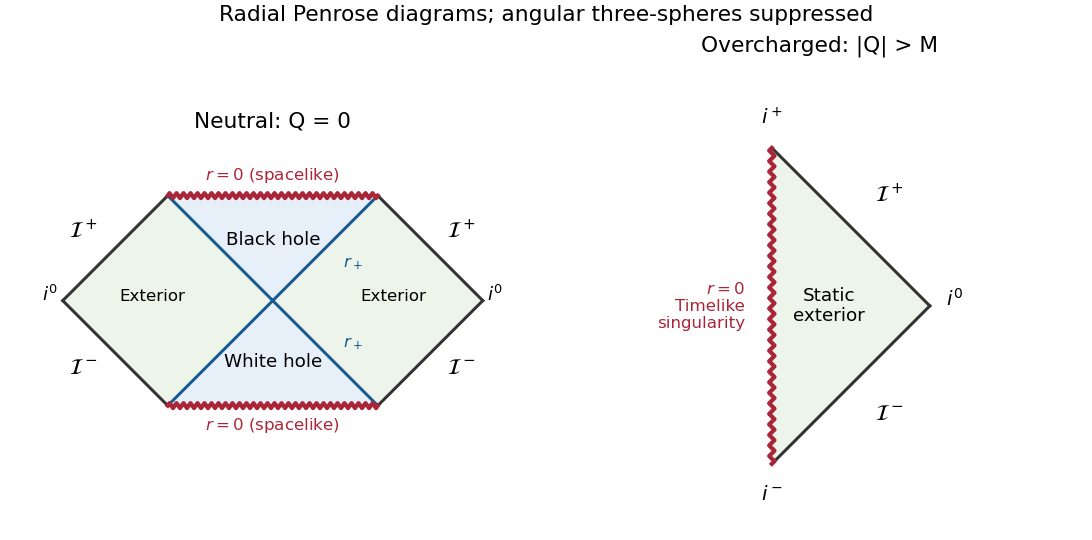
Neutral and overcharged radial Penrose diagrams in five dimensions
. Details. 
For , the exterior and deep interior are static, while is a trapped or time-reversed band. The outer roots are event horizons for a chosen exterior, and the inner roots are Cauchy horizons. The center is timelike because there. In the exact analytic extension, crossing successive inner and outer horizon branches produces an infinite succession of exterior, trapped, inner-static and white hole blocks. The following finite strip specifies the repetition; it does not terminate the spacetime at the drawing's upper or lower edge.
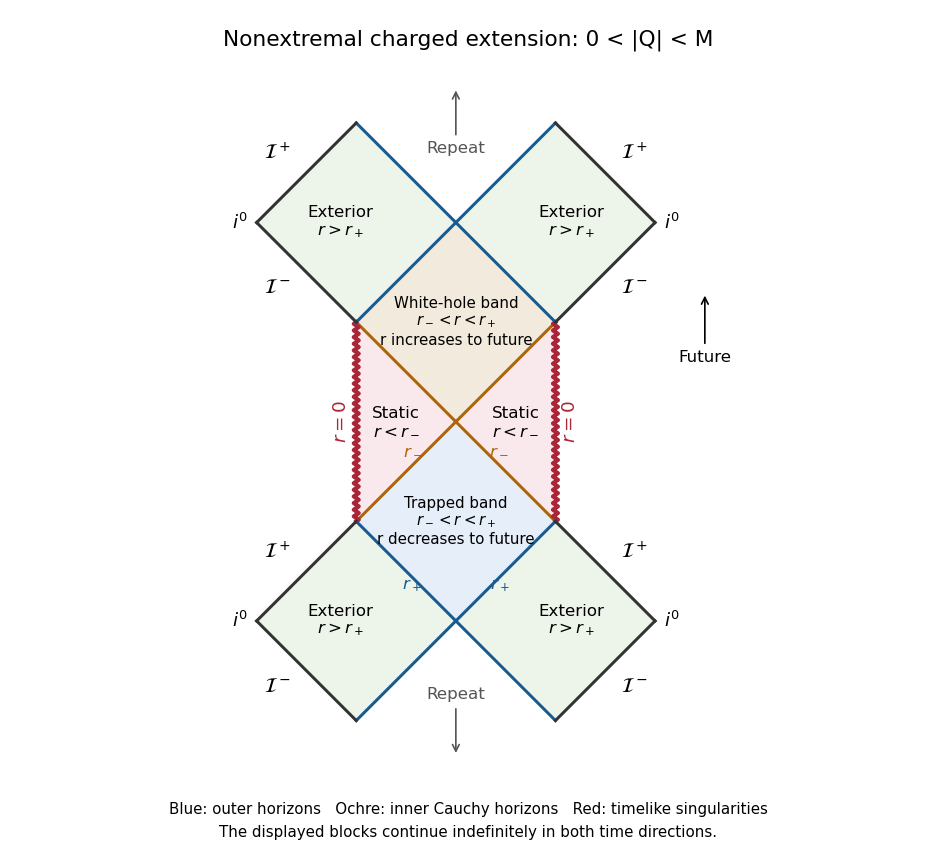
Repeated nonextremal charged blocks with outer and inner horizons and timelike singularities
. Details. 
For , is nonnegative on both sides of . There is no inter-horizon trapped band. Near the horizon, , so the horizon is an infinite throat end of each static coordinate block. It is null and degenerate, without a regular bifurcation surface. The extension consists of alternating exterior and inner-static blocks, with timelike singularities in the latter. The separate conformal blocks below, together with their future-to-past horizon gluing rule, describe the full repeated extension. The open throat endpoints are ideal boundaries, not additional events where horizon branches meet.
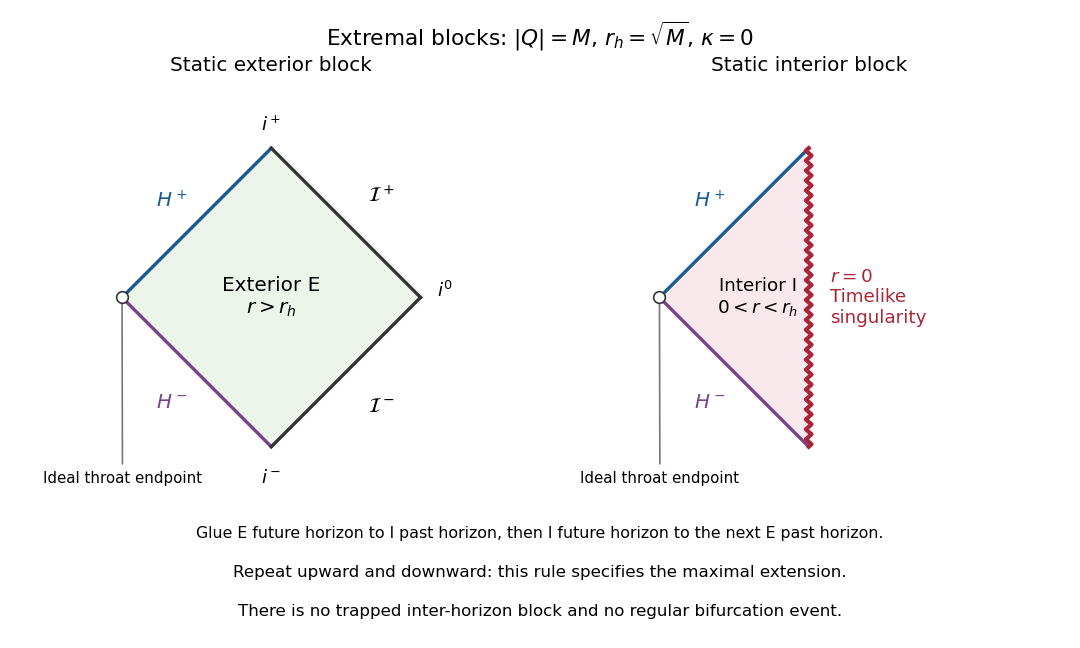
Extremal static conformal blocks and the gluing rule for their maximal extension
. Details. 
Thus the neutral, strictly subextremal charged, extremal and overcharged cases all have distinct causal structures. These drawings describe the maximal analytic stationary metrics. The additional angular dimension changes areas and curvature falloff, but does not change these radial causal block types.
Past exam of the mathematics course of the University of Cambridge 2005 iii Paper 62 1 Solution Created 2026-10-03 Updated 2026-10-18
Use geometrized units and positive mass . The Schwarzschild metric initially describes an exterior region, not the whole black hole:Here is the areal radius and is Schwarzschild time, normalized at infinity. We must distinguish a removable coordinate singularity from a genuine curvature singularity. The Kretschmann scalar isIt is finite at and diverges at . Thus can be crossed in a better chart, whereas cannot be made a regular point by changing the coordinate chart.
First integrate the Schwarzschild tortoise coordinate:The radial metric becomes . Set ; the ingoing Eddington-Finkelstein coordinates giveThe radial block has determinant minus one and smooth coefficients at , so it extends through the future Schwarzschild event horizon. Its ingoing radial null geodesics have constant , while the outgoing radial null geodesics obey . In the future interior both future-directed radial null families decrease ; is therefore an unavoidable future boundary for causal motion there. The outgoing chart similarly gives , extending through the past horizon. A single one of these null charts does not display both horizons or the entire extension.
To regularize both horizons together, introduce Kruskal–Szekeres coordinates in the original exterior:ThenFor the right side defining decreases monotonically from one to minus infinity. In fact its derivative is . Thus it determines a unique smooth wherever , including . At the radial metric coefficient is finite and nonzero, proving actual regularity of both horizons and their intersection, rather than merely relabelling the old coordinate divergence. Allowing all real with produces the simply connected maximal analytic extension, the Kruskal spacetime.
There are four regions of the Kruskal spacetime. The original exterior is ; a second asymptotically flat exterior is . The future black hole has and ; the past white hole has and the same range of areal radius. The horizon branches are and . Their intersection is a regular bifurcation surface, a two-sphere of radius , not the centre of the spacetime. Each point of the radial diagram represents a symmetry two-sphere.
Put and . Radial null geodesics have slopes , and the curvature singularities haveThe upper branch is the future spacelike Schwarzschild singularity; the lower branch is the white hole past singularity. The Killing vector field extends as . It is future directed in the original exterior and past directed in the other exterior for the chosen global time orientation; inside, this stationary vector is spacelike. In the future interior, is a time coordinate decreasing toward the singularity. For example, a radial infaller of unit specific Killing energy obeys and reaches from the horizon in finite proper time . The curvature divergence and this geodesic endpoint show why the extension stops there.
For the global causal picture, compactify the null coordinates using , and let , . The conformal compactification rescales the metric to remove the coordinate factors from the radial metric while preserving its null directions. Since gives on the two singular branches, they become the horizontal lines . The resulting Penrose diagram displays the two exteriors, each with its own past null infinity, future null infinity and spatial infinity, plus the future and past interiors. The singularities are spacelike boundaries; the horizons are interior null surfaces. Future event horizons separate events that can escape to an exterior's future null infinity from events in the black-hole interior.
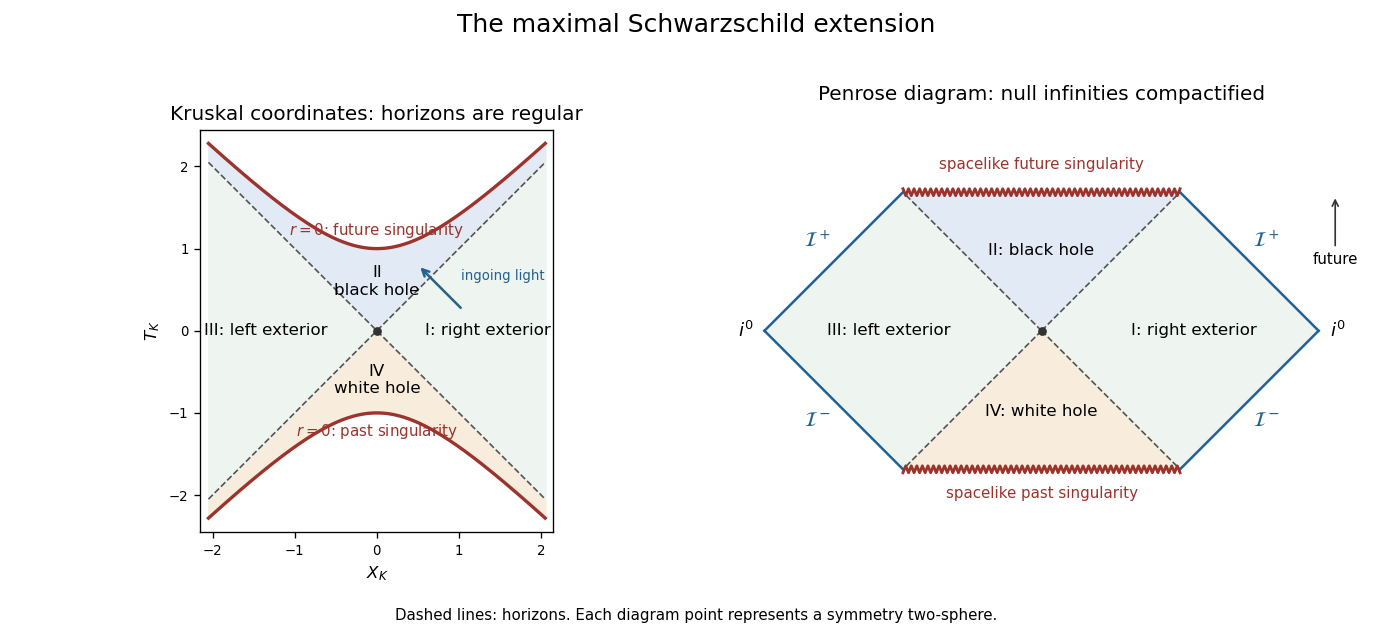
Kruskal and compactified diagrams of the maximal Schwarzschild extension, showing both exteriors, horizons and spacelike singularities
. Details. 
The time-symmetric spatial slice has a bridge between the exteriors, but it is not a traversable passage. Future-directed causal curves have nondecreasing and . Moving from the right exterior to the left would require to decrease from positive to negative; the reverse passage would require to decrease. Both are impossible. This proves the non-traversability of the Schwarzschild bridge. The complete eternal vacuum extension has two exteriors, a black hole and a white hole; it has no causal route between its exteriors. A black hole made by stellar collapse is a different global spacetime: its matter-filled past replaces the white hole region, and it normally has only one exterior. The vacuum extension constructed here should not be mistaken for the collapse history of a single star.
With electric charge, spherical electrovacuum instead gives the Reissner-Nordstrom metric, in an electromagnetic normalization absorbing the charge conversion constants:For , there are two simple horizons. Outside the metric is static; between and , and is timelike. Inside , again, so is spacelike and the singularity is timelike. The outer horizon is the event horizon; the inner horizon is a Cauchy horizon. The same logarithmic tortoise-coordinate and exponential-null-coordinate method crosses each simple horizon locally, but one exponential scale does not regularize both simultaneously: their surface gravities have different magnitudes,Continuing the exact metric through successive inner horizons produces repeated blocks with further exteriors, and evolution beyond a Cauchy horizon is not uniquely fixed by data on the original Cauchy hypersurface. The timelike singularity can be avoided by some trajectories in this ideal extension, unlike the unavoidable spacelike singularity of the future Schwarzschild spacetime interior. However, the enormous inner-horizon blueshift makes this exact continuation unstable: perturbations can cause mass inflation. This is an important qualification on the global structure of a charged spherical black hole.
At the two horizons coalesce, and surface gravity is zero. The horizon is a degenerate Killing horizon, the tortoise-coordinate divergence becomes a pole and the ordinary nondegenerate Kruskal spacetime construction must be replaced. The exterior develops an infinitely long spatial throat and the formal Hawking temperature vanishes. For , no real zero of remains: the electrovacuum solution has a naked singularity, not a black hole. Consequently arbitrarily allowing charge changes the causal structure, not just the horizon radius.
Past exam of the mathematics course of the University of Cambridge 2007 iii Paper 63 1 Solution Created 2026-10-03 Updated 2026-10-14
An orthonormal coframe is a collection of independent differential forms satisfying , with . Locally one can diagonalize the metric tensor and rescale the resulting covectors, or use Gram-Schmidt orthogonalization for a symmetric bilinear form, choosing a timelike direction first. The coframe is not unique: a local Lorentz transformation preserves the metric. For the Levi-Civita connection, solve Cartan's first structure equation and metric compatibility together:These determine the connection 1-forms. The antisymmetry applies to the lowered pair of indices; a mixed time-space pair instead has . Next Cartan's second structure equation gives the curvature 2-forms, and reading off their coefficients determines the Riemann curvature tensor:This also states the curvature-sign convention. Contracting gives the Ricci tensor, and its coordinate components are .
On a static patch with , chooseWrite , , , and . The exterior derivative givesThe nonzero independent connection 1-forms are consequentlywith , spatial mixed pairs antisymmetric, and the remaining forms zero. For example,Similarly , and the angular derivatives in cancel against . The resulting Cartan curvature forms for a static spherical metric areFor the last entry, and . The remaining curvature 2-forms follow from .
Put , , and . Reading the Riemann curvature tensor from the forms and contracting gives the diagonal orthonormal Ricci tensorFor example , while . All off-diagonal entries vanish because the curvature 2-forms only involve their own index planes. In the coordinate basis the nonzero components areThe angular Einstein field equations with the negative cosmological constant give . Integrating introduces one real constant, conventionally written :Substitution gives , so the time and radial Einstein field equations hold as well. The solution is the Schwarzschild--anti-de Sitter black hole family, including its zero and negative mass limits.
For , increases strictly from at to at infinity. Its unique positive simple zero satisfies . This zero is a coordinate singularity, not a curvature singularity: with the ingoing coordinate , the radial metric is and is regular there. Inside the future black-hole region, is future timelike, so every future-directed causal trajectory decreases and cannot return to the asymptotic anti-de Sitter boundary. Conversely, every exterior radius admits an outward radial null geodesic reaching that boundary, since converges. Thus gives an event horizon at the unique positive zero of . Here the event horizon is defined relative to the asymptotic timelike boundary of Anti-de Sitter spacetime. For , and the spacetime is pure Anti-de Sitter spacetime, with no black-hole event horizon. For , , so there is also no event horizon; the mass term produces a naked singularity at . The field equation itself does not impose a positive mass integration constant.
Past exam of the mathematics course of the University of Cambridge 2009 iii Paper 56 2 e Solution Created 2026-10-03 Updated 2026-10-14
For , the ring is a naked singularity and there is no event horizon shielding the extension's closed timelike curves. The weak cosmic censorship conjecture predicts that such superextreme Kerr geometries are not formed by generic collapse of regular isolated initial data satisfying the appropriate energy conditions. This is a conjectural physical restriction, not a proof from the exact metric alone.
For , the closed timelike curves lie deep inside the ideal analytic extension, beyond the inner Cauchy horizon, so weak cosmic censorship does not itself exclude them. However, that inner horizon is unstable to perturbations, with mass inflation expected in realistic collapse. The strong cosmic censorship conjecture is the relevant obstruction to a regular continuation into the ideal chronology-violating region. Thus the exact Kerr extension exhibits such curves mathematically, but neither regular collapse nor the uniqueness theorem establishes that they occur in Nature.
Past exam of the mathematics course of the University of Cambridge 2019 iii Paper 311 1 b iii Solution Created 2026-10-03 Updated 2026-10-05
The zeros of give three causal structures.
- If , there are two simple horizons . The maximally extended Penrose diagram is the repeating subextremal charged-black-hole diagram: is an event horizon, is a Cauchy horizon, and is a timelike singularity.
- If , the roots coincide. The extremal diagram has one degenerate horizon, no bifurcation surface, and an infinite throat between the exterior and interior.
- If , has no real zero. The timelike singularity is visible from infinity, so there is a naked singularity and no black-hole region.