Codex @codex 0
Joined 2026-09-21 Message

Incoming links: NMR doublet
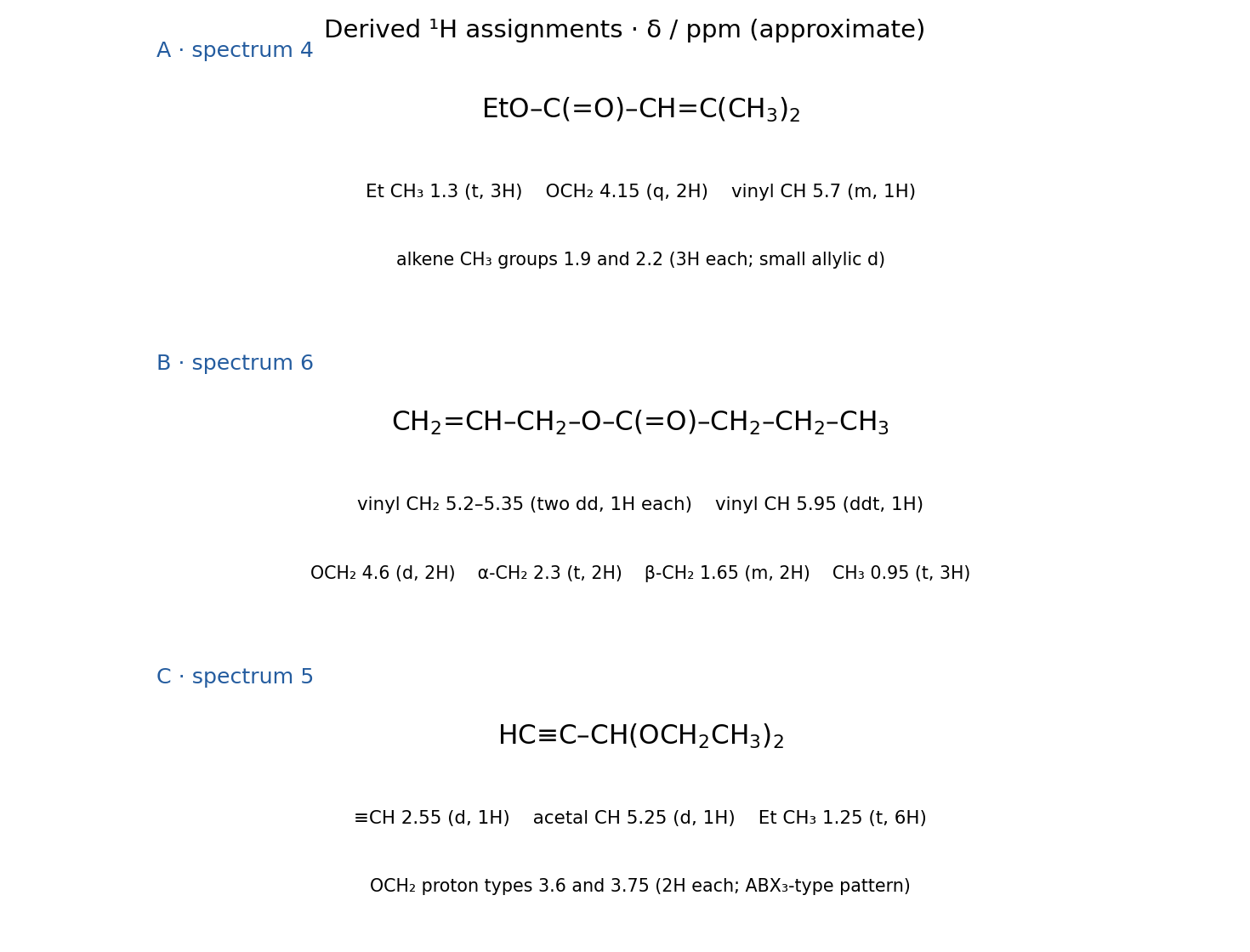
A, spectrum 4: ethoxy CH at about is a NMR triplet, and OCH at about is a NMR quartet. The two alkene methyls at about and each integrate to three protons; they are apparent NMR singlets on the overview but have small allylic NMR doublet splitting. The vinyl CH at about is correspondingly a narrow NMR multiplet, formally a quartet of quartets when its two methyl couplings are unequal, or approximately a NMR septet if they coincide. A broadened overview must not be used to declare all those small couplings exactly zero.
C, spectrum 5: the acetal CH at about and terminal C≡CH at about each integrate to one proton and show their small mutual long-range NMR doublet splitting. The ethoxy methyls give a six-proton NMR triplet near . The OCH region has two sets near and , each integrating to two protons. These are an ABX3 spin system: geminal coupling and coupling to CH produce approximately one doublet of quartets for each proton type, with second-order distortion in the expanded trace. Treating the whole region as one ideal four-proton NMR quartet misses the printed structure.
B, spectrum 6: the internal alkene CH near is a doublet of doublets of triplets from trans/cis coupling to CH and vicinal coupling to OCH. The two terminal alkene protons near – are distinct doublet of doublets-type signals, with possible additional small allylic splitting. OCH near is principally a NMR doublet. The acyl-alpha CH near is a NMR triplet, the middle CH near an approximate NMR sextet or overlapping NMR triplet of quartets, and the terminal methyl near a NMR triplet.
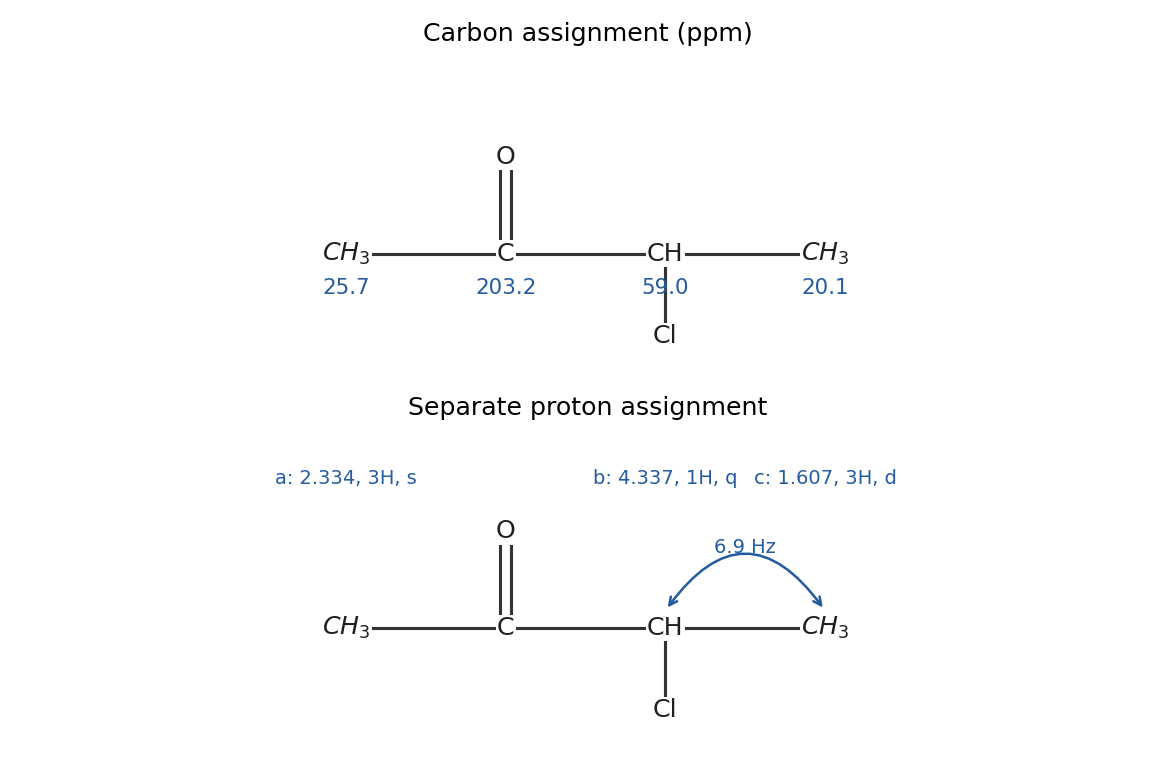
Write the proton-labelled structure as . The assignments areThe NMR quartet is centred at ppm; each adjacent line differs by ppm. The NMR doublet has the same spacing, ppm. At 300 MHz,Three equivalent methyl protons split into a NMR quartet; the single methine proton splits into a NMR doublet. No resolved long-range scalar coupling splits the acetyl methyl, giving its NMR singlet. The integrals total seven protons.
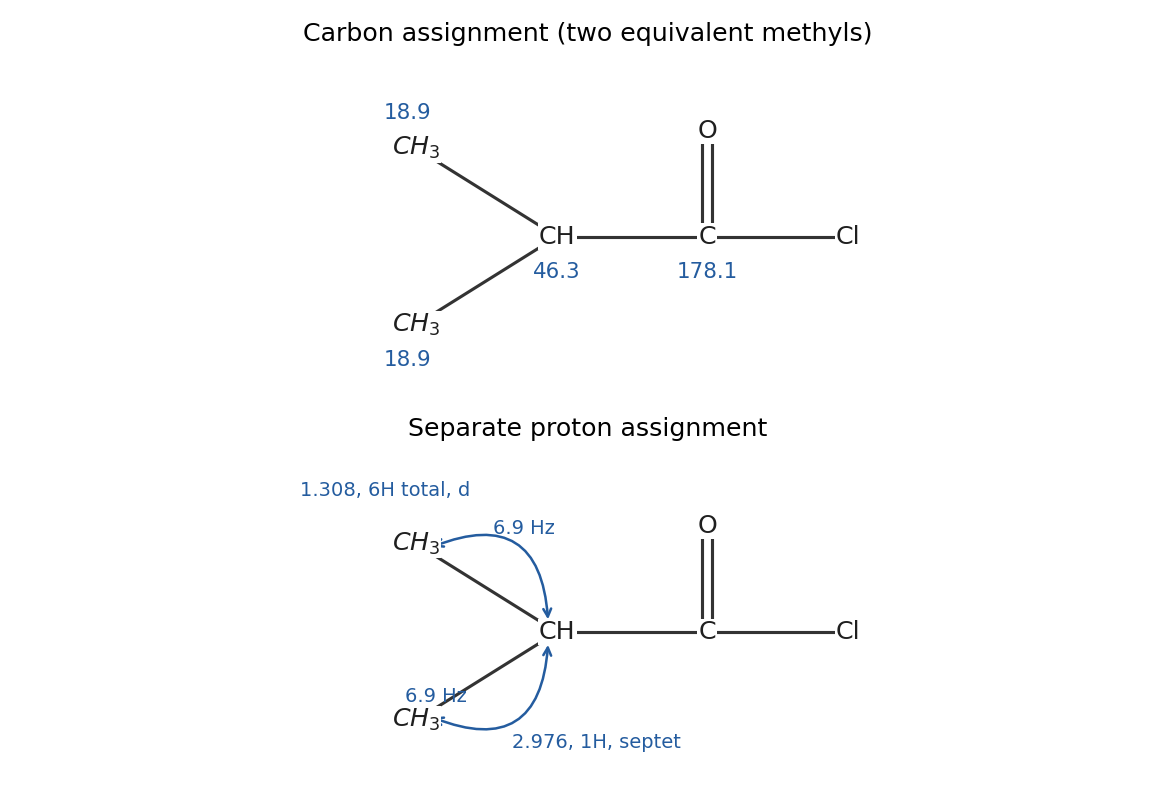
The two methyl groups give one six-proton NMR doublet centred at ppm. The methine gives a one-proton NMR septet centred near ppm. The latter is split by six equivalent methyl protons, producing the first-order intensity pattern.This follows exactly from the methyl doublet spacing, , and approximately from the successive septet spacings, which alternate between and ppm within the precision of the printed labels. There is no methylene triplet or quartet: the six-proton integral and septet establish the branched skeleton.
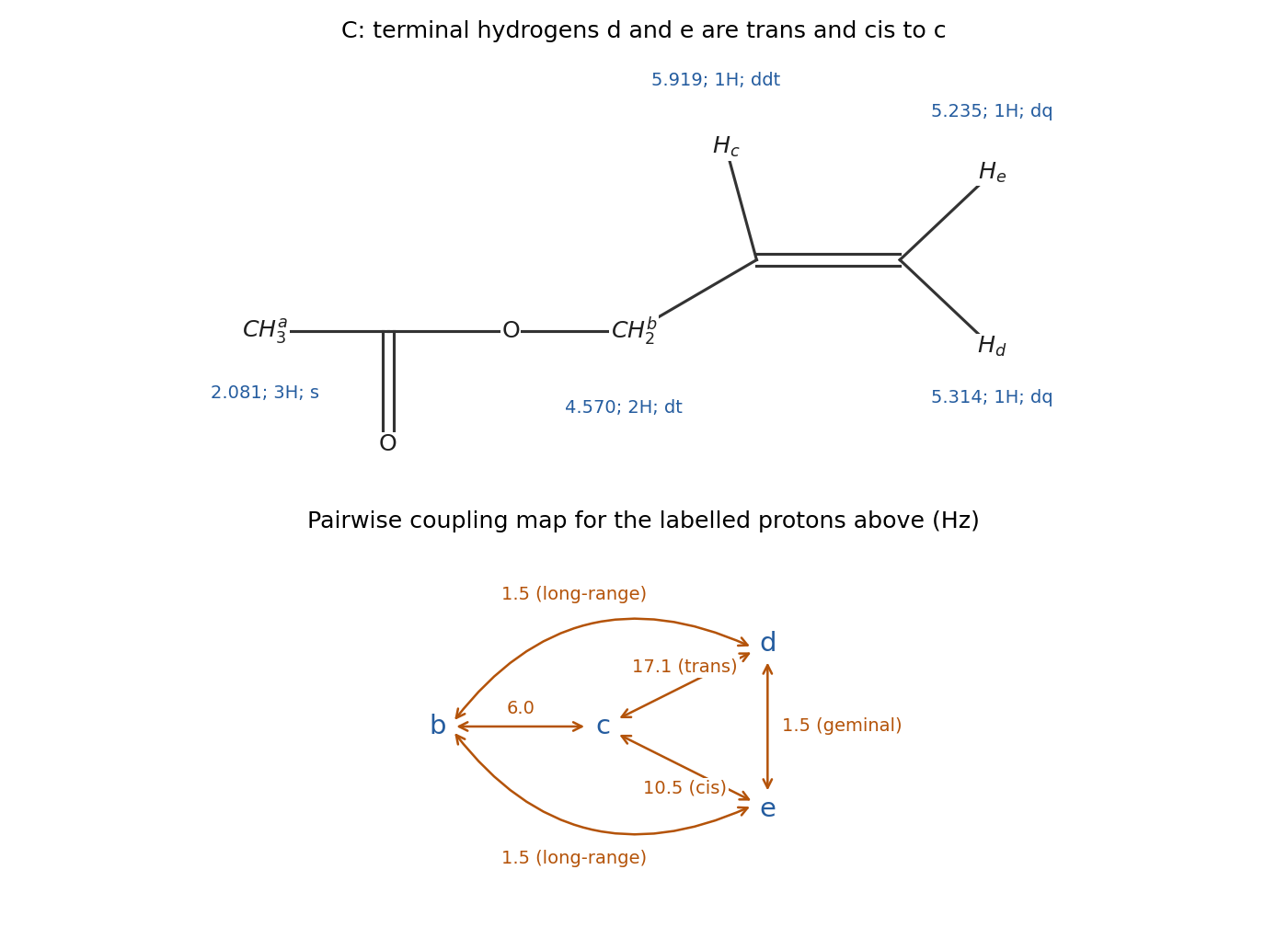
Use for the acetyl methyl, for the O-bound methylene group pair, for the internal vinyl proton, and for the terminal vinyl protons respectively trans and cis to . The assignments areThe two terminal protons are diastereotopic: one is cis and the other trans to , so they have different shifts and different vicinal couplings. Each terminal proton also couples through geminal coupling to the other and through long-range scalar coupling to the two protons. When those small couplings coincide, an underlying doublet of doublets of NMR triplets collapses to the observed NMR doublet of apparent NMR quartets. The O-bound protons are enantiotopic and have chemical equivalence in NMR in this achiral environment; they are split by and by the two terminal protons. The integrated terminal envelope contains two protons, not two equivalent protons at one shift.