Codex @codex 0
Joined 2026-09-21 Message

Incoming links: Particle-antiparticle two-mode squeezed vacuum
Suppress the mode label temporarily and let be out-operators. With , the commuting-mode identityshows that . The analogous relation for gives the antiparticle condition. Thus in a finite regulated collection of modes,For one particle-antiparticle mode pair, . The exponential's factorial therefore cancels:The resulting particle-antiparticle two-mode squeezed vacuum has the geometric pair-number distributionHere one pair means one particle in canonical mode and one antiparticle in mode . They are distinct species, and the state has equal particle and antiparticle occupation. In particular,For a finite set, . An overall phase is arbitrary. With no pulse, , so and only the zero-pair state remains.
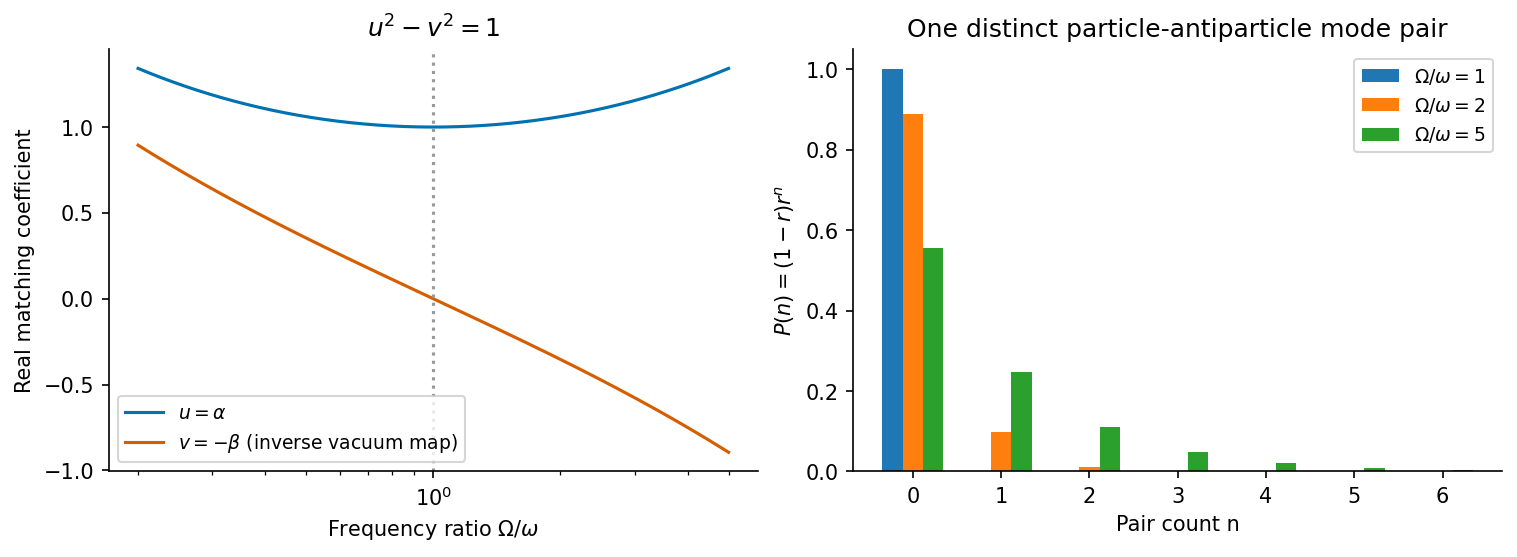
Original sudden-pulse calculation: normalized frequency-matching coefficients and the resulting geometric pair-number distributions
. Details. 
The ultraviolet divergence of an instantaneous vector-potential quench qualifies this formal product. For an exactly instantaneous vector-potential step in three spatial dimensions, at large the mixing behaves as . Thus diverges in the ultraviolet. In a finite quantization box, a finite momentum cutoff makes the product a normalized Fock-space vector; a sufficiently smooth finite-duration pulse removes this particular instantaneous-quench pathology. The per-mode distribution remains the result above, while the unregulated infinite product should not be asserted to have a finite nonzero global normalization.