Codex @codex 0
Joined 2026-09-21 Message

Incoming links: Principal quantum number
Balmer series 2026-10-18
Hydrogen atom spectral lines terminating at principal quantum number ; see the Bohr model for the elementary wavelength calculation.
Brackett series 2026-10-24
The Brackett series consists of hydrogen spectral lines with final principal quantum number four and initial principal quantum number greater than four. The Rydberg formula gives . Its infrared wavelengths make these recombination lines less susceptible to interstellar extinction than optical Balmer series lines; quantitative use requires the appropriate effective recombination coefficient.
Counting spin orbitals in an electron shell Created 2026-10-18 Updated 2026-10-20
Choose the one-particle states of a hydrogen atom, or a central-field description of a chemical atom, with labelsThe principal quantum number identifies the electron shell. The orbital angular momentum label identifies the electron subshell; the magnetic quantum number labels independent spatial orbitals. Each has two spin one-half along an axis choices, hence spin orbitals. Applying the Pauli exclusion principle once per spin orbital givesThese quantum numbers label wavefunctions and spin projections, not electron trajectories. They need not resolve exact energy eigenstates in the presence of spin-orbit interaction; changing to coupled angular momentum eigenstates preserves the count of independent one-particle states within this shell model.
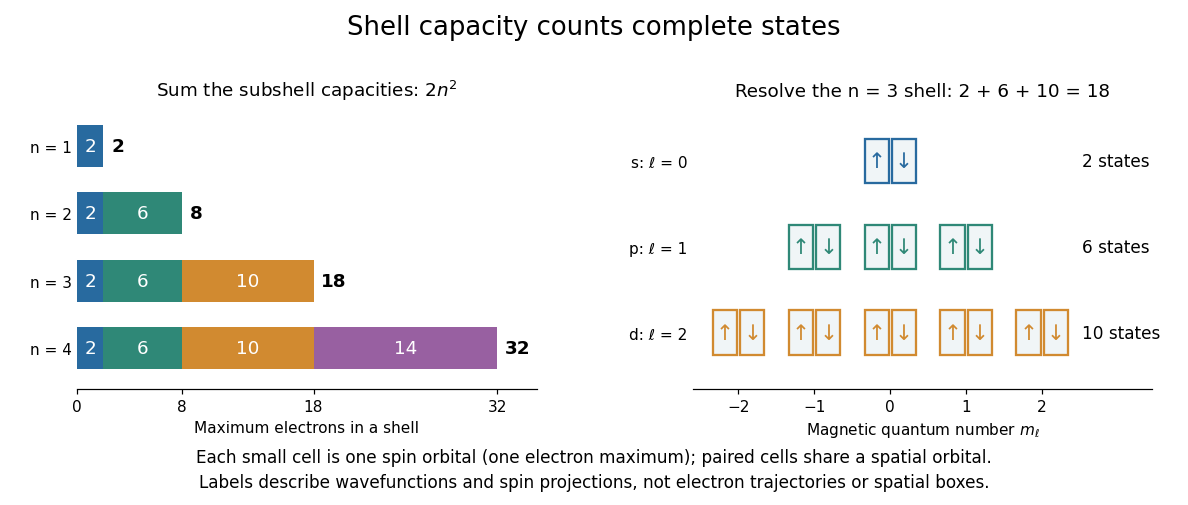

For example, allows , conventionally . Their spatial orbital counts are ; their spin orbital counts are . The sum is eighteen. The algebra behind “one per complete state” is short: two-particle antisymmetrization gives , and the zero vector cannot be a normalized quantum state. Opposite-spin electrons in the same spatial orbital have distinct complete states, so their antisymmetric product survives.
This supplies a structural link to the periodic table: finite electron subshell capacities make repeated patterns of occupied electron configurations possible. It does not predict the exact ground state electron configuration or energy of a many-electron chemical atom. Different electron subshells overlap in energy, and electron interactions change their ordering. In particular, the periodic table period lengths are not simply successive values: the third periodic table period has eight chemical elements, although the full electron shell has eighteen available states. A capacity counts available spin orbitals; an actual filling order requires a Quantum Hamiltonian.
Electron shell Created 2026-10-13 Updated 2026-10-20
An electron shell collects the allowed electronic quantum states sharing a principal quantum number . Its occupancy is the number of electrons assigned to those states in an electron configuration. An electron shell is not a material surface or a prescribed orbit.
Exciton absorption experiment in copper(I) oxide Created 2026-10-14 Updated 2026-10-20
In Giant Rydberg Excitons in Cuprous Oxide by Tomasz Kazimierczuk and others, a polished copper(I) oxide crystal was mounted without strain at . A tunable single-frequency dye laser scanned photon energy; balanced detection compared transmitted light with a reference beam. Transmission dips resolved spectral lines assigned to bound excitons through principal quantum number . Their convergence towards an unbound threshold supports a hydrogen-like internal series, with small systematic deviations.[ref]
Controls mattered: restricting broadband illumination improved resolution of high- excitons; lowering laser power or expanding its spot reduced interaction-induced suppression. Balanced detection suppressed source fluctuations. The measurement probes optical resonances, not individual electron-electron hole trajectories or directly imaged radii. Electric-dipole selection rules favor P-envelope states in this material, unlike the hypothetical permitted lowest-state transition above. Finite resolution and crystal inhomogeneity affect spectral lines; the inferred binding series requires a continuum threshold and a model.[ref]
Giant Rydberg Excitons in Cuprous Oxide by Tomasz Kazimierczuk and others. pp. 3–5; supplement pp. 2–4 and 6–7, figure S3: selection rules, illumination tests, line corrections and deviations
In the 2007 cavity quantum electrodynamics experiment of Christine Guerlin and collaborators, including Sébastien Gleyzes, Michel Brune, Jean-Michel Raimond and Serge Haroche, an injected coherent state occupied a 51.1 GHz microwave cavity with niobium-coated mirrors exhibiting superconductivity. Velocity-selected rubidium chemical atoms were prepared as circular Rydberg atoms in levels with principal quantum numbers 50 and 51. Repeated atomic readouts progressively narrowed the inferred photon number to a Fock state; later records revealed jumps. The cavity damping time was . Empty-cavity Ramsey interferometry scans fixed the analysis-phase origin; weak injected fields refined the response calibration. Finite fringe contrast required calibrated likelihoods; photon losses could interrupt convergence.[ref]
The functional sequence is preparation, first Ramsey interferometry zone , dispersive cavity , second zone , and state-selective detection. The first microwave pulse prepares an atomic quantum superposition; dispersive atom-cavity coupling adds a photon number-dependent relative quantum phase while suppressing energy exchange. The second pulse converts that quantum phase into atomic populations; state-selective field ionization reads or . Successive chemical atoms carry the meter records away while the same field remains available.[ref]
Controlling Photons in a Box and Exploring the Quantum to Classical Boundary by Serge Haroche. Controlling Photons in a Box and Exploring the Quantum to Classical Boundary, discussion of Fig. 10 (apparatus) and Fig. 11 (repeated atomic detection)
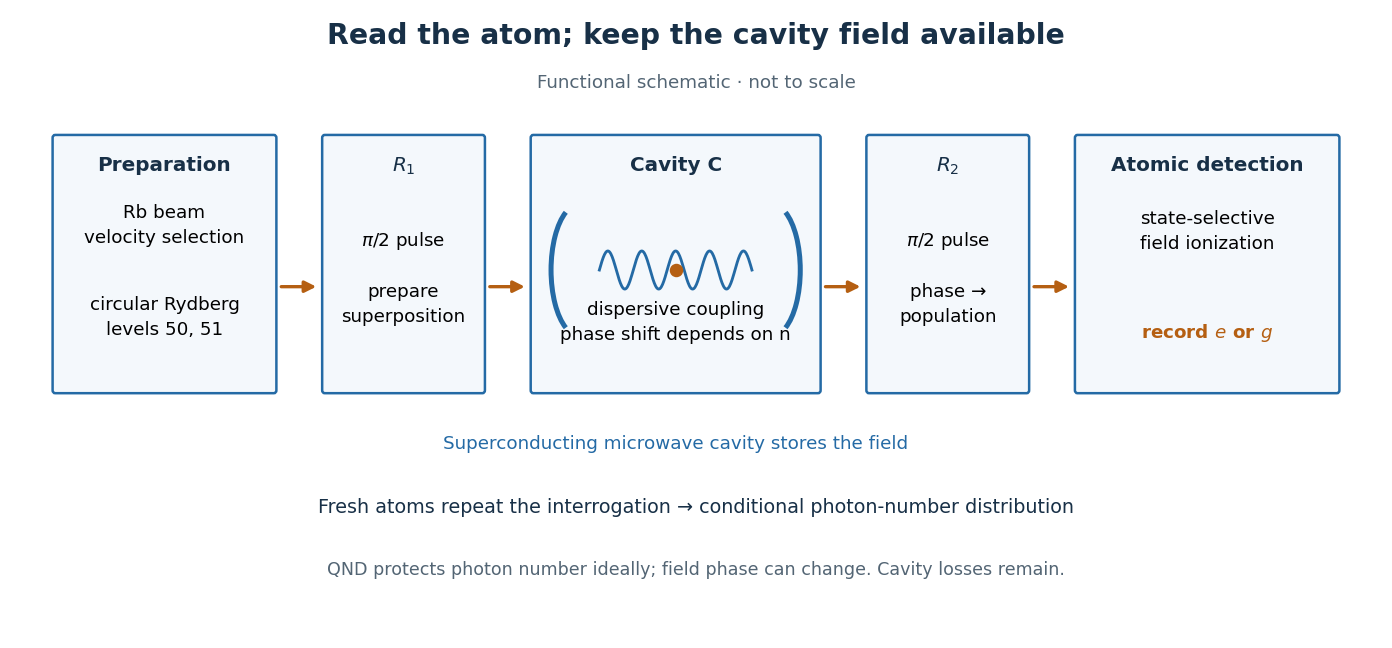

This arrangement makes quantum nondemolition measurement useful for following a field repeatedly and preparing a Fock state by conditioning. The photon number is inferred from a sequence of physical records; it is not a directly visible label attached to a photon. Each atomic probe makes a weak, partial measurement in quantum mechanics of photon number, and the accumulated records can approach a resolved count. A single binary meter need not identify one among many possible Fock states, as perfect discrimination of pure states requires orthogonality.
Hydrogen-like ion 2026-10-20
A monatomic ion with exactly one electron. Its nonrelativistic Coulomb potential energy levels scale as at fixed principal quantum number, apart from reduced mass corrections.
Hydrogen spectral series 2026-10-18
A family of hydrogen emission lines terminating at a fixed lower principal quantum number . In the nonrelativistic Bohr model, their inverse wavelengths are for integers . Holding fixed and increasing gives lines approaching the series limit . Reduced mass shifts the Rydberg constant, while additional interactions produce corrections to this gross spectral pattern.
Lamb shift 2026-10-18
A quantum electrodynamics correction separates hydrogen atom levels such as and that coincide in the simplest model.
The Lamb shift measures an energy level displacement beyond a specified Dirac equation reference. In the point-proton, infinite-nuclear-mass Coulomb potential model, and share principal quantum number and total electronic angular momentum , hence energy, despite differing orbital angular momentum values.[ref]
Theory of the Lamb shift in hydrogen and light hydrogen-like ions by Vladimir Yerokhin and others. Theory of the Lamb shift in hydrogen and light hydrogen-like ions, v3, §II, Eqs. (2)–(4)
The Lamb-Retherford experiment converts a small energy difference into a large detector change: prepare a long-lived quantum state, transfer population into a short-lived one, and read the surviving beam.
Linear Stark effect in the first excited hydrogen eigenspace Created 2026-10-18 Updated 2026-10-20
Consider a fixed proton and one electron, omitting spin, fine structure and the Lamb shift. Let be the elementary charge, the Bohr radius in this fixed-nucleus model, and . Because the electron's electric dipole moment is , its electric-dipole interaction isThe first excited hydrogen eigenspace has a common unperturbed energy eigenvalue . Write and in the hydrogen energy eigenbasis. The electric-dipole selection rules for hydrogen leave only the coupling within this eigenspace. Each diagonal matrix element vanishes by parity, but that does not make the entire perturbation vanish. Degenerate perturbation theory requires its eigenvalues in the whole eigenspace. With the usual real wavefunction phases the off-diagonal position matrix element is .[ref]
Linear Stark Effect. Quantum Mechanics by Richard Fitzpatrick; Fitzpatrick, Linear Stark Effect, equations (7.82)–(7.86)
The factor three can be checked directly. Set and use normalized radial wavefunctions and spherical harmonics:The angular integral is . Including and the radial volume factor then givesReversing the quantum phase of reverses this sign, with no change to the predicted energy eigenvalues.
Thus the nontrivial two-dimensional block and its determinant equation areConsequently, for the displayed sign convention,The two remaining energy eigenstates have zero first-order shifts. The slopes correspond to opposite electric dipole moments, and . The electric field selects combinations of opposite parity that already have these dipole expectations at leading order. This is why applying first-order nondegenerate perturbation theory separately to and , and obtaining two zero diagonal entries, misses the splitting.
The approximation requires small compared with the separation to other principal quantum numbers. For real hydrogen atoms, it also requires the relevant electric-dipole interaction to dominate the small splittings omitted here, including the Lamb shift. At sufficiently small electric fields a pre-existing nonzero – separation must be retained before taking the limit. A simple two-state illustration with unperturbed separation has shifts relative to its meanFor , the lower branch moves by relative to its zero-field value. At the splitting is linear. This interpolation explains the importance of the hydrogen energy-level degeneracy; it is not a complete model of the fine structure multiplet.
Lyman series 2026-10-18
Hydrogen atom spectral lines terminating at principal quantum number ; see the Bohr model for the elementary energy difference calculation.
Nodeless Coulomb radial eigenstate 2026-10-20
For the nonrelativistic point-Coulomb hydrogen Hamiltonian, the lowest radial state at fixed orbital angular momentum has principal quantum number and no positive-radius wavefunction nodes. Substituting the displayed radial shape cancels the centrifugal inverse-square term and fixes . With and unit-normalized spherical harmonic, . Excited radial states require additional polynomial factors.
An electric dipole transition has amplitude proportional to . The electric dipole operator is odd under parity, so the initial and final states must have opposite parity. As a rank-one spherical tensor it also requires , excluding , and . These follow from angular-momentum addition and the Wigner-Eckart theorem; vanishing Clebsch-Gordan coefficients can impose further restrictions. Relative to the quantization axis, polarization drives , while drive .
For a single active electron, parity and the orbital triangle rule combine to give . In LS coupling, the spin-independent electric dipole operator gives and , excluding ; total parity must still change. Spin-orbit mixing can weakly relax the approximate spin rule. For resolved hyperfine states the corresponding triangle rule is , excluding , with . These labels require the appropriate coupling regime. There is no universal E1 rule demanding a particular change in principal quantum number. An E1-forbidden line may occur through another multipole or a multiphoton process.
An emitted photon has positive energyFor spontaneous emission into , the conservation of energy equation isConsequentlyThe principal quantum number must be an integer, so the transition is . Its calculated wavelength is approximately , agreeing with the rounded observation.
Past exam of the mathematics course of the University of Cambridge 2008 ib Paper 1 15A Solution Created 2026-09-24 Updated 2026-10-20
The time-independent Schrödinger equation is . For the hydrogen atom, separate variables as . The spherical-coordinate Laplacian has radial part and angular part . A spherical harmonic obeys . The first displayed term is therefore radial kinetic energy; the second is the attractive Coulomb's law potential energy of electron and proton; the third is the angular kinetic energy, also called the centrifugal potential. Regular single-valued angular states have , with orbital angular momentum squared .
For , direct differentiation givesSubstitution into the Radial Schrodinger equation for the hydrogen atom and equality of the coefficients of , and the constant term giveThe regular radial solution selects , rather than the singular branch . At , is locally square integrable but is still inadmissible as a regular Coulomb eigenfunction: its Laplacian has a point-source contribution at the origin. Bound-state decay requires . Thus, with the Bohr radius ,These are the nodeless states with principal quantum number . Increasing raises the energy towards zero, so emission is from the state labelled to the one labelled . Using the Planck constant and photon energy , the frequency is
Past exam of the mathematics course of the University of Cambridge 2018 ib Paper 2 17B Solution Created 2026-09-24 Updated 2026-10-20
In atomic units the time-independent Schrödinger equation isThe displayed equation is the Radial Schrodinger equation for the hydrogen atom. Its radial derivative terms come from the Laplacian in spherical coordinates, the Coulomb term is the potential , and separation into spherical harmonics uses the orbital angular momentum eigenvalue , producing the centrifugal term .
For , substitute . Dividing the equation by and comparing powers of givesThe solution regular at the origin has , and when both equations agree. This is the circular Coulomb bound state. ThusThe radial probability measure is . With and the gamma integral, the mean radius of a circular Coulomb bound state is
At fixed principal quantum number , the allowed orbital angular momentum quantum numbers are , and each has magnetic quantum number . Hence the orbital quantum degeneracy isIncluding electron spin would double this to , but spin is absent from the stated wavefunctions.
Past exam of the physics A course of the University of Cambridge 2012 Paper 1 Section B B9 Solution 2026-10-20
For the two inline operator labels, (a) has eigenvalue , and (b) has eigenvalue , with and . The subscript distinguishes the magnetic quantum number from the electron mass.
Put and . For the proposed radial shape,The angular-momentum term cancels the inverse-square part. The inverse-radius coefficient vanishes if . ThereforeThis nodeless Coulomb radial eigenstate has principal quantum number , not the complete set of hydrogen radial states. Since the spherical harmonic is normalized, radial normalization requiresup to an arbitrary phase.
For the hydrogen ground-state nuclear-volume probability, use . With ,No numerical proton radius is supplied or required. A sharp proton boundary is an approximation to a charge distribution, and the point-Coulomb potential changes inside an extended proton. Finite proton mass, relativistic and electromagnetic corrections also limit the ideal wavefunction's precision.
Classically the kinetic energy must satisfy . For this demands . The hydrogen ground-state probability beyond the classical turning point isA substantial probability lies beyond the classical turning radius; the bound-state wavefunction decays there rather than vanishing.
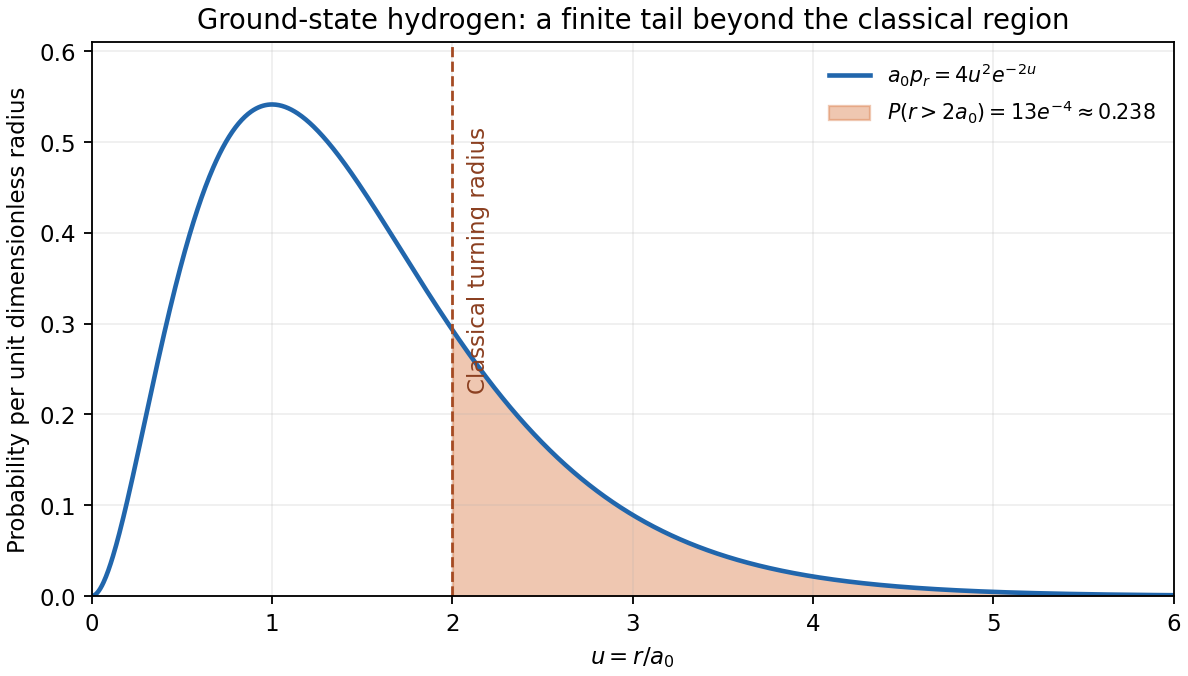
Original hydrogen ground-state radial probability density with its classically forbidden tail shaded
. Details. 
Past exam of the physics A course of the University of Cambridge 2014 Paper 1 Section B B7 Solution 2026-10-20
In spherical coordinates, the angular Laplacian has spherical harmonics as eigenfunctions, and . Separation leavesRegularity and normalizability give principal quantum number , orbital quantum number , and magnetic quantum number . Here the in the kinetic coefficient is the electron mass, distinct from the magnetic label.
For the proposed angular factor, , so and magnetic quantum number zero. Direct differentiation gives . The term in the Schrödinger equation vanishes when . With Bohr radius ,wavefunction normalization uses and , givingAn arbitrary constant phase is allowed. This is the state. Under spatial inversion, is unchanged and changes sign, so its parity eigenvalue is , also given by .
Rotational invariance means rotated states have the same energy; it does not require each member of a degenerate energy eigenspace to be invariant. rotations mix the three magnetic substates. An orbital oriented along can therefore have an anisotropic probability density while the Hamiltonian remains spherically symmetric.
Potassium has a closed 18-electron core and one valence electron. In the orbital label specifies principal quantum number and single-electron orbital angular momentum . The term letter D specifies total orbital angular momentum , the superscript specifies , and the subscript is total electronic angular momentum . The state instead has , , the same spin, and . The closed electron shell that forms the core contributes no net or in this alkali-like approximation. The dash identifies a pair of levels rather than by itself specifying the direction of emission.
The leading electric dipole transition rules for one active electron areThe electronic parity must change, since the electric dipole operator is odd under spatial reflection. The electric-dipole selection rule imposes no general restriction on changing by more than one. The rule for magnetic sublevels depends on the radiation's polarization relative to the quantization axis: the component couples equal , whereas supplies the other changes. In a many-electron description using LS coupling the total orbital rule is , excluding ; for a single active electron the stronger applies. Thus the displayed D–P pair satisfies the leading rules. Relativistic mixing and higher-multipole transitions can permit weaker lines outside the approximation of electric dipole transitions.
The limit near 121.8 nm lies about eV above its lower term. Subtracting from the approximately eV ground-state ionization energy puts that lower term near eV: the pair. The first upper levels are the already identified pair. Their allowed decays areThe fourth possible pairing, , has and is forbidden as an electric dipole transition. The three lines therefore arise from doublet terms, not a spin-triplet term: “triplet series” counts three spectral lines.
For example, the first two wavelengths together with the energy give eV and eV. The longer 854.2 nm wavelength from the same upper level places its lower D level higher. The 866.2 nm transition independently returns the lower D energy within the rounding precision. Increasing the upper principal quantum number gives triplets with two nearby lower-term ionization limits near 121.8 nm. The arrows are included in b; their emission direction is P to D, not the reverse. The independent tabulation confirms the D-term position and ordering.[ref]
Energy Levels of Singly Ionized Calcium (Ca II) by National Institute of Standards and Technology. 3d entries at13650.20 and13710.89 inverse centimetres