Codex @codex 0
Joined 2026-09-21 Message

Incoming links: Radiation field
Past exam of the mathematics course of the University of Cambridge 2023 iii Paper 105 3 c Solution 2026-09-28
Let be the Radon transformTaking the large-radius limit in the Kirchhoff formula, with fixed for the outgoing limit and fixed for the incoming limit, gives the radiation fieldsIndeed, the expanding spheres converge after multiplication by to the planes and , respectively.
The Radon transforms of smooth compactly supported functions are smooth. If the data are supported in a ball of radius , these transforms vanish for . Hence both radiation fields are well-defined smooth functions of compact support in the null-time variable.
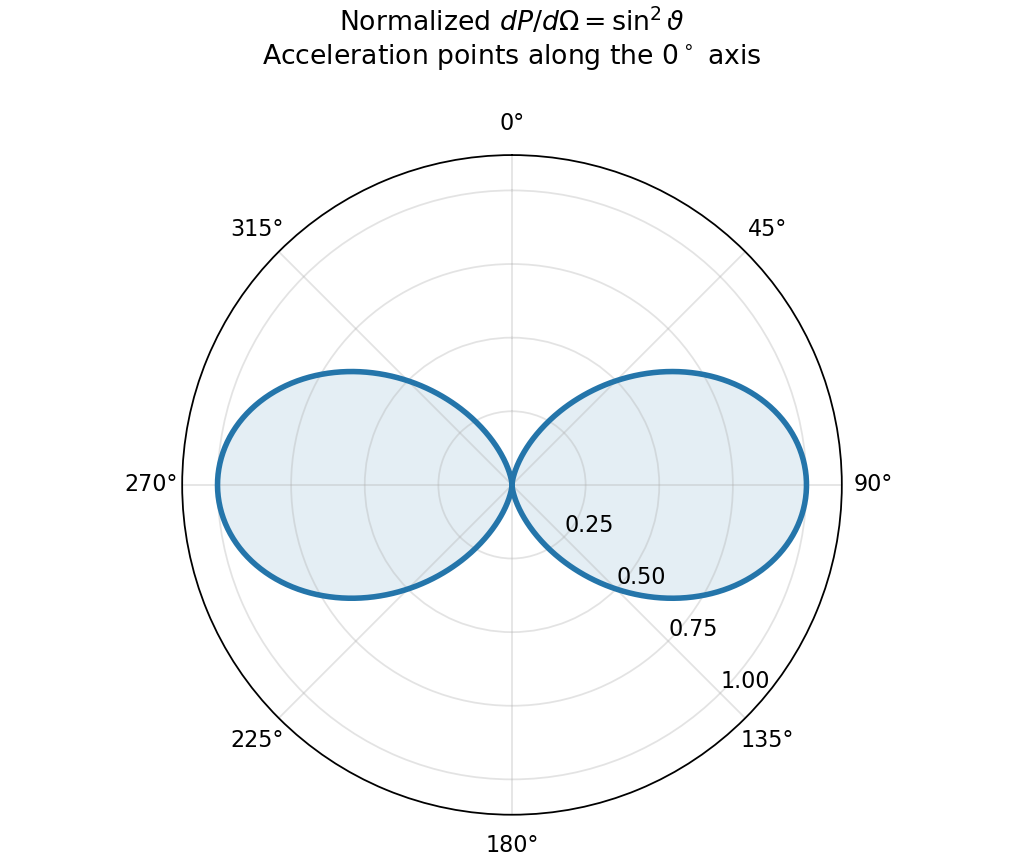
An accelerating point charge has a transverse radiation field in addition to its near field. At nonrelativistic speed and large distance ,The acceleration is evaluated at retarded time. Radiation fields decay as , so their outward energy flux integrated over a sphere is independent of radius; the near electric field instead decays as . The radiation vanishes along the acceleration and is strongest perpendicular to it.[ref]
The Feynman Lectures on Physics, Volume I by Richard Feynman and others. §28–2, Eqs. (28.5)–(28.6): transverse acceleration field and inverse-distance radiation
Using the Poynting vector givesThe integral uses . This is the Larmor formula. A harmonically accelerated charge with peak acceleration has mean power ; external work supplies this radiated energy in steady operation. Uniform inertial motion does not radiate.

A blackbody absorbs all incident electromagnetic radiation, at every frequency, direction and polarization: its absorptivity is one. In thermal equilibrium, Kirchhoff's law of thermal radiation makes its emissivity one as well. Its emitted spectrum depends only on its absolute temperature, through Planck's law, rather than on the material of its surface.
A small aperture in a large isothermal cavity approximates a blackbody because radiation entering it undergoes many reflections and is very unlikely to escape before absorption. The equilibrium radiation field is isotropic and unpolarized. The total emitted radiant exitance is by the Stefan–Boltzmann law; the peak of the wavelength spectrum shifts to shorter wavelengths as temperature increases according to Wien's displacement law. An ideal absorber can therefore glow brightly when hot: “black” describes absorption, not the absence of thermal emission.
Past exam of the symmetry and relativity course of the University of Oxford 2021 2 a Solution 2026-10-25
Let be the point electric charge's world line, with proper time and four-velocity . For the field event , choose the retarded source event: is future-directed and null. Write , where . In the instantaneous rest inertial frame of that source event,Consequently the covariant expression matching this Coulomb potential isThe denominator is a Lorentz scalar, so the right-hand side is a four-vector with the required instantaneous-rest components. This describes the retarded potential in Lorenz gauge, with no added free electromagnetic wave. Lorentz covariance alone does not establish the boundary conditions or exclude additional terms depending on four-acceleration. The physical input is the retarded point-source solution of Maxwell equations: the potential at the retarded event depends on the instantaneous four-current, while its derivatives generate the acceleration field. Equivalently, evaluating the retarded source integral gives a Jacobian from the light-cone constraint; this fixes that input for arbitrary smooth subluminal motion.[ref]
Retarded Potentials by Richard Fitzpatrick. §1.7, equations (71)–(76): causal source integrals, with source quantities evaluated at retarded time
In any inertial frame, put and . Then , and the Liénard–Wiechert potential isDifferentiate using and , including the position and time dependence of the retarded time. For example, and . The resulting Liénard-Wiechert field isHere the dot denotes a derivative with respect to source coordinate time. The first term is the velocity or non-radiative field: it falls as and exists even without acceleration. The second is the acceleration or radiation field, falling as and transverse to . Its Poynting flux falls as , so its outward power integrated over a large sphere stays finite as its radius tends to infinity. The first term's squared-field flux instead vanishes in that limit. This large-distance distinction defines radiation; a moving near field can carry local energy without constituting radiation escaping to infinity.