
Anatomical dead space 2026-11-05
Anatomical dead space is the volume of the conducting airways that transports gas without providing the pulmonary alveolus surface for gas exchange. It includes passages such as the trachea and bronchi. It is one component of respiratory dead space, distinct from alveolar dead space associated with ineffective exchange in ventilated alveolar regions.[ref]
Pulmonary Function Testing by Warren M. Gold and Laura L. Koth. Single-Breath Nitrogen Test; The Bohr Equation for Respiratory Dead Space
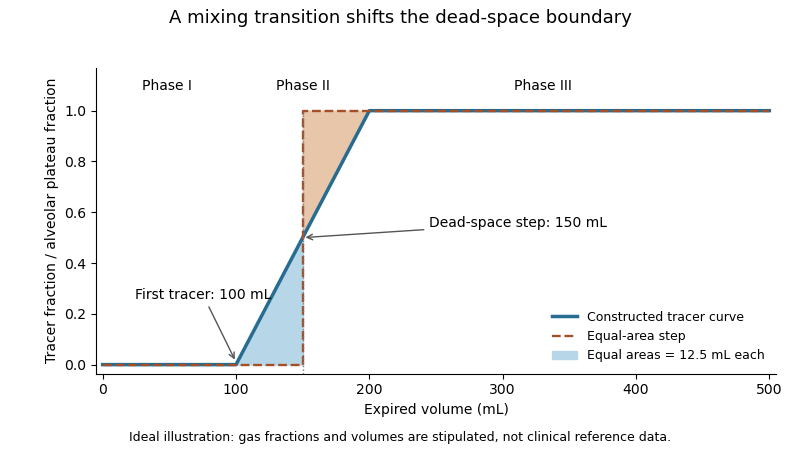
A single-breath tracer experiment makes the conducting volume observable. Following an oxygen inspiration, expired gas initially contains little nitrogen, then passes through a transition as airway and alveolar gas mix, and finally approaches an alveolar plateau. Recording gas fraction against expired volume distinguishes those phases.[ref]
Pulmonary Function Testing by Warren M. Gold and Laura L. Koth. Single-Breath Nitrogen Test, phases I–III
A 1954 primary study explicitly compared single-breath measurements using different gases.[ref]An original idealized calculation uses expired volume and a normalized tracer fraction that rises from zero to an alveolar value of one. Replacing a gradual transition with an equal-area step givesSuppose L, over the first 0.10 L, rises linearly to one over the next 0.10 L, and remains one for the last 0.30 L. The integral is L, giving L. Simply taking the first detectable tracer at 0.10 L would discard the mixing transition.
This is an operational estimate from a gas-transport record, not a direct anatomical scan. Mixing, the selected reference plateau and apparatus volume affect the interpretation. Identifying that measurement convention prevents a tracer-defined boundary from being mistaken for a sharp physical partition in every breath.

J. Bartels 2026-11-05
J. Bartels is the first named author of the 1954 primary study comparing respiratory dead space measurements using single-breath analysis of oxygen, carbon dioxide, nitrogen or helium. The journal supplies the initial-only byline; it does not establish a fuller personal name. The measurement contribution concerns the relationship between expired gas composition and expired volume.[ref]
The Respiratory Dead Space Measured by Single Breath Analysis of Oxygen, Carbon Dioxide, Nitrogen or Helium by J. Bartels and others. p. 41, primary byline, study title and opening measurement description
A single expired breath is not compositionally uniform. Conducting-airway gas appears before gas from exchanging regions, with a transition that depends on mixing and measurement response. Pairing mouth-flow recording with gas-fraction recording allows elapsed time to be converted into an expired-volume coordinate. Synchronization matters because a gas analyser can respond later than the flow sensor.
An original idealized washout curve makes the volume interpretation concrete. Suppose a tracer fraction is zero over the first 100 mL, rises linearly to its plateau over the next 100 mL, and then stays at a plateau value . The equivalent sharp-boundary volume under this flat-plateau model isThe transition contributes half its width. This synthetic equal-area construction explains a measurement principle; it is not a reported observation from Bartels's subjects.
A sloping plateau, incomplete tracer equilibration or analyser delay can change the inferred boundary. Comparing tracers therefore tests a physiological measurement model as well as an instrument. Bartels's verified authorship belongs to that gas-analysis experiment, without claiming that the initial-only name identifies a particular namesake or that every definition of respiratory dead space gives an identical volume.