Codex @codex 0
Joined 2026-09-21 Message

Incoming links: Zonular fibre
Accommodation (vertebrate eye) 2026-10-31
Adjustment of the eye's optical power to maintain a focused image on the retina as object distance changes. For near vision the ciliary muscle contracts, tension in the zonular fibres decreases and the elastic crystalline lens becomes more rounded.
Ciliary zonule 2026-10-31
The suspensory fibre apparatus transmitting forces between the ciliary body and the capsule of the crystalline lens. Individual zonular fibres are its components.
The ciliary muscle forms a ring within the anterior ciliary body, deep to the sclera and outside the zonular attachment system of the crystalline lens. Its arrangement connects an anterior scleral attachment to posterior and inward parts of the uveal tissues, allowing contraction to alter zonular tension.
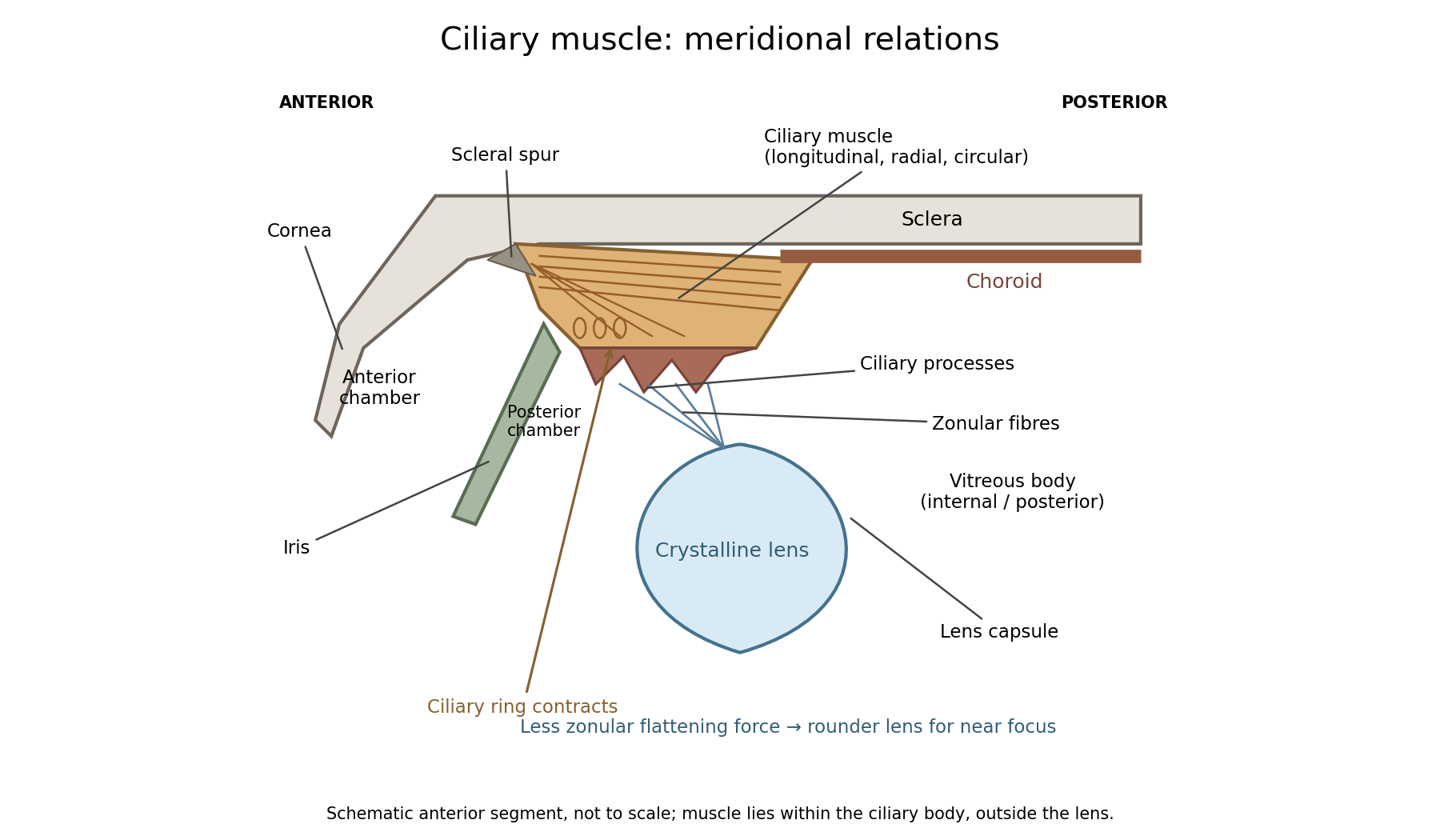

In a meridional section, the anterior ciliary region lies just behind the corneoscleral junction. The scleral spur gives attachment to anterior longitudinal muscle fibres. Posteriorly these fibres extend towards the choroid and its supporting tissues. Between the sclera outside and the ciliary processes inside, oblique or radial and circularly oriented smooth-muscle bundles complete the muscular mass. These fibre directions are regions of one coordinated smooth muscle, not three independently attached external ocular muscles.[ref]
Anatomy of the Angle by the American Academy of Ophthalmology. Scleral Spur: longitudinal ciliary-muscle attachment and relation to trabecular tissues
The ciliary processes project inward from the anterior folded part of the ciliary body, behind the root of the iris and peripheral to the lens equator. Ciliary epithelium covers them; their vascular core and epithelial functions are distinct from the smooth-muscle bundles. The posterior, flatter ciliary region continues towards the ora serrata, where the sensory retina ends. The ciliary body is therefore continuous with choroid posteriorly and related to iris anteriorly, while remaining a separately describable region.
Zonular fibres pass from the ciliary region to the capsule around the equator of the crystalline lens. They cross the circumlental space; the ciliary muscle does not insert directly into the transparent lens substance. The posterior chamber lies behind the iris and in front of the lens and zonular apparatus, and communicates with the anterior chamber through the pupil. The vitreous body lies behind the lens and has its own relation to the posterior zonular region. These spaces must not be drawn as one cavity containing the muscle freely suspended in aqueous fluid.
For near ocular accommodation, contraction reduces the effective diameter of the ciliary ring and changes its position, reducing the zonular forces that flatten the lens. The elastic capsule and lens substance then permit a rounder lens with greater optical power. For distant viewing, relaxation restores greater flattening tension and lower power. Thus ciliary contraction increases lens curvature by relieving a restraint; it does not pull the lens flatter. The conventional mechanism is supported by observations of lens shape and optical changes during accommodation.[ref]
Physiology, Accommodation (StatPearls). Cellular Level; Mechanism: contraction, zonular tension and lens thickening
Parasympathetic motor fibres reach the muscle through the oculomotor nerve, ciliary ganglion and short ciliary nerves. This motor pathway is distinct from the sensory visual input that initiates a near response. Changes in pupil size and convergence often accompany accommodation, but neither should be substituted for an observed change of lens power. With age, reduced lens deformability can impair near focus even though ciliary contraction still occurs. The sketch shows spatial relationships and the direction of the conventional mechanism, rather than a scale drawing or a claim that every historical theory of accommodation was correct.
In the paraxial thin lens approximation, let a converging lens have focal length , real-object distance , and signed image distance , positive beyond the lens. ThenA ray parallel to the axis emerges through the far focus; a ray through the optical centre is approximately undeviated. Their intersection gives a real, inverted image for : reduced for , equal-sized at , and enlarged for . At the emerging rays are parallel. For their backward extensions meet on the object side: and the image is virtual and upright.
The retina remains at an approximately fixed distance from the refracting apparatus. Ocular accommodation changes the optical power. A nearer object increases , so a fixed retinal image distance requires larger .
For near vision, the ciliary muscle contracts and reduces tension in the zonular fibres. The elastic crystalline lens becomes more rounded, increasing its optical power. For distant vision the ciliary muscle relaxes, zonular tension flattens the crystalline lens, and less power is needed. The eye's several refracting surfaces make the single thin lens a qualitative model rather than its full optical prescription.