
Addition combines two numbers into their sum. For natural numbers, joining disjoint collections of sizes gives a collection of size . On a number line, adding shifts a starting position by : rightward when and leftward when .
Starting at and adding reaches . Starting there and adding returns to , because . Additive inverses turn this return move into an algebraic rule. With real numbers, addition is commutative and associative: exchanging two shifts or grouping several shifts differently leaves the final position unchanged.
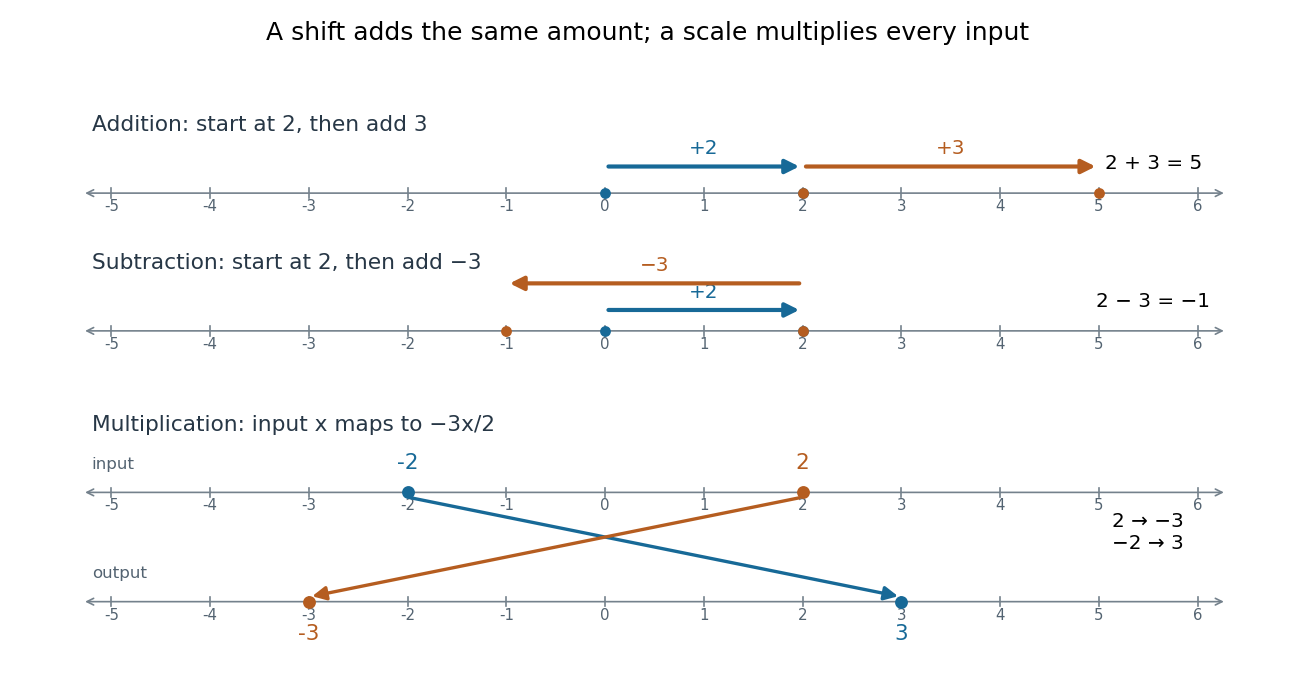
Addition shifts positions on a number line, while a negative multiplication factor changes both scale and direction
. Details. The bottom panel applies . Input becomes , and input becomes . Multiplication by a negative real number rescales distances from zero and reverses direction, giving a reflection in mathematics as well as a scale change. This is a different operation from shifting every input by one fixed amount.

Addition is a fundamental mathematical operation that involves combining two or more numbers to obtain a total or sum. It is one of the four basic arithmetic operations, alongside subtraction, multiplication, and division. The symbol used for addition is "+". For example, in the expression \(3 + 2\), the numbers 3 and 2 are added together to yield a result of 5.


New to topics? Read the docs here!