Area-equivalent lumen diameter
ID: area-equivalent-lumen-diameter

The area-equivalent lumen diameter is the diameter of a circle having the same area as a measured lumen. For positive area ,It converts an area observation into a length scale without asserting that the actual lumen is circular. The definition applies to an irregular outline as well as to an ideal geometric shape.
For an ellipse with full principal diameters , area is , soAn original ellipse with diameters and has area and area-equivalent diameter . The arithmetic mean of its two diameters is , which would define a circle of larger area.
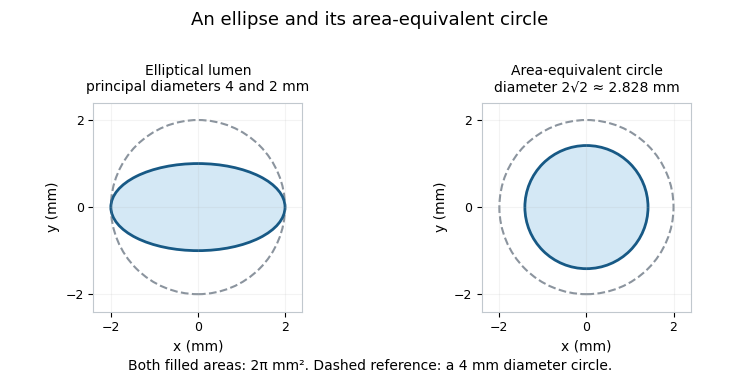

Using an equivalent diameter in a circular area-ratio formula is valid by construction:Using an arbitrary single projected width instead is not. Eccentric lumen stenosis can show different widths in different views while retaining the same area. Primary selective coronary arteriography used serial and cine recording to observe the contrast-filled arterial route; interpreting such images still requires the chosen projection and reconstruction model.[ref]
Selective Coronary Arteriography: Part I: A Percutaneous Transfemoral Technic by Melvin P. Judkins. Material and Technic, serial/cine recording
The equivalent diameter also differs from hydraulic diameter, , which includes wetted perimeter . Two equal-area outlines can have different perimeters and flow resistance. An area-equivalent circle is therefore not automatically an equivalent flow model.
For small area uncertainty, differentiation gives . A relative standard uncertainty in area gives approximately in the derived diameter if other inputs are fixed. This propagates area uncertainty; it does not correct an incorrectly segmented outline or a mismatched reference region.
New to topics? Read the docs here!