Basis intensities and phase ambiguity
ID: basis-intensities-and-phase-ambiguity

Keep the cubic translations above, but attach an atomic basis with A at fractional crystal coordinates and B at . Stipulate real, angle-independent relative scattering amplitudes and . Neglect wave absorption, repeated crystal scattering and thermal motion. This is a point-scatterer model under the Born approximation, not a claim about the scattering strengths of named elements. Its crystal basis structure factor isHere is a dimensionless squared motif amplitude. Comparing it with measured integrated wave intensities requires the experimental geometry and detector response as well. The algebra follows directly by multiplying by its complex conjugate; the cross term records wave interference between the two sites.
With , reflections with even have , whereas odd gives , a ratio of . With , the first four values instead are . Their geometrically possible positions are unchanged, although their strengths change. For equal stipulated amplitudes and , the odd- amplitude vanishes exactly: an example of a systematic absence. Different motif weights can thus expose a repeat that equal weights conceal.
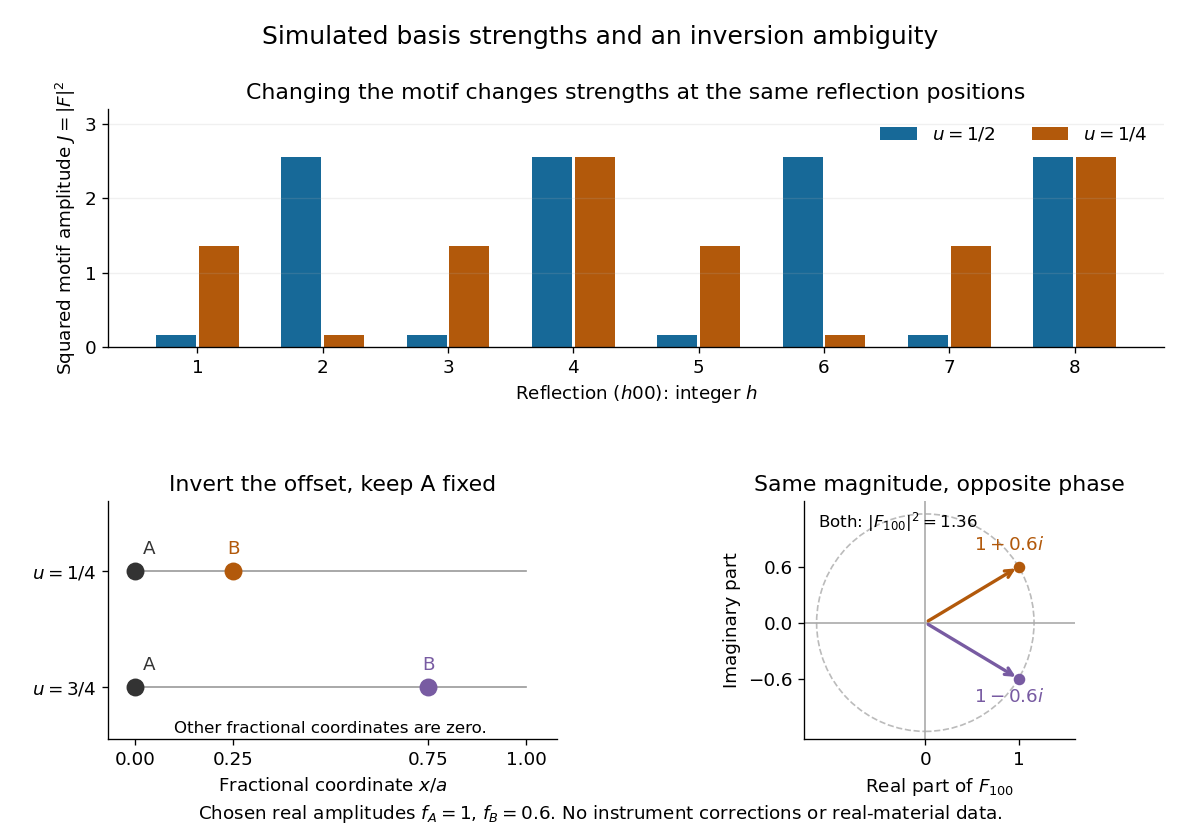
The motif changes intensities, while inversion can preserve them
. Original point-scatterer simulations with and . Top: the same reflection labels have different squared motif amplitudes for and . Bottom left: moving B from to inverts its offset modulo a translation. Bottom right: the two crystal basis structure factors are complex conjugates, , with the same squared modulus . No detector profiles or real-material measurements are plotted. Details.
The same formula also proves an ambiguity: and give identical for every integer , because . Yet changes from to , reversing its wave phase. This particular ambiguity is inversion of the motif; it does not prove that these two simple motifs are distinct chemical substances. The conclusion is conditional on the stipulated real scattering amplitudes.
New to topics? Read the docs here!