
Increasing the number of page frames can increase misses under a given page replacement policy on the same page-reference trace. For FIFO page replacement on the displayed twelve-reference sequence, an empty start with three page frames gives nine misses, while an empty start with four gives ten. The larger run hits only at indices 5 and 6; it misses at 1–4 and 7–12. These are miss counts, not observed running times.[ref]
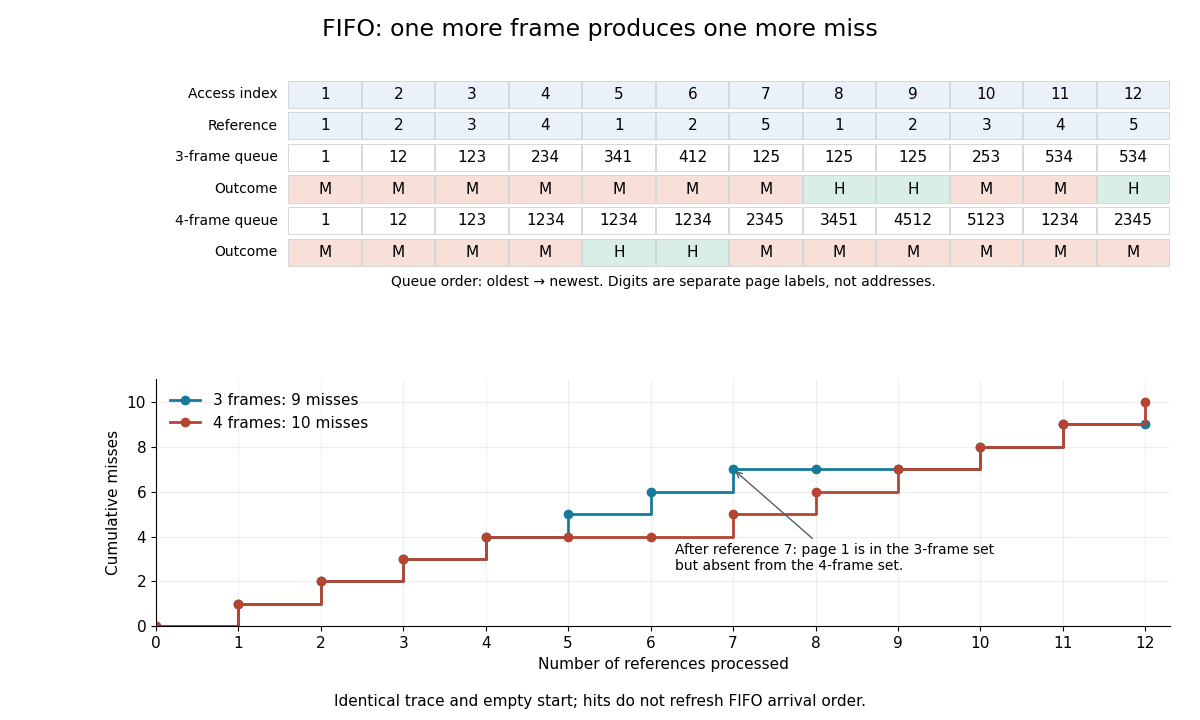
FIFO page replacement queue states and cumulative misses: four page frames give ten misses versus nine with three
. Details. 
The explanation is visible before the final count. After access 6, the three-page frame queue is and the four-page frame queue is , both oldest first. Loading memory page 5 at access 7 removes memory page 4 in the smaller run but memory page 1 in the larger. Their resulting resident sets are and . The smaller resident set is not a subset of the larger: its next access to memory page 1 hits while the larger run misses. Different earlier evictions create different histories; an extra page frame is not simply an extra unchanged slot. FIFO page replacement can improve on other sequences; the anomaly is an existence claim, not a claim that more page frames usually hurt.
New to topics? Read the docs here!