Buffer cache state model
ID: buffer-cache-state-model

Use one fixed-size buffered device block per buffer cache key, serialized operations, successful reads and writes, and no outside changes to the backing contents. Record an absent state or a reserved key with validity , dirty flag , and retained-reference count . The bits describe contents, while the nonnegative integer describes lifetime. Every dirty buffer is valid, so implies . Reservation begins at ; successful fill changes only to 1. Modifying a valid retained structure sets . Releasing a caller changes , not or .
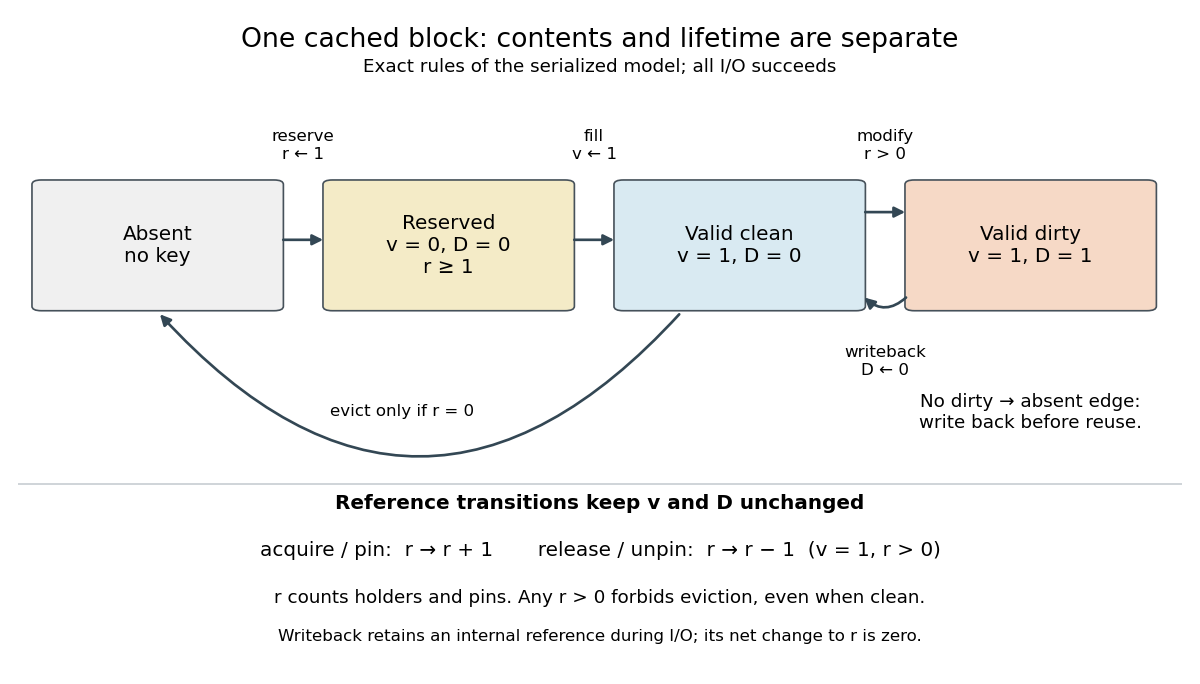
Buffer cache validity, dirty buffers and retained references impose different state-transition rules
. Details. 
The first diagram separates contents transitions from reference transitions. Buffer cache writeback temporarily retains the structure while transferring its contents; that internal reference is acquired and released inside the single serialized operation shown. Buffer cache eviction requires a valid clean buffer with . The diagram omits read errors, explicit cancellation of invalid reservations, concurrent writes, invalidation and journal ordering. In particular, a journal can forbid otherwise possible buffer cache writeback until its write-ahead logging dependencies are satisfied.
For a small independent check, bound to . Starting absent, allow reservation, acquisition, successful fill, modification, successful buffer cache writeback, release of a valid retained structure, and eligible buffer cache eviction. Exactly nine abstract states are reachable: absent, two invalid reservations with , and six valid states combining with . Every transition preserves ; the only eviction source has . This bounded finite-state machine check supports these safety rules, not a claim that work always completes.
New to topics? Read the docs here!