
The ceiling function gives the least integer large enough to meet a real lower bound. For a real number ,Thus , , and . The operation rounds upward in the total order on the real numbers, which can move a negative input towards zero. Its difference from the input obeys . Python's
math.ceil implements this least-integer definition. [ref]https://docs.python.org/3.14/library/math.html#math.ceil. Python 3.14 math.ceil documentation: the least integer at least x
.The ceiling count for fixed-size batches is a direct application. Suppose each box holds at most items, with positive integer , and there are items. The smallest number of boxes with enough capacity is : a candidate count must satisfy . For , , six boxes are needed, leaving unused places. Exactly 100 items need only five boxes, and zero items need zero boxes. Adding one to the floor function result unconditionally would therefore overcount at exact multiples of .
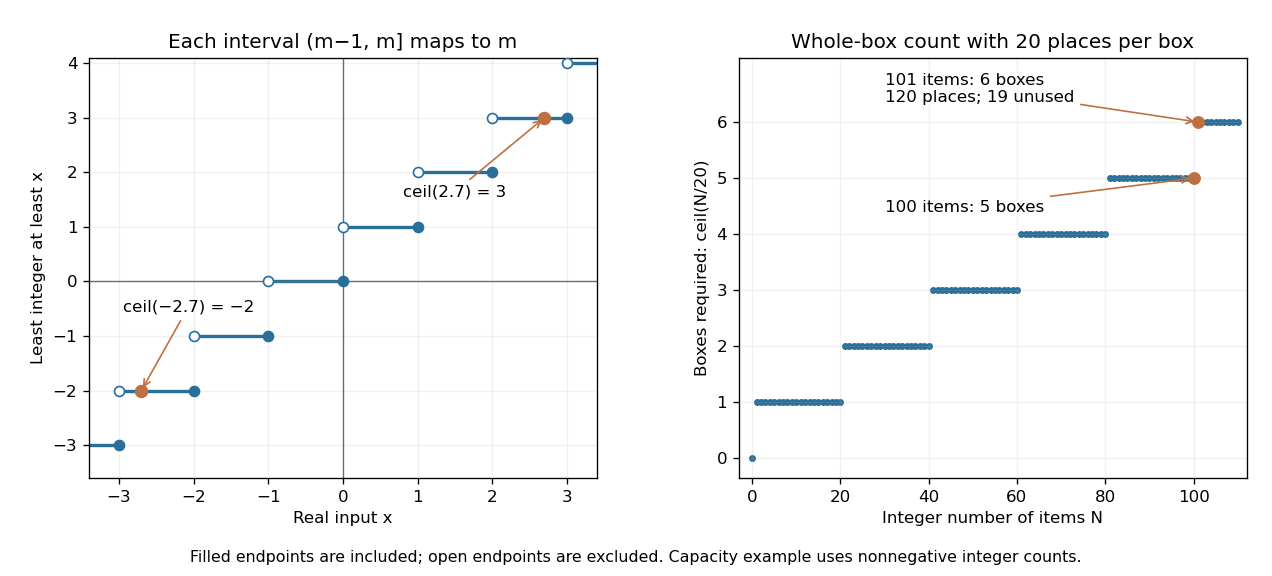
The ceiling function retains the endpoint on the left and counts enough whole containers
. Left: open and filled endpoints distinguish the half-open intervals where , including negative inputs. Right: the original capacity example uses 20 items per box; 101 items need six boxes, while an exact multiple of 20 needs no extra box. The right-hand inputs are integer item counts. Details.
For nonnegative integer and positive integer , Euclidean division gives the exact identityWrite , . The count is when the remainder is zero and otherwise, and the right-hand side encodes these two cases. This argument specifies the domain of the identity; arbitrary negative denominators require their own sign conventions.
The ceiling function is a nondecreasing function, constant on each of the half-open intervals , and has a discontinuity of a function at every integer. It is tied to the floor function by . Adding an integer shifts its output by the same amount: . At an integer the floor and ceiling agree; at every other input they differ by one. These statements refer to exact real numbers; an input already perturbed by floating-point arithmetic can land on the other side of a threshold.
New to topics? Read the docs here!