
C. Neinhuis, identified as Christoph Neinhuis in the Bonn team's 1998 nomination profile, investigated how plant surfaces repel water and shed contamination with W. Barthlott. Their work connected plant structure with biomimetics.[ref]
Unverschmutzbare Werkstoffe: Team 1 1998 by Deutscher Zukunftspreis. team identities, Bonn affiliation and project description
The 1997 experiment compared smooth and rough water-repellent plant surfaces. After artificial contamination, the specimens were rinsed using a sprinkler or fog generator; rolling droplets removed particles from the water-repellent leaves. This supplied a functional test of the lotus effect, beyond simply imaging an unusual surface.[ref]
Purity of the sacred lotus, or escape from contamination in biological surfaces by W. Barthlott and C. Neinhuis. Abstract, comparison surfaces, artificial contamination and rinsing
An original quantitative comparison would count retained particles over equal sampled areas. Suppose two surfaces each begin with 1000 particles; after matched rinsing one retains 50 and the other 400. The respective removal fractions are and . These hypothetical counts illustrate a measurable cleaning outcome, not data from Neinhuis's paper.
The comparison needs controls for particle type, initial loading, water delivery and how the sampled area is selected. A surface can have a large static contact angle yet pin droplets through contact-angle hysteresis. Measuring water repellency, droplet motion and contamination removal separately therefore tests more of the proposed mechanism than a single photograph of a rounded droplet.
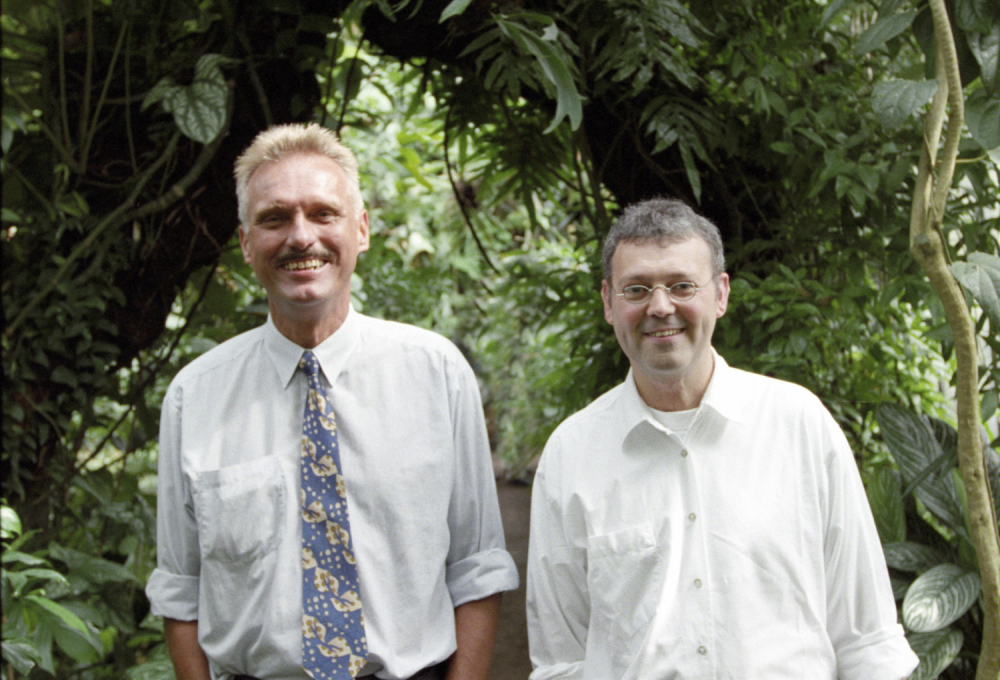
Wilhelm Barthlott at left and Christoph Neinhuis at right, identified in the 1998 Deutscher Zukunftspreis nomination profile; photograph by Ansgar Pudenz
. New to topics? Read the docs here!