
An equivalence relation says which set elements should count as the same for a particular purpose. In modular arithmetic, for example, distinct integers with the same remainder are equivalent. The relation gathers interchangeable set elements into equivalence classes; the quotient set then treats each whole equivalence class as one object.
Formally, an equivalence relation on a set is a binary relation , written , satisfying three conditions for all :These conditions make the equivalence classes a partition of a set: each set element belongs to exactly one class. [ref]
- Reflexivity: .
- Symmetric relation: implies .
- Transitivity: and imply .
https://www.jirka.org/ra/html/sec_basicset.html. Jiří Lebl, Basic Analysis, §0.3.4, Definitions 0.3.21 and 0.3.23 and Proposition 0.3.24
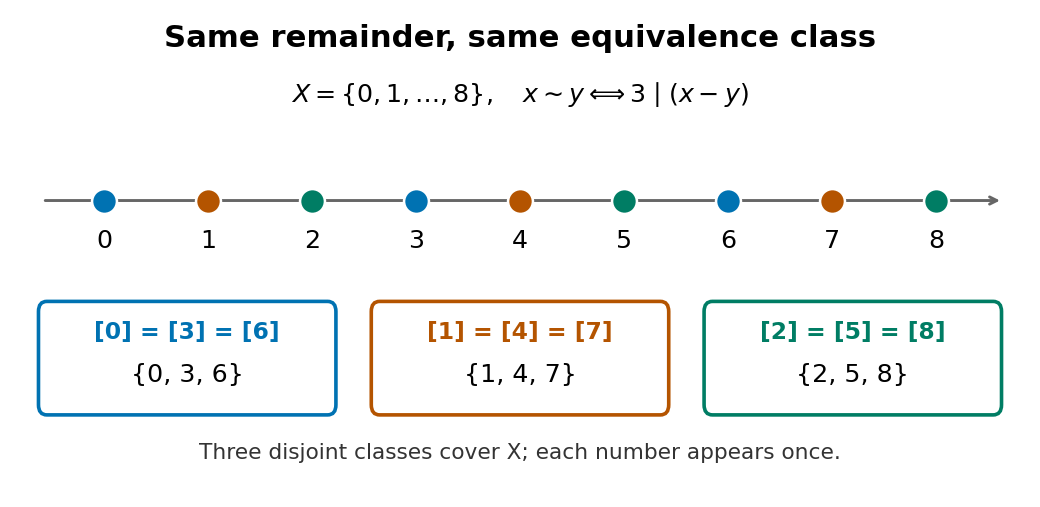
For a worked example, take the finite set and restrict integer congruence modulo three to :Reflexivity follows because . The symmetric relation property follows by changing the sign of a difference, and transitivity follows by adding and : divisibility by three is preserved in both steps. Thus and force . The three equivalence classes are , and . Their members alternate along the number line; membership in an equivalence class need not mean being close together.

The transitivity requirement rules out a tempting alternative. On , define nearness by the absolute value condition . This binary relation is reflexive and symmetric, but is near and is near while is not near . Its neighborhoods , and overlap without being equal. They are not equivalence classes or a partition of a set.
New to topics? Read the docs here!