
For positive integers , the Euclidean algorithm repeatedly performs division with remainder: write with , then replace by until the second entry is zero. The final nonzero entry is their greatest common divisor. A remainder preserves the set of common divisors: an integer divides and exactly when it divides and . The positive remainders strictly decrease, so the calculation terminates.
The complete calculation for and isHence . The fraction reduces to by dividing numerator and denominator by that common factor. The same remainder calculation has a geometric interpretation: remove squares from a -by- rectangle, then repeat on the remaining strip. Each division step records how many equal squares fit and the width of the new strip.
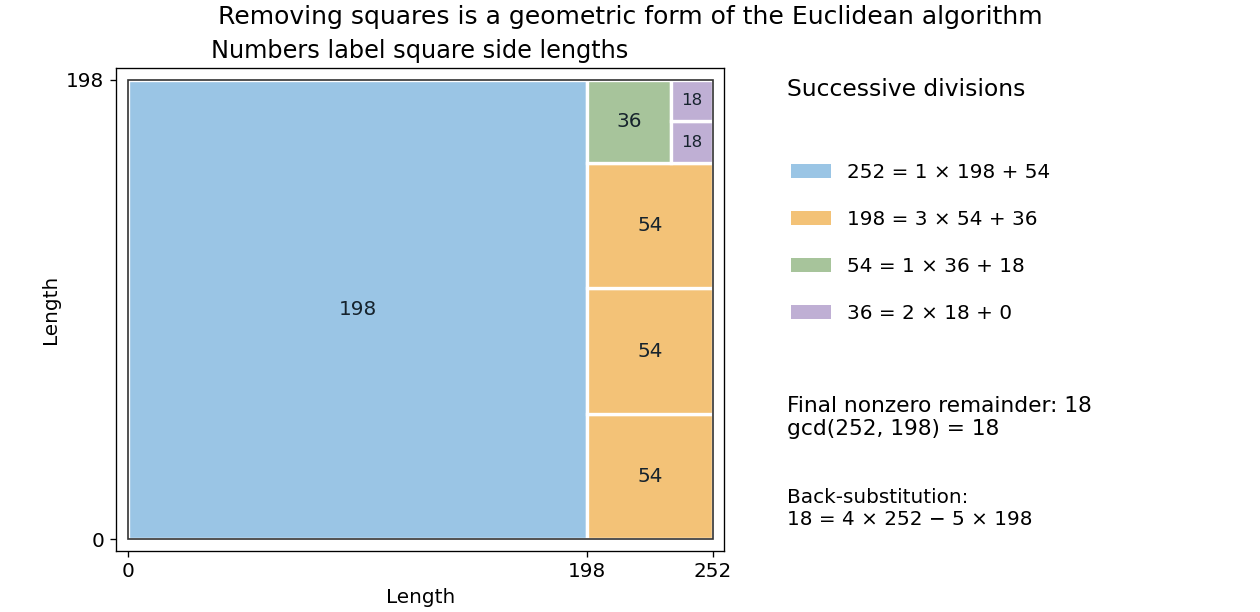
Successive square removals record the Euclidean algorithm for 252 and 198
. Details. The procedure does more than test individual divisors. Each step replaces the whole common-divisor problem by a smaller equivalent one. Euclid's Book VII, Proposition 2 describes the corresponding repeated-subtraction construction; batching those subtractions into division with remainder gives the present formulation. [ref]
https://mathcs.clarku.edu/~djoyce/java/elements/bookVII/propVII2.html. Euclid, Elements VII.2, greatest common measure



New to topics? Read the docs here!