Euler characteristic with different coefficient fields
ID: euler-characteristic-with-different-coefficient-fields

For a concrete example of cellular homology of real projective space, the real projective plane has one topological cell in each of dimensions zero, one and two. Its one-dimensional topological cell is a loop, and the face attaches around that loop twice. Choose orientations so that the cellular chain complex over the integers iswith nonzero chain groups in degrees two, one and zero. The twice-around attachment is why the first boundary operator shown is multiplication by two.[ref]
Algebraic Topology by Allen Hatcher. Algebraic Topology by Allen Hatcher, §2.2, Example 2.42, printed p. 144: real projective cellular boundary maps
Over the rational numbers, multiplication by two is invertible, so and vanish, while . Over the finite field , two equals zero. Both boundary operators then vanish, giving one-dimensional homology groups in all three degrees. Their respective Betti numbers areNevertheless,The direct cell count is also .
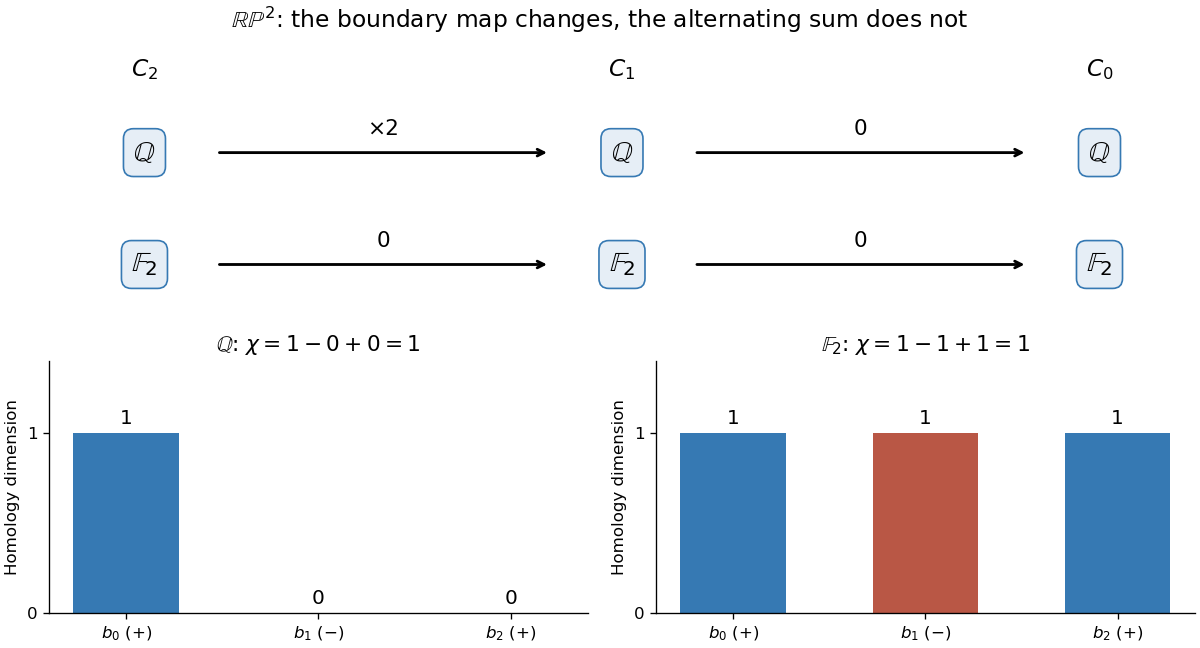
Changing coefficients changes the projective plane's homology groups, but their alternating dimension sum remains 1
. Details. 
This calculation makes the strength and loss of information visible. The Euler characteristic survives a change of the field used for coefficients, while individual homology groups can change. Over the integers, the same chain complex has and : a torsion subgroup that rational Betti numbers do not record. The rank cancellation in the Euler-Poincare formula explains why the alternating total still agrees with the cell count.
New to topics? Read the docs here!