External memory fragmentation
ID: external-memory-fragmentation

External memory fragmentation occurs when free capacity is divided among separated blocks so that a request for one sufficiently large contiguous block cannot be satisfied. It concerns the layout available to a particular allocator, rather than only the total free computer memory. In a fixed nonmoving pool, occupied blocks can separate free intervals that would have been useful if adjacent.[ref]
Operating Systems: Three Easy Pieces by Remzi H. Arpaci-Dusseau and others. Chapter17, “Free-Space Management”, introduction and §17.1, variable-size allocation and nonrelocatable live blocks
For an original example, a104-byte pool contains free blocks of24,40 and16 bytes, separated by occupied blocks of16 and8 bytes. Total free capacity is80 bytes, but the largest free memory block is only40 bytes. A contiguous48-byte request therefore fails in this closed pool, assuming live blocks cannot move and ignoring metadata/alignment overhead.
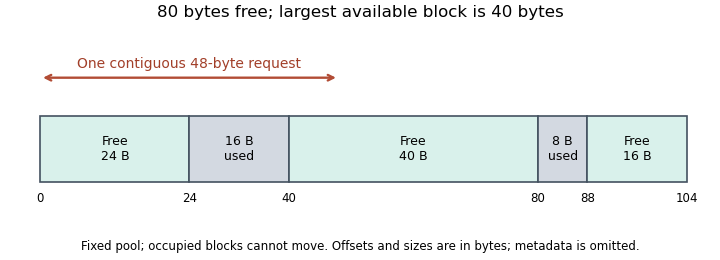

Memory block coalescing merges adjacent free intervals. If the occupied16-byte block between the first two holes is released, the neighboring24,16 and40-byte intervals can form one80-byte free block. Coalescing does not merge across a still-occupied interval. Memory compaction instead moves live data to collect free space, which requires a way to preserve or update references. An allocator generally cannot relocate an arbitrary live block behind an unchanged C programming language pointer.[ref]
Operating Systems: Three Easy Pieces by Remzi H. Arpaci-Dusseau and others. §17.1, relocation assumption; §17.2, splitting and coalescing
The illustrative measure equals0.5 for the original layout, but it does not say that half the memory is universally unusable: requests no larger than16 bytes can still fit. Actual allocation success depends on request sizes and allocator policy. Internal fragmentation instead concerns unused space inside allocated units.
The contiguity requirement also needs its address space specified. A virtually contiguous block can use noncontiguous physical page frames through virtual memory. Physical page fragmentation and an application's heap holes are therefore different allocation-layer questions. Changing the physical mapping alone does not merge separated virtual holes around live objects.
New to topics? Read the docs here!