
An extraneous solution satisfies a transformed equation but fails the original equation or its restrictions. The term describes a candidate generated during the calculation, rather than a true solution that can be kept in the final solution set.
Consider the real equationThe square root requires . Because the square root is nonnegative, any solution must also have , so . Squaring givesThe squared equation has candidates and . At , the original equality is . At , it is , which fails: this candidate is an extraneous solution. Thus the original solution set is exactly .
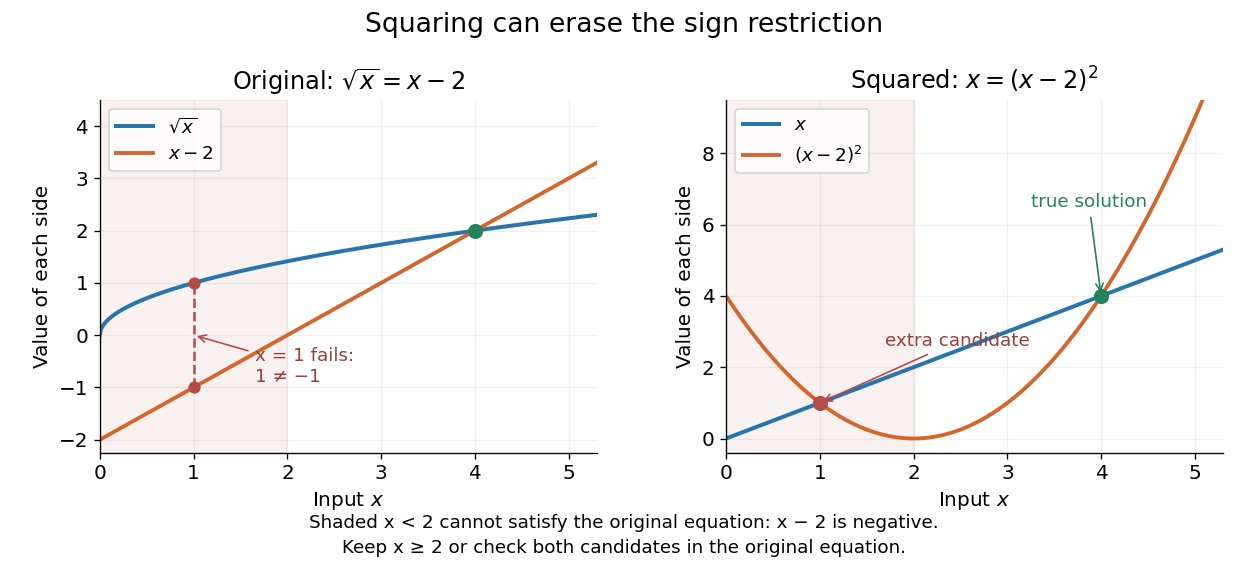
Squaring removes a sign distinction and creates a second intersection at , which fails the original equation
. Details. 
On the restricted domain of a function , both original sides are nonnegative, so squaring is reversible there and the two equations are equivalent. Retaining the sign restriction or checking every candidate in the original equation achieves the same final solution set. The general need to check candidates after raising both sides to a power is explained in College Algebra 2e, §2.6: Solving Radical Equations.
New to topics? Read the docs here!