Finite-layer model of Lippmann reflection
ID: finite-layer-model-of-lippmann-reflection

To isolate the readout mechanism, replace the processed photographic emulsion by equally spaced, identical weak scattering planes, with separation . Take the readout refractive index to be real and independent of wavelength, and let be the internal angle from the plane normal. Adjacent specularly backscattered contributions differ in wave phase by . Their geometric series givesHere is a small plane reflection wave amplitude, assumed constant in this illustrative band; at by continuity. Since incident and reflected waves occupy the same external medium, is the model reflectance when transmission factors are absorbed into . Require for the weak-scattering sum to remain self-consistent. Normalizing to discards absolute brightness; it does not predict a highly reflecting historical plate.
The first-order peak obeysThis is Bragg's law with an angle measured from the normal, rather than the glancing Bragg angle. For external viewing angle in air approximated by refractive index one, Snell's law gives , henceThe expression describes specular readout: illumination must supply the matching incident direction. Tilting a plate under fixed narrow illumination can make the signal disappear as well as change its selected colour.
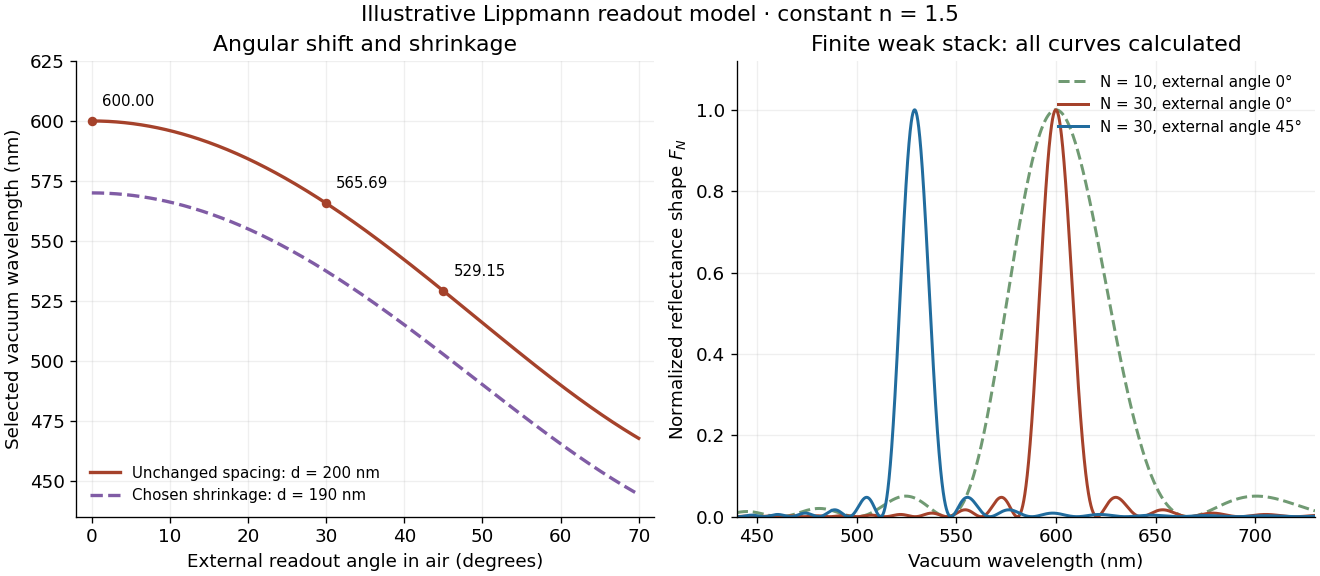
For the chosen and , calculated peaks are at , at , and at . Greater obliquity selects a shorter wavelength. Uniform shrinkage to , with unchanged , multiplies every peak wavelength by : a chosen moves the normal peak to . More generally, at normal incidence. A change of thickness alone is insufficient if processing also changes the refractive index.
Finite gives a finite spectral response. The nearest zeros satisfy , giving . At the normal peak, gives neighbouring zeros at approximately and ; gives and . Thus greater sampled depth narrows the central band in this model. The small-detuning distance from peak to a nearest zero is approximately ; it is not the full width at half maximum.
Calculated angular colour shift and finite-stack reflectance shape
. Original weak-scattering finite-grating model with chosen and . Left: predicted first-order peak versus external angle, with a separate illustrative 5 percent shrinkage calculation at unchanged refractive index. Right: normalized , comparing and at normal readout and at external readout. Every curve is calculated; none is a measured spectrum. Source. Details.
Real processed photographic emulsions have a continuous, irregular depth response rather than identical planes. Absorption, wavelength-dependent refractive index, unequal scattering strengths, a nonideal exposure reflector, changes during photographic processing and multiple scattering of light can alter both peak positions and shapes. A transfer calculation with measured material parameters would be needed for quantitative reflectance. The present model explains the phase-selection mechanism and the tradeoff between depth and spectral width; it cannot establish faithful reproduction of an arbitrary incident optical spectrum. Its useful lesson is that a photograph can record colour through sub-wavelength structure, while its eventual appearance still depends on illumination, viewing geometry and processing.
New to topics? Read the docs here!