
Glucuronic acid is the uronic acid corresponding to glucose; in the usual D form, carbon 6 of D-glucose carries a carboxyl group instead of its primary alcohol group. Its neutral free-acid molecular formula is . The reference carbon numbering remains that of glucose.[ref]
Nomenclature of Carbohydrates (Recommendations 1996) by Alan D. McNaught. Section 2-Carb-22.1: D-glucuronic acid structure and numbering
Check the atom count: changing into adds one oxygen and removes two hydrogen atoms. Loss of the acidic proton gives glucuronate, with negative electric charge. The free monomer's formula should not be substituted unchanged for a residue inside a linked polysaccharide.
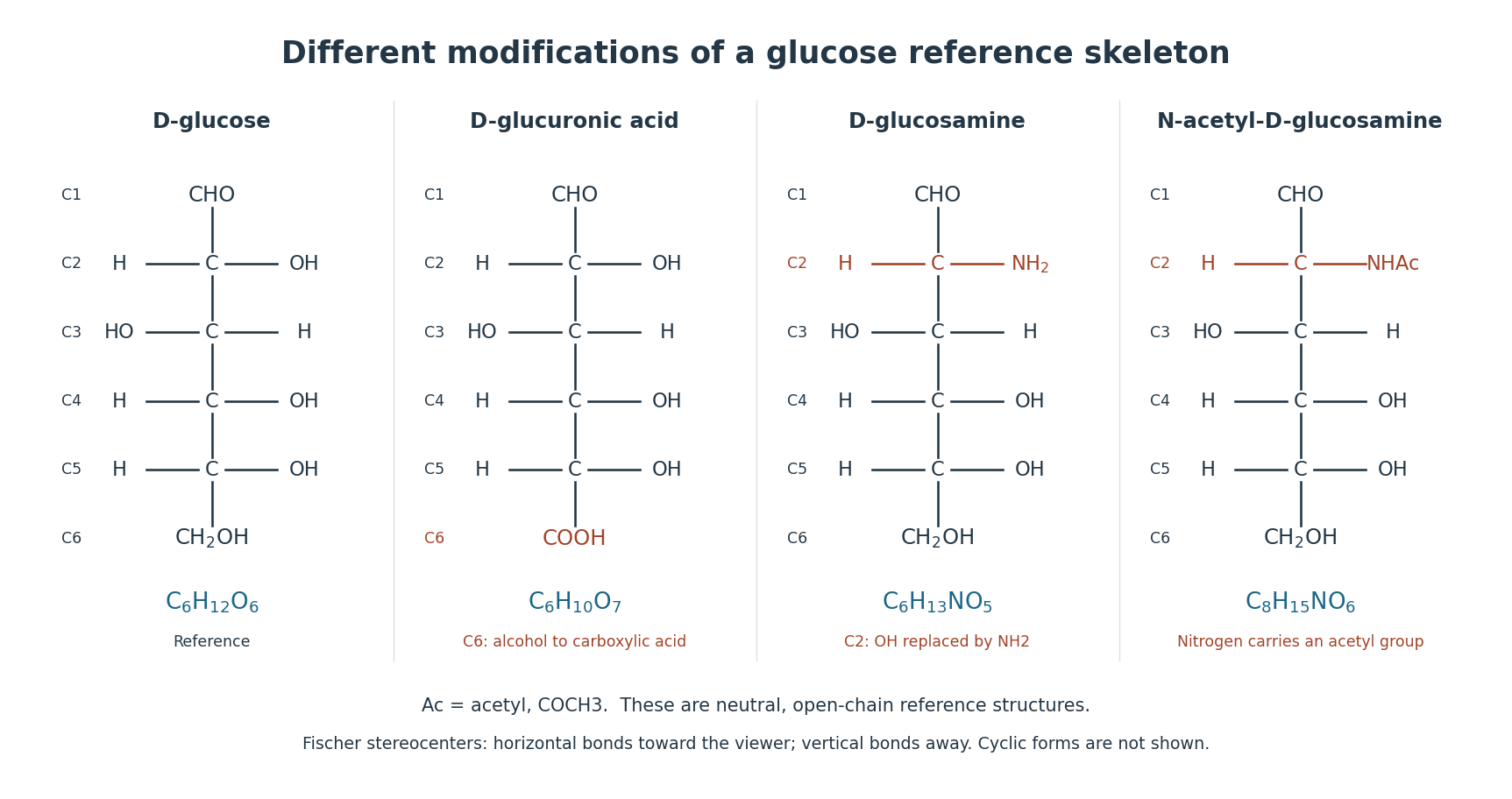

In a synthesis experiment, P. L. DeAngelis used UDP-glucuronic acid together with UDP-N-acetylglucosamine as activated substrates for hyaluronan synthase. Incorporation of the two sugar types into hyaluronic acid turns a repeating structural description into a reaction whose components can be varied.[ref]
Enzymological characterization of the Pasteurella multocida hyaluronic acid synthase by P. L. DeAngelis. Abstract, PMID 8703949: two UDP-sugar substrates and cell-free synthesis
New to topics? Read the docs here!