
Grid fitting adjusts scaled glyph geometry relative to a target pixel grid before rasterization. TrueType font hinting can move outline points to preserve important strokes and alignment at small sizes. The result depends on the requested resolution and transformation.[ref]
TrueType Fundamentals by Microsoft. From Font File to Paper; instructions and grid-fitting distortions
A simple area-coverage antialiasing model shows the problem. A vertical stroke from horizontal coordinate 0.4 to 1.6 covers 60 percent of each of two neighboring pixel columns. An equal-width stroke from 3.9 to 5.1 covers 10 percent, 100 percent and 10 percent of three columns. Both geometries have width 1.2 pixels, yet their darkest columns differ. Snapping their boundaries to give each stroke one full column changes the outlines but gives consistent displayed stroke weights.
This is a tradeoff between geometric fidelity and small-size legibility, rather than a change to the stored Unicode text. Grid fitting operates on the geometry supplied to the rasterization step; glyph substitution and glyph positioning address the forms and layout that precede it.
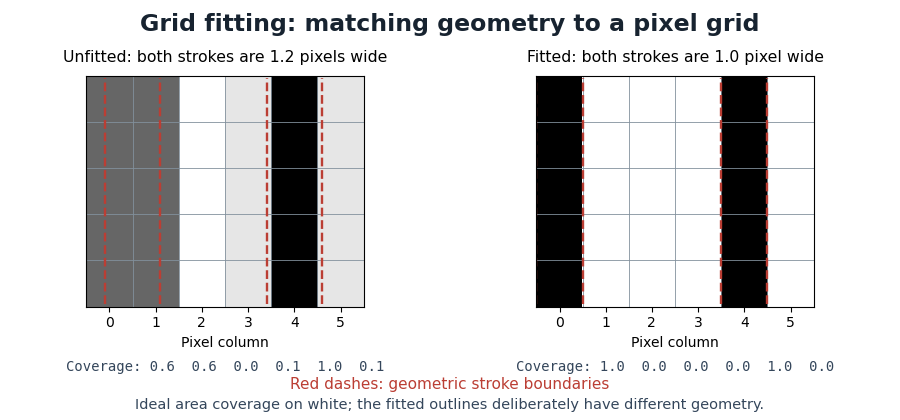
Pixel coverage before and after grid fitting
. Original ideal area-coverage antialiasing model of rectangular strokes, not measurements of a particular computer font. The unfitted strokes both have width 1.2 pixels, but their placements give different column coverage. The fitted strokes each occupy one full column; their changed geometry is explicit. Red dashed lines mark the geometric stroke boundaries. Details.
New to topics? Read the docs here!