
A maximal matching is a matching in a graph to which no extra edge can be added while retaining all current selected edges. Equivalently, no edge joins two unmatched vertices in a matching; those vertices form an independent set. Every maximum cardinality matching is a maximal matching, but the converse fails.
Take the path graph with vertices and edges . A greedy algorithm that first selects the middle edge produces . Both remaining edges touch a matched vertex, so this size-one matching in a graph is maximal. Yet has two edges. No matching in a graph on four vertices has more than two edges, so is a maximum cardinality matching. The two remaining free vertices of , namely and , are not adjacent; that does not prevent a longer augmenting path in a matching from joining them.
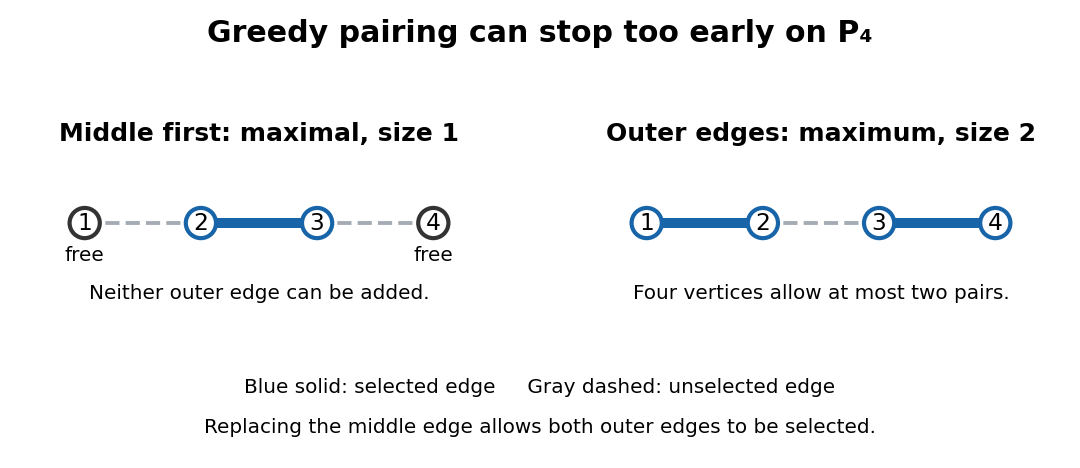
Choosing the middle edge of P₄ gives a maximal matching of size one; the outer edges give a maximum cardinality matching of size two
. Details. 
Maximality is useful as a quick stopping rule and a modest guarantee. For any maximal matching and maximum cardinality matching in a finite simple graph, every edge of touches an endpoint of an edge of . Assign it to one such edge of . Since has disjoint endpoints, each edge of receives at most two assignments, proving . The P₄ example reaches equality. Thus maximality guarantees at least half the largest cardinality, but says nothing comparable about arbitrary edge benefits. Its selected endpoints also form a vertex cover, as explained under vertex cover.
New to topics? Read the docs here!