McShane extension theorem
ID: mcshane-extension-theorem

Let be a nonempty subset of a metric space , and let satisfy a Lipschitz bound . Thenare real-valued Lipschitz functions on all of , agree with on , and obey the same bound . Every other extension satisfying that bound lies between them, . Despite the infimum in its formula, is the largest such extension: every given sample supplies an upper constraint .
Take three real samples , , , and allow the bound . Their least Lipschitz constant is only , so this is deliberately a looser permitted bound. The two extensions areAt , the allowable interval is . The interpolant obtained by linear interpolation is a piecewise linear function and has value there. Extending it constantly outside obeys the same bound on the entire real line. At , the allowable interval is . Thus the data and the bound control possible values without selecting a unique curve.
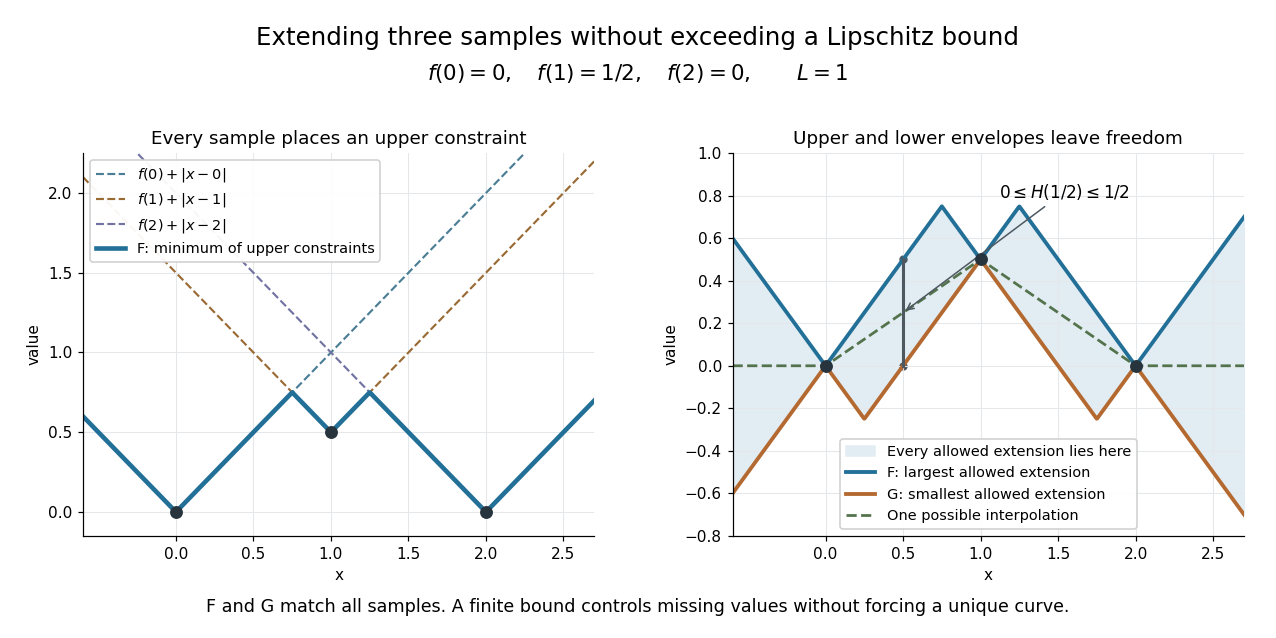
Each sample constrains a Lipschitz function; the upper and lower envelopes bound every allowed extension
. Details. 
The construction is useful when data are known only on a subset: it extends them without increasing an allowed Lipschitz bound. A short justification explains why the envelopes work. Fix . The triangle inequality and the bound on implyso the infimum is finite below; the term makes it finite above. At a sample , all upper terms are at least , while that term gives equality. Finally, gives after taking an infimum; exchanging proves the bound. The lower envelope follows by applying the same argument to .
E. J. McShane's paper Extension of range of functions appeared in the Bulletin of the American Mathematical Society, volume 40, in 1934, pp. 837–842. [ref]
https://www.ams.org/books/surv/012/surv012-endmatter.pdf. AMS bibliography: E. J. McShane, Extension of range of functions
[ref]https://doi.org/10.1090/S0002-9904-1934-05978-0. McShane's original publication
New to topics? Read the docs here!