Nonzero residue permutation
ID: nonzero-residue-permutation

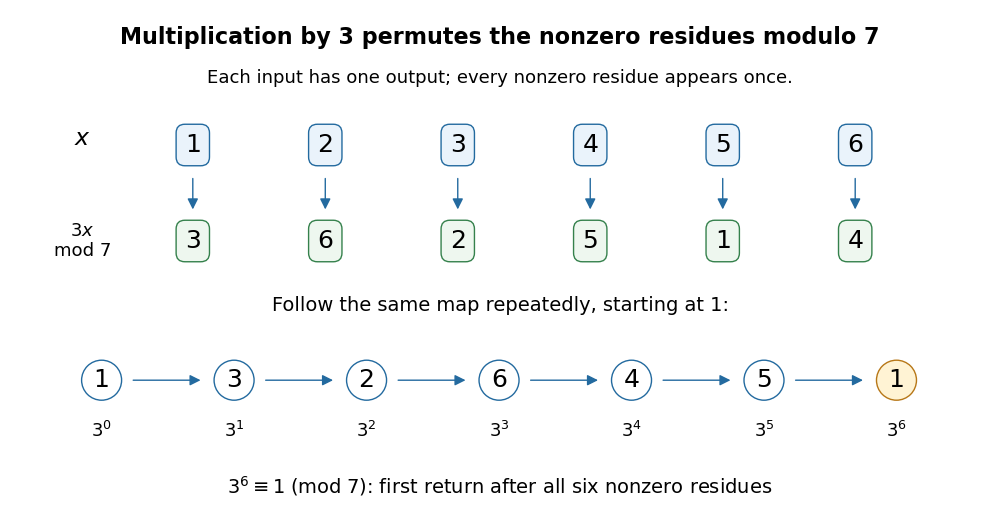
For a prime number and , multiplication by gives a permutation of the nonzero residue classes. For modulo seven, the representatives map to : the same collection in a different order. Repeating this permutation from one visits all six representatives before returning.

For modulo seven, the permutation cycles are instead and . The powers of two visit only the permutation cycle containing one, so their multiplicative order is three. Both permutation cycles return after three steps; applying the permutation six times still fixes every nonzero residue class. Fermat's little theorem guarantees a return at six, not that every base visits every nonzero residue class.
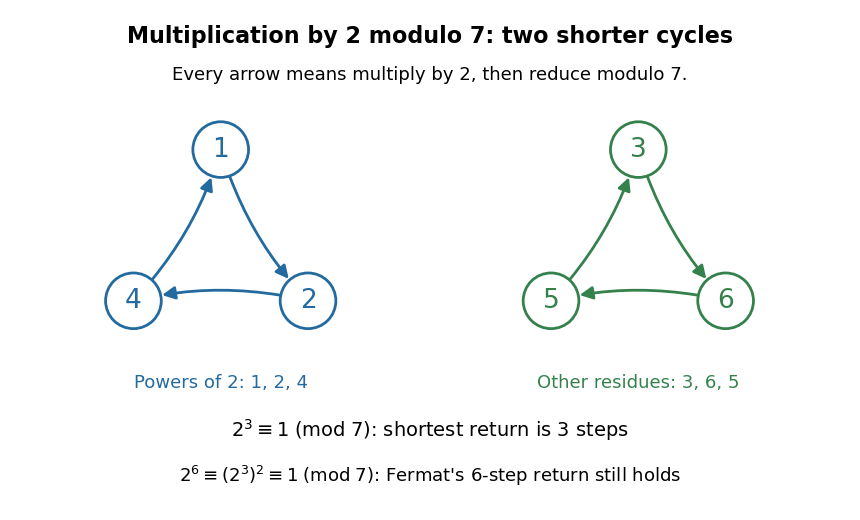

More generally, every permutation cycle of this map has length equal to the multiplicative order of : starting at a nonzero residue class , a return means , and its modular multiplicative inverse allows cancellation of . Thus the nonzero residue classes split into equal-length permutation cycles, which also explains the divisibility of the multiplicative order into .
The product argument gives a short proof outline. Since multiplication by is a permutation of the nonzero residue classes,Every factor is a unit, so their product has a modular multiplicative inverse and can be cancelled. This leaves . The whole argument works for , where the product is just one.[ref]
New to topics? Read the docs here!