
The normal Zeeman effect is the simple three-frequency pattern obtained in the orbital limit. Assume negligible net spin, negligible hyperfine structure and quadratic shifts, and an allowed electric-dipole interaction between levels with orbital splitting factor one. A level with has only and no first-order shift. For the other levels, gives . Define , rather than the final-minus-initial change of the emitting atom. The electric-dipole selection rule allows , henceMany allowed transitions can share one frequency; a triplet need not mean exactly three transitions. The cleanest illustrative example is , with three upper quantum states and one unshifted lower quantum state. The component is called , and components with this stated convention. During emission the atom changes its magnetic quantum number by .
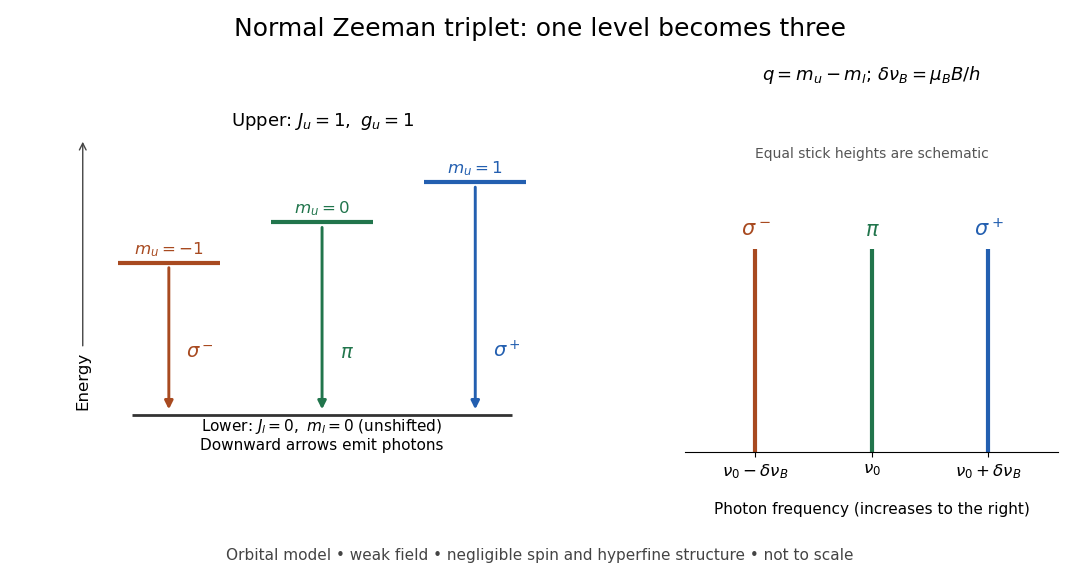
Normal Zeeman triplet from three photon transitions
. Original schematic of the ideal orbital model. The upper splitting factor is one and the lower level has zero first-order shift. Downward arrows show photon emission; the spectrum uses frequency increasing to the right. Equal stick heights are schematic and do not predict observed intensities. Details.
For an original numerical example choose and a zero-field vacuum wavelength . Using and gives . The two outer components are separated by . Differentiating the vacuum relation , with the speed of light, givesEach outer component lies about from the centre. Positive means higher frequency and shorter wavelength. Equal spacing in frequency is only approximately equal spacing in wavelength. These are calculated values for a chosen model, not historical measurements.
New to topics? Read the docs here!