
A memory access trace reduced to the ordered sequence of accessed memory page identities, retaining repetitions. An address-only reduction loses read/write information, so annotate writes when studying dirty memory pages. Use the following classic Belady anomaly sequence, where the numbers label memory pages, not physical addresses:Start with three empty, equal-sized page frames allocated to one operating-system process. Every memory page can occupy any page frame, and every resident memory page is eligible for eviction. Use demand paging: a hit finds the requested memory page in the resident set; a miss causes exactly one nonresident page fault and loads it before the next access. Fill the lowest-numbered empty page frame, then reuse the victim's page frame. Assume only reads, no fetching ahead of requests, no competing operating-system processes, and no external removal of memory pages. CLOCK page replacement uses its declared hand rule, which fills the same initial page frames here. The memory page labels alone do not determine the result without these assumptions.
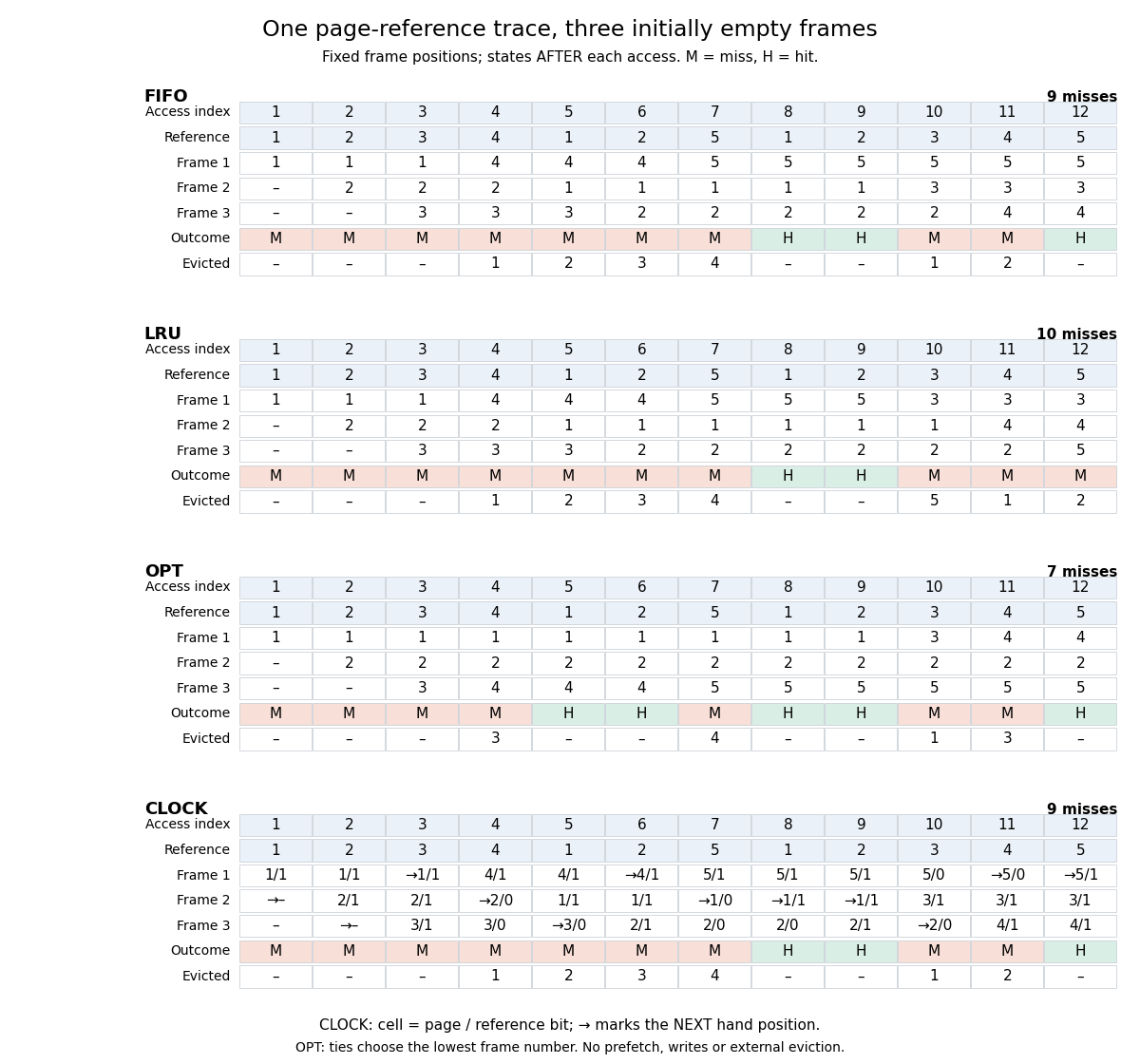
All twelve accesses with three page frames: FIFO page replacement, exact LRU replacement, offline optimal page replacement and the stated CLOCK page replacement variant
. Details. 
Each column shows the state after servicing that access. Rows keep physical page frame positions fixed, rather than silently sorting the resident set. The CLOCK page replacement entries also show reference bits and the next hand position. The independently computed totals are:
The first three misses fill unused page frames; the fourth miss needs eviction. At access 4, FIFO page replacement and LRU replacement evict memory page 1. Optimal page replacement instead evicts memory page 3: the next uses of resident memory pages 1, 2 and 3 are at indices 5, 6 and 10. At access 10, FIFO page replacement evicts memory page 1 while LRU replacement evicts memory page 5. Consequently the last access to memory page 5 hits under FIFO page replacement but misses under LRU replacement. Matching totals for FIFO page replacement and CLOCK page replacement on this sequence do not make the policies equivalent. The generators compute every displayed state; a separate search over all legal victims confirms the seven-miss optimal page replacement bound for three page frames.
New to topics? Read the docs here!