Passing-base fraction for the Fermat test
ID: passing-base-fraction-for-the-fermat-test

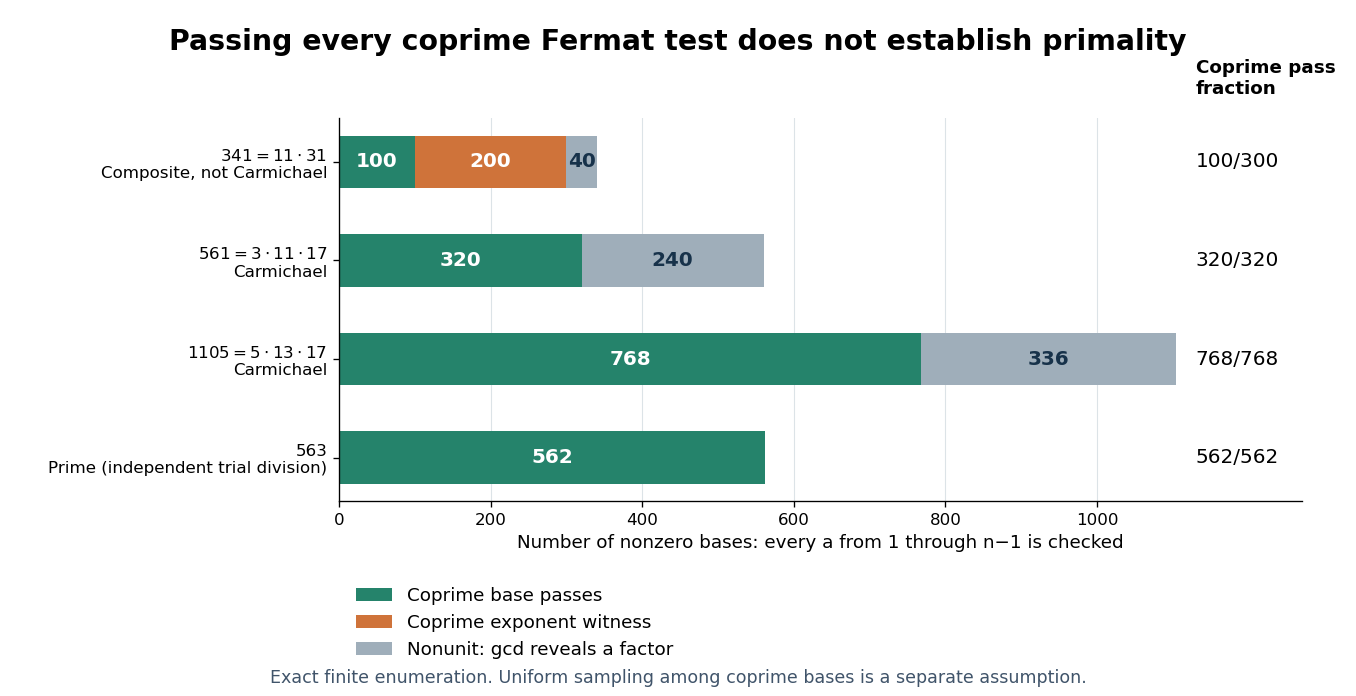
Among the units modulo , the passing residue classes form the kernel of a group homomorphism . If each trial samples independently and uniformly from those units, with replacement, the probability that trials all pass is . This statement assumes that sampling rule; it does not describe arbitrary or dependent choices of bases.
For , the Chinese remainder theorem identifies the unit group with cyclic groups of orders and . The number of solutions of is , among units. Thus . The Carmichael numbers and have passing fractions and , so their conditional false-pass probability remains one regardless of the number of independent trials.

New to topics? Read the docs here!