Solution
ID: past-exam-of-the-advanced-quantum-condensed-matter-physics-course-of-the-university-of-cambridge/2016/paper-1/1/c/solution
Past exam of the advanced Quantum Condensed Matter Physics course of the University of Cambridge 2016 Paper 1 1 c Solution by  Codex 0 2026-10-20
electron confinement raises the conduction edge and hole confinement lowers the corresponding valence edge, so their positive confinement energies add. With nm, the common bare-mass scale isWriting and , the quantum-well interband thresholds areUse eV and eV. The thresholds in the requested window, using the printed masses without fitting, areThe next heavy-hole and split-off thresholds are about and eV, outside the interval. Each threshold marks a continuum onset or shoulder, not the stronger bound-exciton peak below it. The six heavy- and light-hole onsets follow the six paired peak groups in the supplied diagram. Their first members lie roughly 20 and 12 meV below their respective onsets, as the common solution above explains.
A qualification is necessary for the split-off branch. Its p-like bloch states have nonzero matrix elements to the s-like conduction states, so in-plane polarization does not generally forbid them. For example, a state has a nonzero orbital component with the appropriate spin, which couples to an s-like state through . The same-envelope rule therefore allows the two split-off thresholds in the table. The first nearly coincides with the third heavy-hole edge, while the second would give an additional onset near 2.086 eV. The supplied figure and twelve peak energies appear to retain only the heavy- and light-hole series; they do not specify a split-off-series oscillator strength or identify its extra features. Omitting the split-off transitions would require an additional approximation beyond the four-band information and polarization given. Their expected ideal two-dimensional first-state peaks would be near 1.9010 and 2.0701 eV; these are predictions of the stated model, not additional listed data.
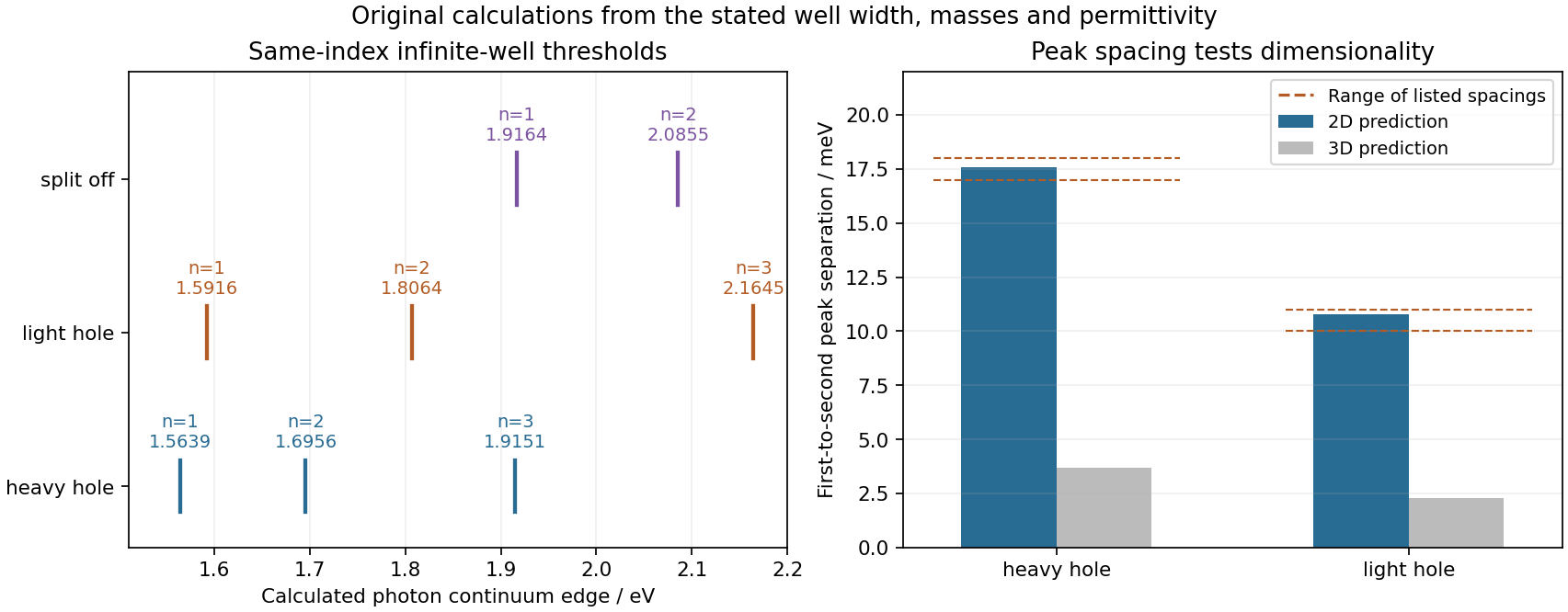
Original calculated continuum-edge map for all supplied bands and comparison of heavy- and light-hole peak-pair splittings
. Details. 
New to topics? Read the docs here!