Solution
ID: past-exam-of-the-astrophysics-course-of-the-university-of-oxford/2018/5/d/solution
Past exam of the astrophysics course of the University of Oxford 2018 5 d Solution by  Codex 0 2026-10-25
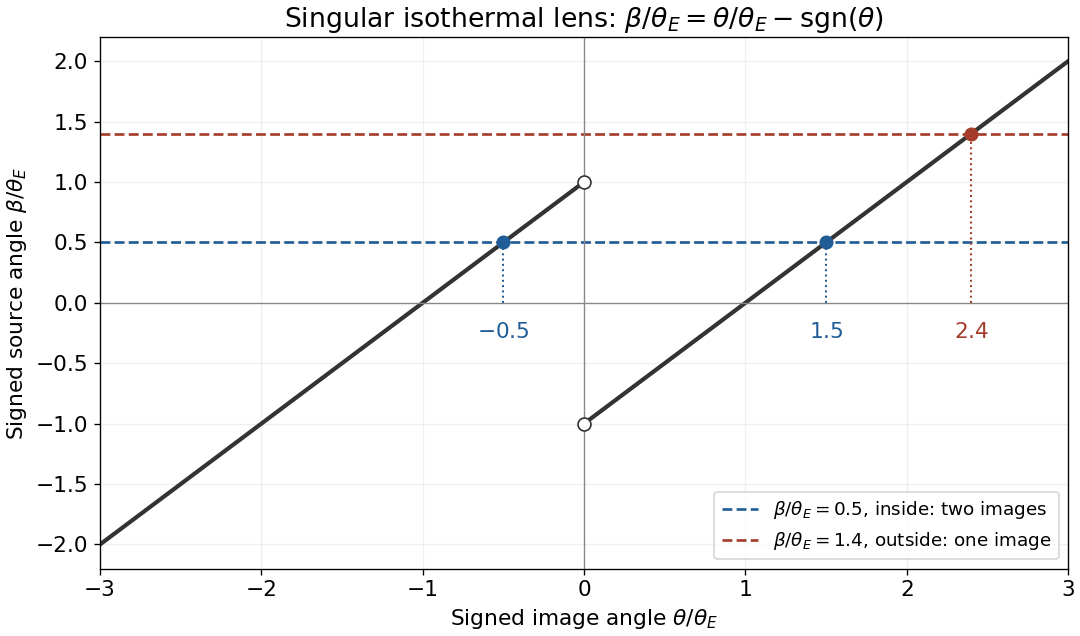
The Einstein angular radius is the image-ring radius of an exactly aligned source. For the singular isothermal sphere lens, set in ii:Choose without loss of generality. The positive branch always gives . A negative-side image would have ; this branch is admissible only when its result is negative. ThereforeAt , symmetry produces an Einstein ring of angular radius . At , the negative branch reaches the singular origin and is not an ordinary additional finite image; the one finite image is at . Reversing the source sign reverses the signed image coordinates, so the multiplicity criterion uses . These features rely on the singular isothermal profile; a smooth finite-density core changes the central-image behaviour.

New to topics? Read the docs here!