Solution
ID: past-exam-of-the-chemistry-a-course-of-the-university-of-cambridge/2021/paper-1/a4/a/v/solution
Past exam of the chemistry A course of the University of Cambridge 2021 Paper 1 A4 a v Solution by  Codex 0 2026-10-20
The hydrogen symmetry orbital mixes with both nitrogen and , giving three molecular orbitals. The two hydrogen functions mix with , giving a bonding pair and an antibonding pair. Eight valence electrons fill the lower levels asThis uses conventional numbering that reserves for the omitted nitrogen core orbital. The low and levels provide the principal N–H bonding molecular orbitals; the highest occupied level is the mainly nitrogen lone pair, with some bonding admixture permitted by the pyramidal geometry. Empty and levels are antibonding. Symmetry fixes which orbitals can mix, rather than their quantitative energy separations.
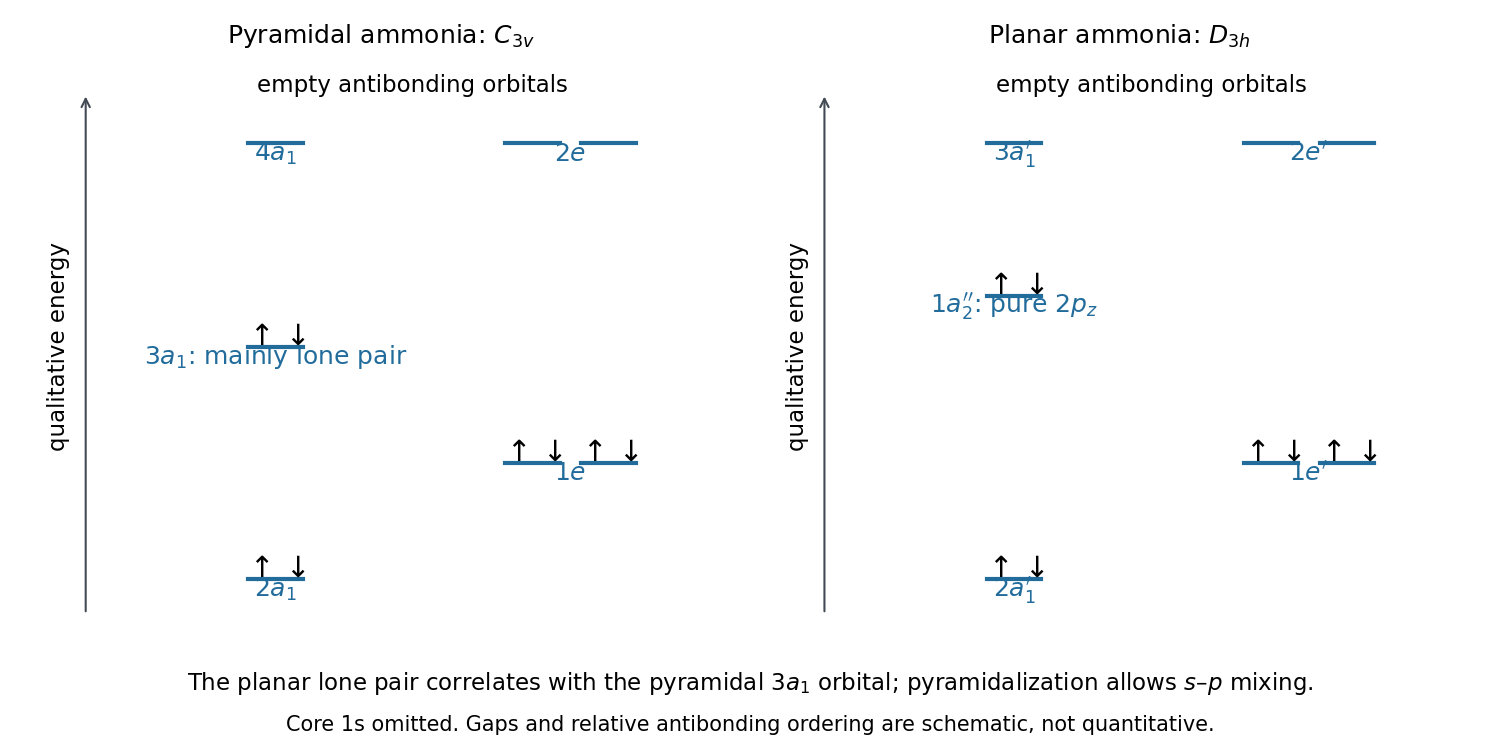
Original qualitative ammonia molecular orbital diagram comparing pyramidal and planar geometries; the core orbital is omitted
. Details. 
New to topics? Read the docs here!