Solution
ID: past-exam-of-the-chemistry-a-course-of-the-university-of-cambridge/2024/paper-2/a7/c/iii/solution
Past exam of the chemistry A course of the University of Cambridge 2024 Paper 2 A7 c iii Solution by  Codex 0 2026-10-20
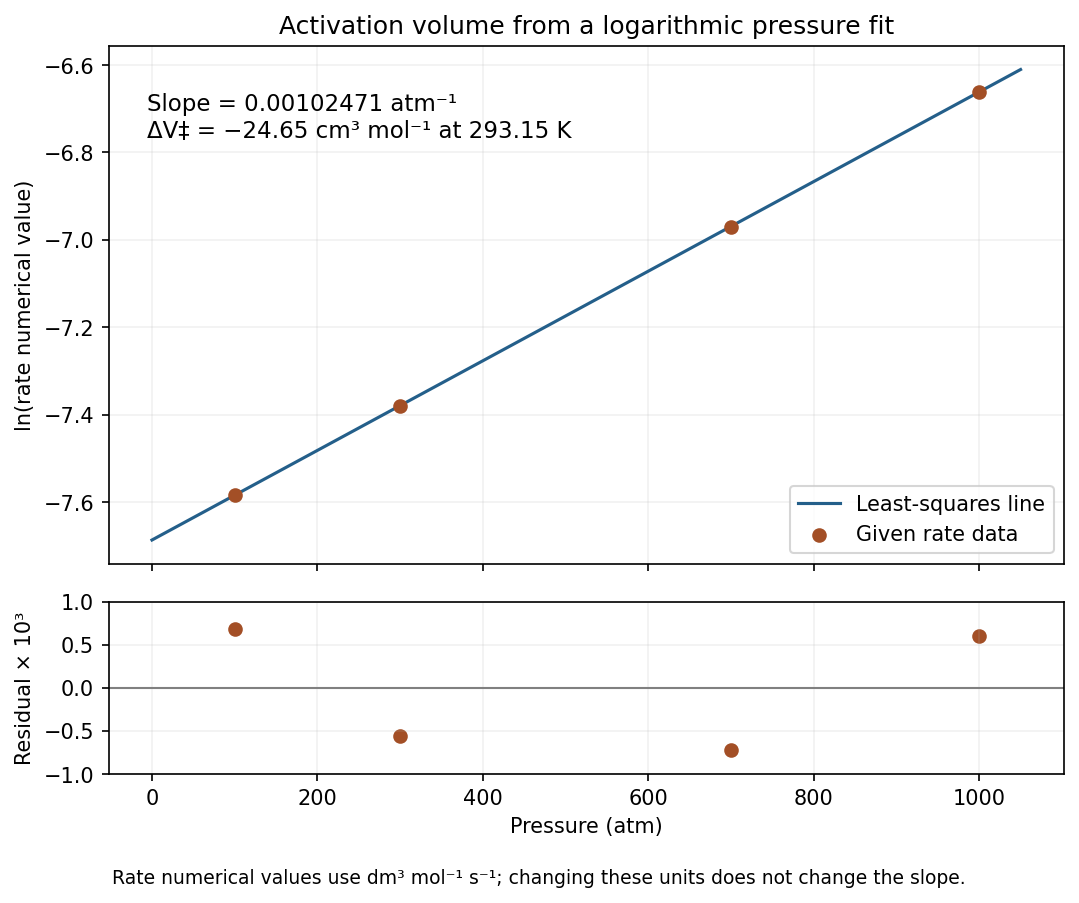
Using the numerical rate constants in , the logarithms areA straight-line least-squares fit isEvery logarithmic residual has magnitude below , so the rates follow the fitted exponential to within ; . Thus a constant activation volume describes these data well.

New to topics? Read the docs here!