Solution
ID: past-exam-of-the-chemistry-b-course-of-the-university-of-cambridge/2023/paper-2/b6/c/solution
Past exam of the chemistry B course of the University of Cambridge 2023 Paper 2 B6 c Solution by  Codex 0 2026-10-20
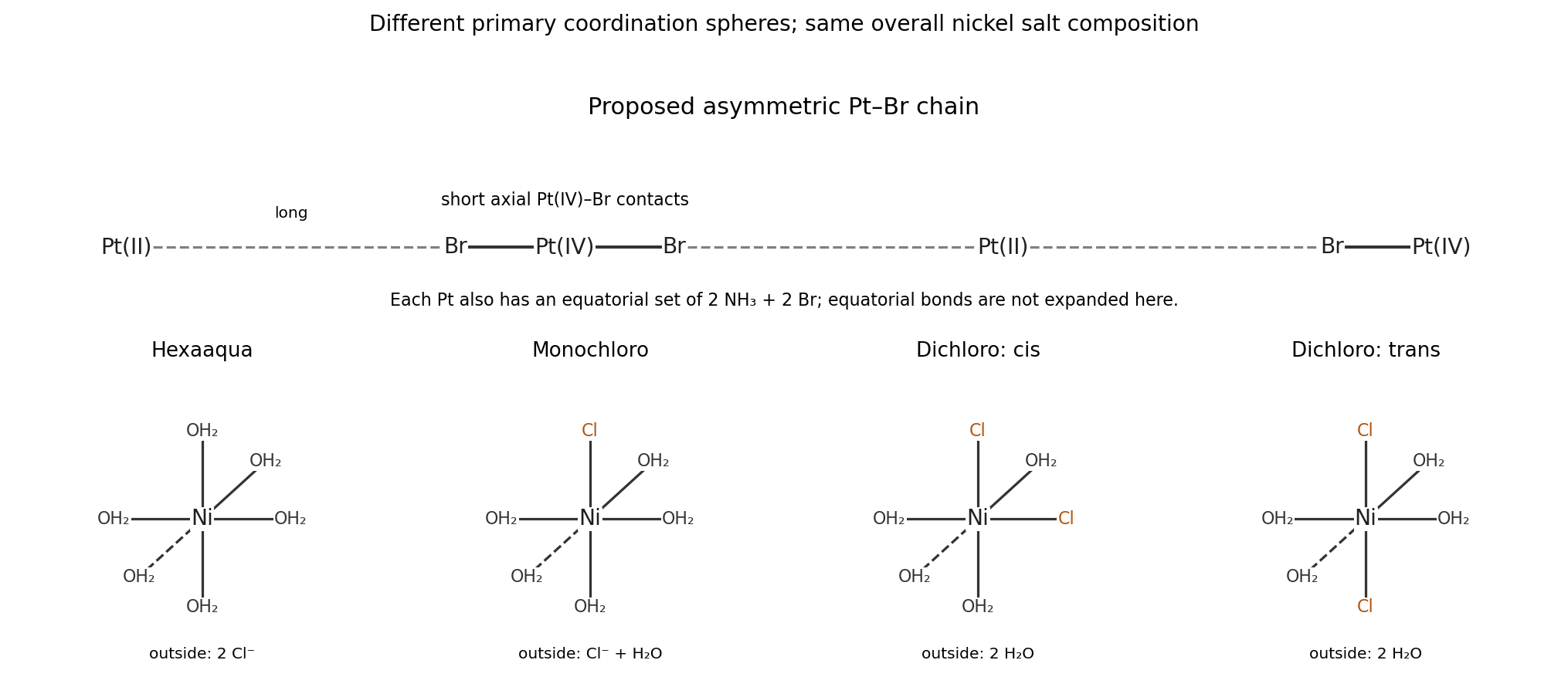
The average Pt oxidation state is , since six bromides balance the two metal atoms. A natural mixed valence assignment is alternating Pt(II), , and Pt(IV), , rather than two equivalent Pt(III) sites. Use neutral square-planar units and octahedral units. At every site place two ammonia and two bromide ligands in an equatorial plane; the Pt(IV) sites have two additional axial bromides pointing toward the adjacent Pt(II) sites.
Along the chain the connectivity isEvery Pt–Br–Pt bridge is asymmetric: short to Pt(IV), long to Pt(II). The latter contact is a secondary axial interaction, consistent with the preference of Pt(II) for a square-planar primary coordination sphere. The Pt(IV) site is smaller and more strongly attracts the bridging bromides. A drawing with all axial distances identical would obscure the distinct local environments.
There are four equatorial bromides and two axial bridging bromides per two-Pt repeat, giving precisely . A direct Pt–Pt bond is not required. This is a proposed structure consistent with the stated composition and two environments; the formula alone does not determine every equatorial cis/trans arrangement or numerical bond length.

New to topics? Read the docs here!