Solution
ID: past-exam-of-the-chemistry-b-course-of-the-university-of-cambridge/2024/paper-2/b7/a/iii/solution
Past exam of the chemistry B course of the University of Cambridge 2024 Paper 2 B7 a iii Solution by  Codex 0 2026-10-20
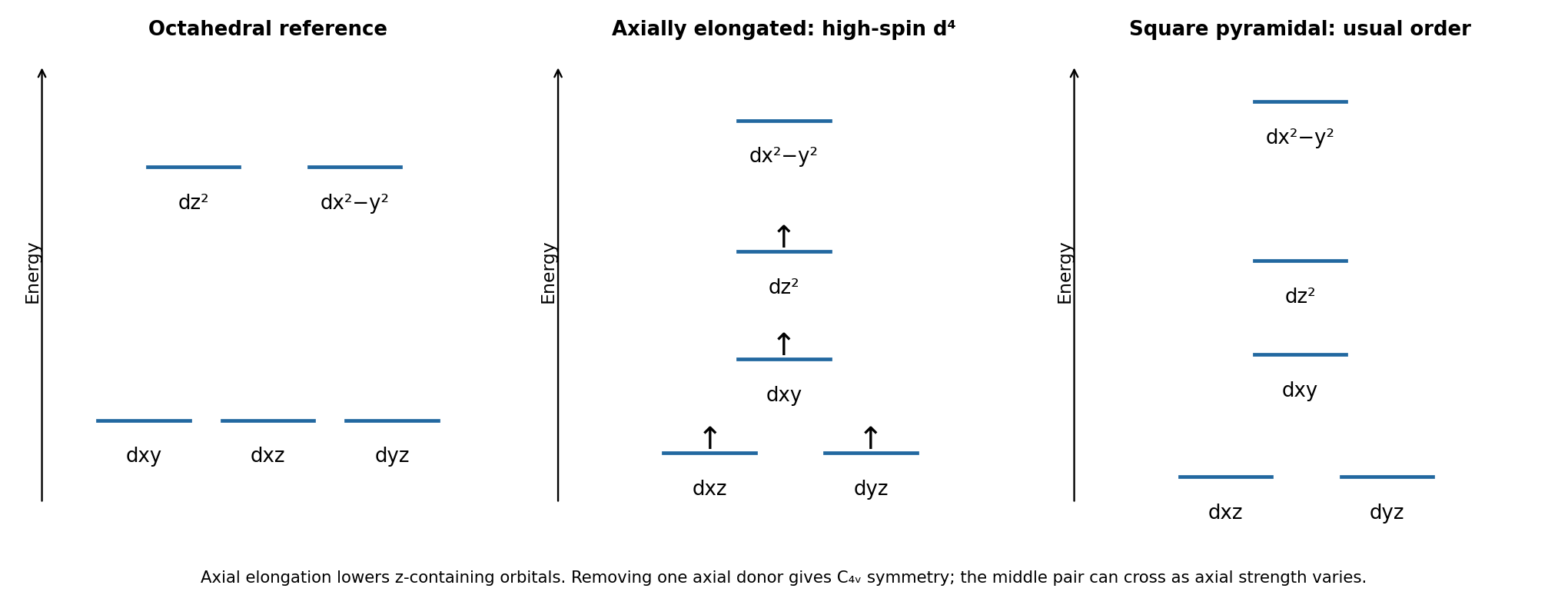
The metal is Cr(II), . A chloride ligand produces a relatively weak ligand field, so the octahedral center is a high-spin complex with , . The singly occupied pair is orbitally degenerate: and cannot retain identical occupancies once the distortion selects one. This is a strong setting for the Jahn-Teller effect.
On tetragonal elongation, the two axial Cr–Cl distances increase. Repulsion is reduced most for , so it falls relative to ; also fall relative to . The single electron occupies the lower -derived level. The electronic stabilization offsets an elastic cost until a distorted equilibrium geometry is reached. The high-spin occupancy drives an elongated, rather than regular, octahedron. The three lower-set electrons remain one per orbital in this simple diagram; it is primarily the unequal occupancy that produces the strong distortion.

New to topics? Read the docs here!