Solution
ID: past-exam-of-the-chemistry-b-course-of-the-university-of-cambridge/2024/paper-2/b9/b/i/solution
Past exam of the chemistry B course of the University of Cambridge 2024 Paper 2 B9 b i Solution by  Codex 0 2026-10-20
The methyl nucleophile attacks an electrophilic ring boron. That boron becomes tetrahedral, bearing its original methyl, the incoming methyl, and its two ring nitrogen neighbors. This interrupts its p-orbital participation, so the metal attaches to the remaining five-atom conjugated segment. is the anionic heptamethylated-ring Cr(CO) complex, paired formally with ; solvent ligation and ion pairing at magnesium are not specified by the spectrum. The original connectivity, with the attacked boron labeled , is shown in the first panel below.
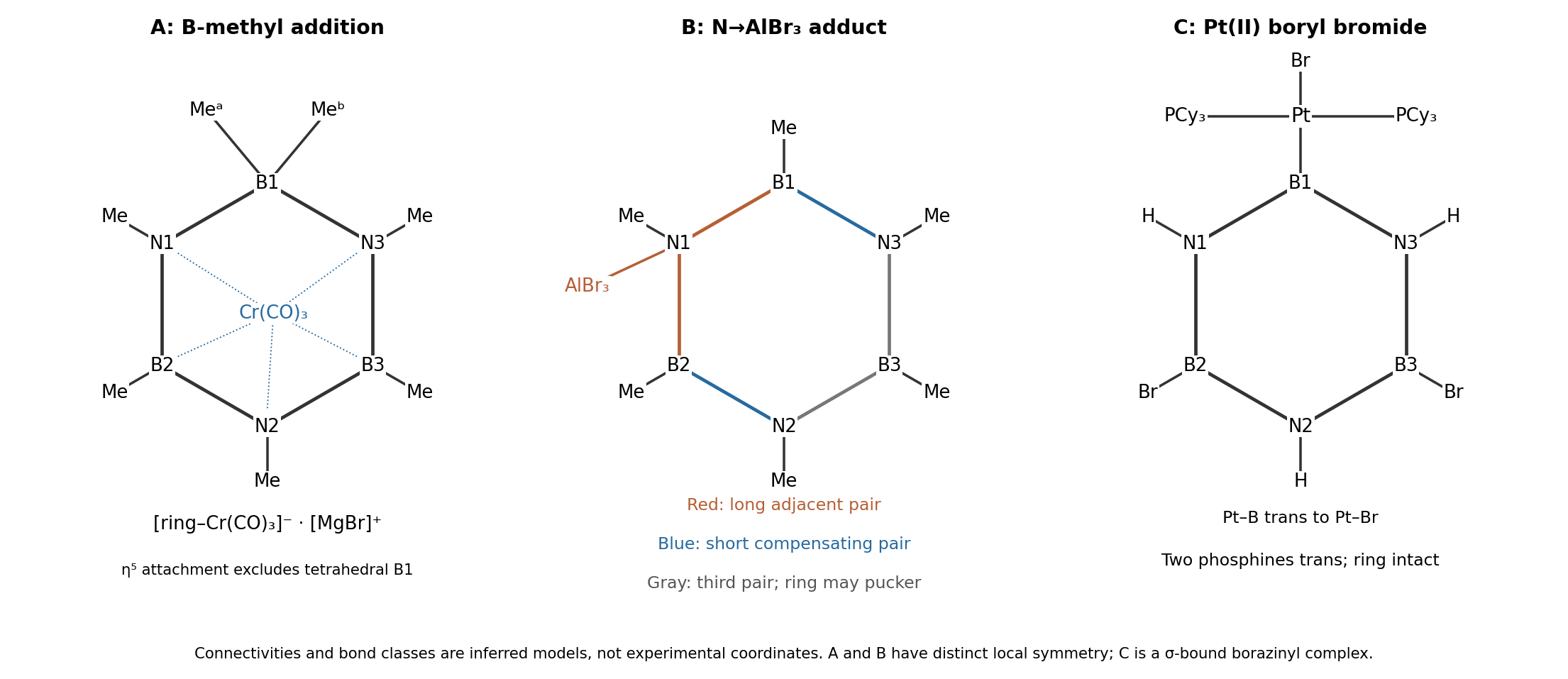

There are seven methyl groups. The two attached to tetrahedral are inequivalent because the chromium-bound face distinguishes their environments: one signal of relative integral one for each. The other two B–Me groups are equivalent to one another, giving a signal of integral two. The two N–Me groups adjacent to form another equivalent pair, while the N–Me opposite is unique. The predicted methyl-group multiplicities are therefore , the same unordered set as the observed ratio. Multiplying by three gives proton integrals totaling 21. This assignment assumes no fast process interchanging the two methyl environments.
New to topics? Read the docs here!