Solution
ID: past-exam-of-the-chemistry-b-course-of-the-university-of-cambridge/2025/paper-1/b3/a/solution
Past exam of the chemistry B course of the University of Cambridge 2025 Paper 1 B3 a Solution by  Codex 0 2026-10-20
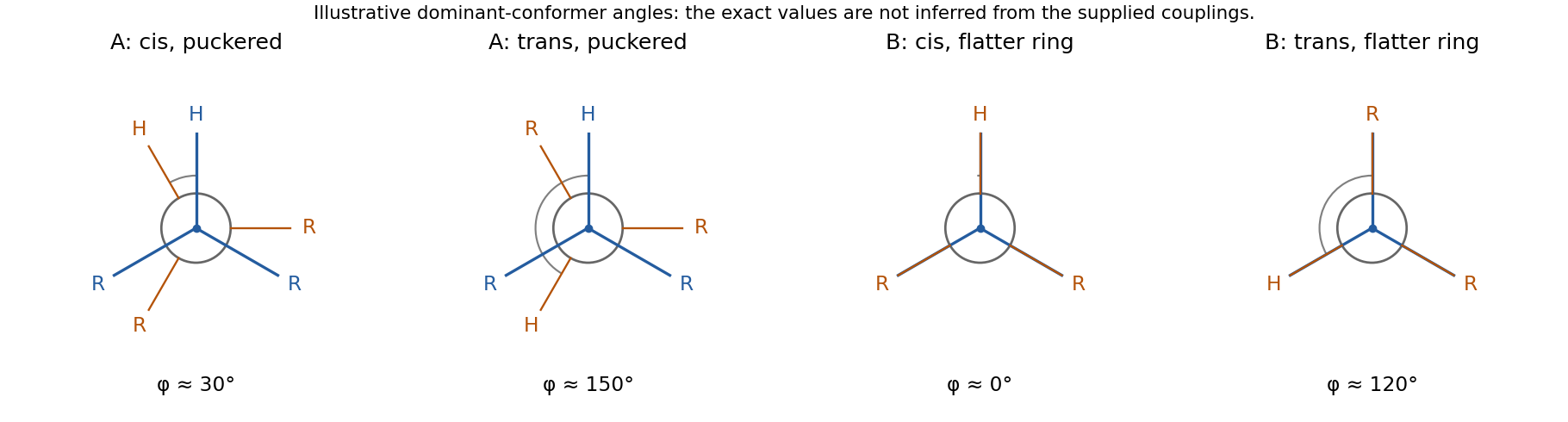
The relevant quantity is the H–C–C–H dihedral angle, through the Karplus relation, rather than the labels cis and trans alone. Couplings tend to be larger near eclipsed or antiperiplanar arrangements and smaller nearer a right angle. The observed value averages the accessible conformations.
In A, the saturated five-membered ring is puckered. A preferred envelope-like conformation can place the trans hydrogens closer to an antiperiplanar arrangement, giving a slightly larger coupling than the cis pair. In B, the double bond restricts ring geometry toward a flatter arrangement: the cis hydrogens are more nearly eclipsed, whereas the trans pair has an oblique dihedral angle. The cis coupling is then larger. Approximate Newman projections illustrate these trends; exact angles cannot be recovered from four coupling constants without a calibrated relation and conformational populations.

New to topics? Read the docs here!