Solution
ID: past-exam-of-the-chemistry-b-course-of-the-university-of-cambridge/2025/paper-2/b9/c/solution
Past exam of the chemistry B course of the University of Cambridge 2025 Paper 2 B9 c Solution by  Codex 0 2026-10-20
, with two cyclohexylamino substituents on each original phosphorus. All six P–Cl bonds have been replaced; the six N–H bonds of those substituents remain. Each equivalent of triethylamine traps one equivalent of HCl.
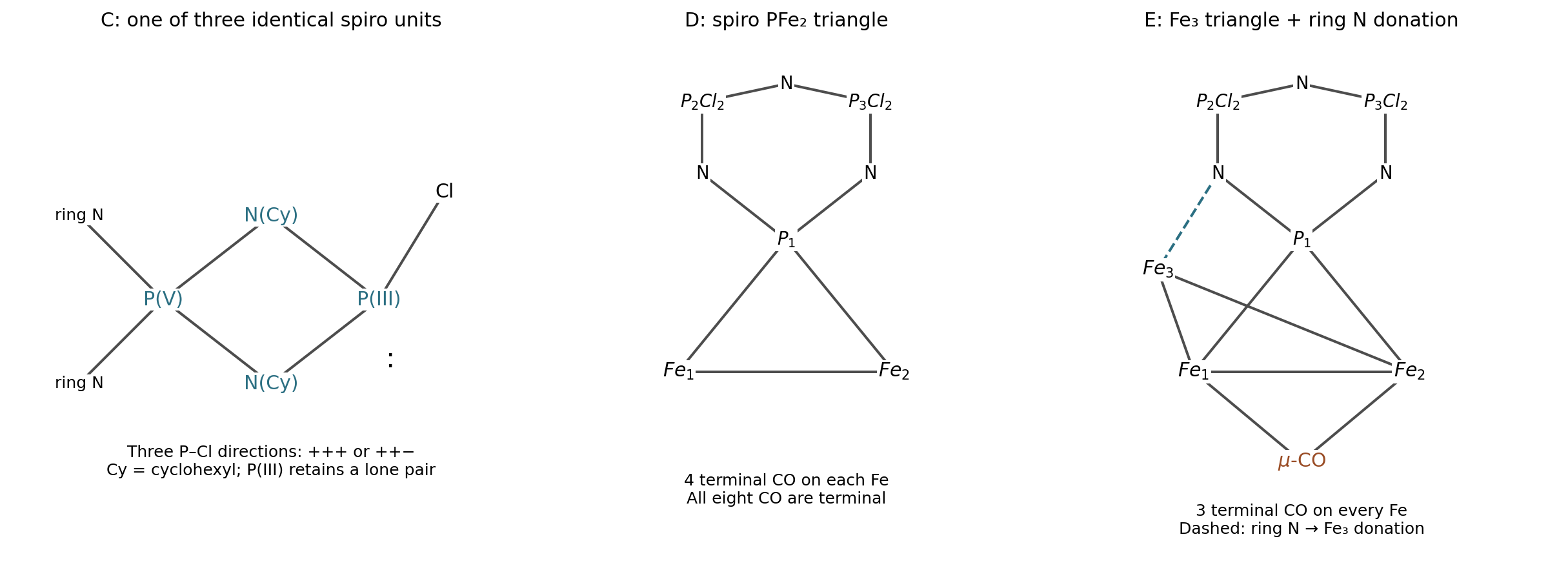
contains three four-membered spiro rings, one at each original ring phosphorus. Each PCl joins the two geminal NHCy groups: replacement of two of its chlorides forms two new P–N bonds and releases two HCl, consuming both N–H protons. The new phosphorus retains one chloride and a lone pair, making it three-coordinate P(III); the original six-membered ring retains P(V). The product formula is . For each spiro ring, the original phosphorus is bonded to both exocyclic nitrogens, and each of those nitrogens is bonded to the same new PCl center; the braces do not indicate a simple linear substituent.
The three new P–Cl directions permit an all-cis isomer and a cis,trans isomer. Relative to the central ring, write these as and , with cyclic relabeling giving equivalent choices. Reversing all signs does not create a third relative configuration. This describes the configuration pattern; puckering and substituent conformations are additional structural details.

New to topics? Read the docs here!