Solution
ID: past-exam-of-the-chemistry-course-of-the-year-1-of-the-natural-sciences-course-of-the-university-of-cambridge/2023/paper-1/2/b/i/solution
Past exam of the chemistry course of the year 1 of the natural sciences course of the University of Cambridge 2023 Paper 1 2 b i Solution by  Codex 0 2026-10-20
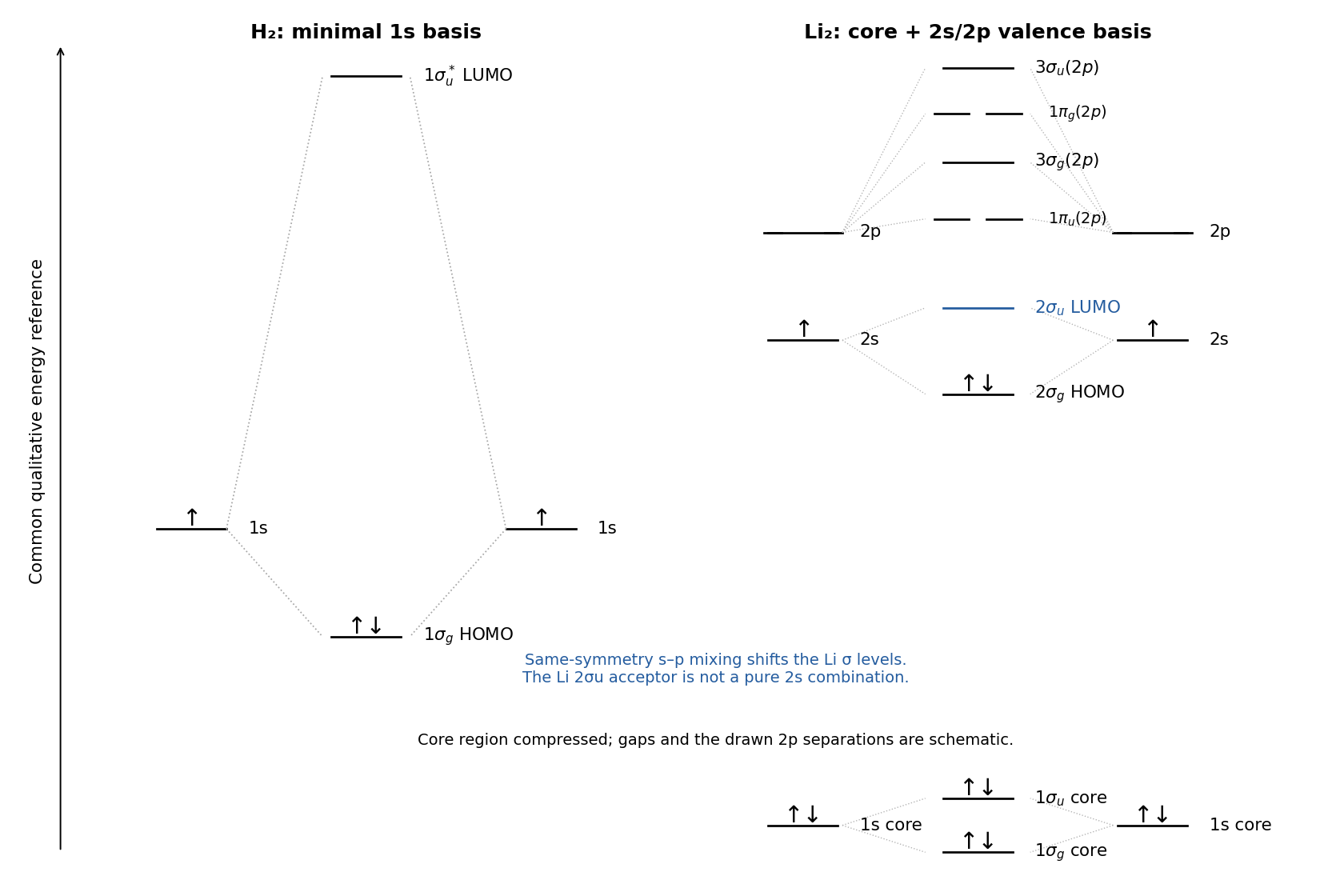
Both dimers have two electrons in a valence sigma-bonding orbital and a formal valence bond order of one. For hydrogen the minimal-basis configuration is , with the -derived as highest occupied molecular orbital and as LUMO. The bonding combination has no internuclear node; the antibonding combination does.
For lithium, include the filled core pair of levels as well as the valence levels:The first two orbitals are predominantly core combinations whose bonding and antibonding occupations cancel in a simple bond-order count. The highest occupied molecular orbital is predominantly , denoted ; the LUMO is , predominantly the antibonding combination but modified by mixing with compatible contributions. The nearby empty -derived sigma and pi levels must also be shown. Only orbitals of matching symmetry mix, so this does not mean that every combination mixes with every combination.
On a common qualitative energy reference, hydrogen is much lower than lithium's valence , while lithium's core levels lie much deeper. The Li valence bonding–antibonding separation is smaller, consistent with its longer and weaker bond. The figure uses a compressed core region and schematic gaps, not measured orbital energies. The role of symmetry-compatible s–p orbital mixing in the first-row diatomics is illustrated in institutional molecular-orbital notes.[ref]

New to topics? Read the docs here!