Solution
ID: past-exam-of-the-chemistry-course-of-the-year-1-of-the-natural-sciences-course-of-the-university-of-cambridge/2023/paper-1/2/b/ii/solution
Past exam of the chemistry course of the year 1 of the natural sciences course of the University of Cambridge 2023 Paper 1 2 b ii Solution by  Codex 0 2026-10-20
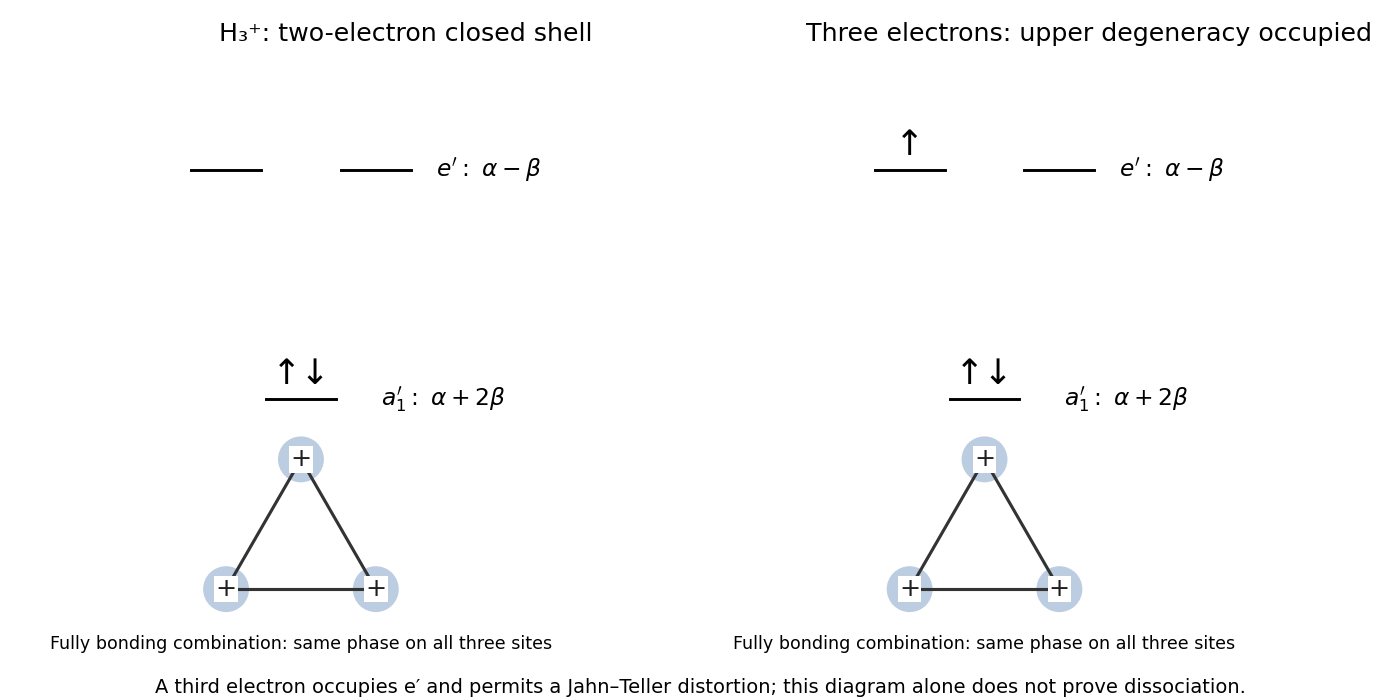
Two electrons can occupy a fully bonding orbital delocalized equally over all three hydrogen atoms. Three atomic orbitals on an equilateral triangle form one totally symmetric combination and a degenerate pair of higher orbitals. In an orthonormal equal-interaction model with diagonal energy and off-diagonal ,The lower orbital is proportional to , with constructive overlap along every edge. Its two electrons give a three-centre two-electron bond and equivalent interactions between every pair of nuclei. At the equilibrium distance, this bonding competes with nuclear Coulomb force to favour the symmetric triangular arrangement. The occupied shell is nondegenerate and closed, so there is no first-order Jahn-Teller incentive to distinguish the three edges. A straight-line or localized single-bond description would miss that equally shared bonding pattern.

New to topics? Read the docs here!