Solution
ID: past-exam-of-the-chemistry-course-of-the-year-1-of-the-natural-sciences-course-of-the-university-of-cambridge/2024/paper-1/1/b/solution
Past exam of the chemistry course of the year 1 of the natural sciences course of the University of Cambridge 2024 Paper 1 1 b Solution by  Codex 0 2026-10-20
The carbon spectra are A → 5, B → 8, C → 6, and D → 7. Number each acyclic acid or ester chain from its carbonyl carbon. The assignments below account for every carbon-13 NMR environment.
For A, both ketone carbonyl carbons have ppm and all four methylene carbons have ppm. Molecular symmetry and rapid conformational averaging explain why six carbons give only two resonances.
For B, written , assign , , , , , and ppm. The alternation among vinylic chemical shifts reflects polarization of the conjugated chain, especially the deshielded carbon beta to the carboxyl group.
For C, written , assign the carbonyl at , the adjacent sp carbon at , the other sp carbon at , and the terminal methyl at ppm. The two methylene resonances are and ppm. A plausible assignment is and ppm, but their ordering is tentative from the supplied shift list alone; a correlation experiment would resolve it.
For D, written , the carbonyl is at ppm. The crotonyl beta-CH, alpha-CH and methyl carbons are at , and ppm, respectively. The O-bound vinyl CH is at ppm and its terminal is at ppm. The two sides of the ester oxygen therefore produce quite different vinylic environments.
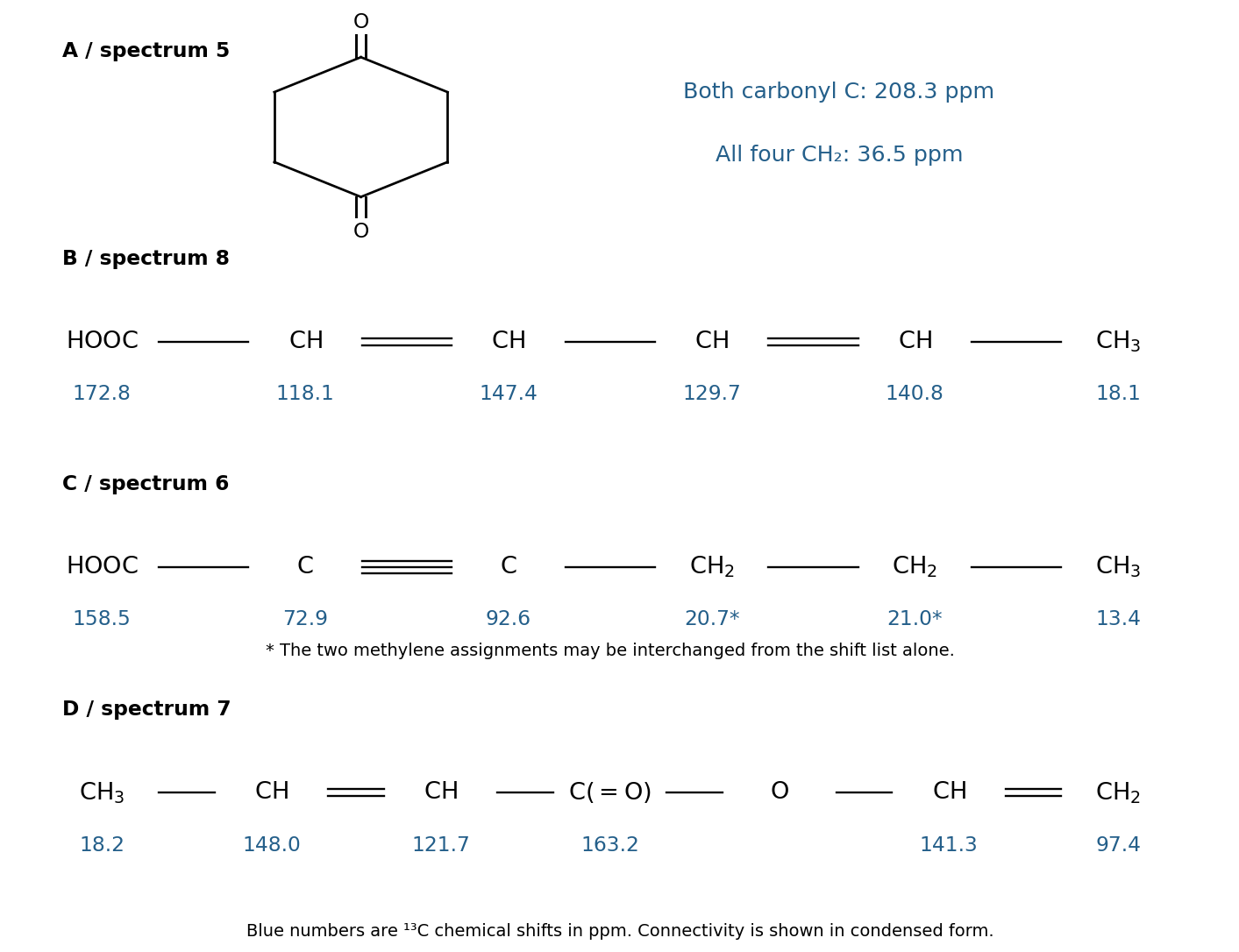
Original structural maps of all supplied carbon-13 NMR assignments
. Details. 
New to topics? Read the docs here!