Solution
ID: past-exam-of-the-chemistry-course-of-the-year-1-of-the-natural-sciences-course-of-the-university-of-cambridge/2024/paper-1/2/d/solution
Past exam of the chemistry course of the year 1 of the natural sciences course of the University of Cambridge 2024 Paper 1 2 d Solution by  Codex 0 2026-10-20
The elementary valence-MO model gives . Each carbon supplies four valence electrons, so fill eight electrons in the ordering appropriate to the lighter second-row diatomics:The two orbitals are degenerate, as are the two orbitals. The bonding and antibonding occupations cancel; four net p-bonding electrons remain, giving . Mixing between sigma orbitals of compatible symmetry places the occupied pair below the empty p-derived orbital in this diagram. All occupied orbitals are paired.
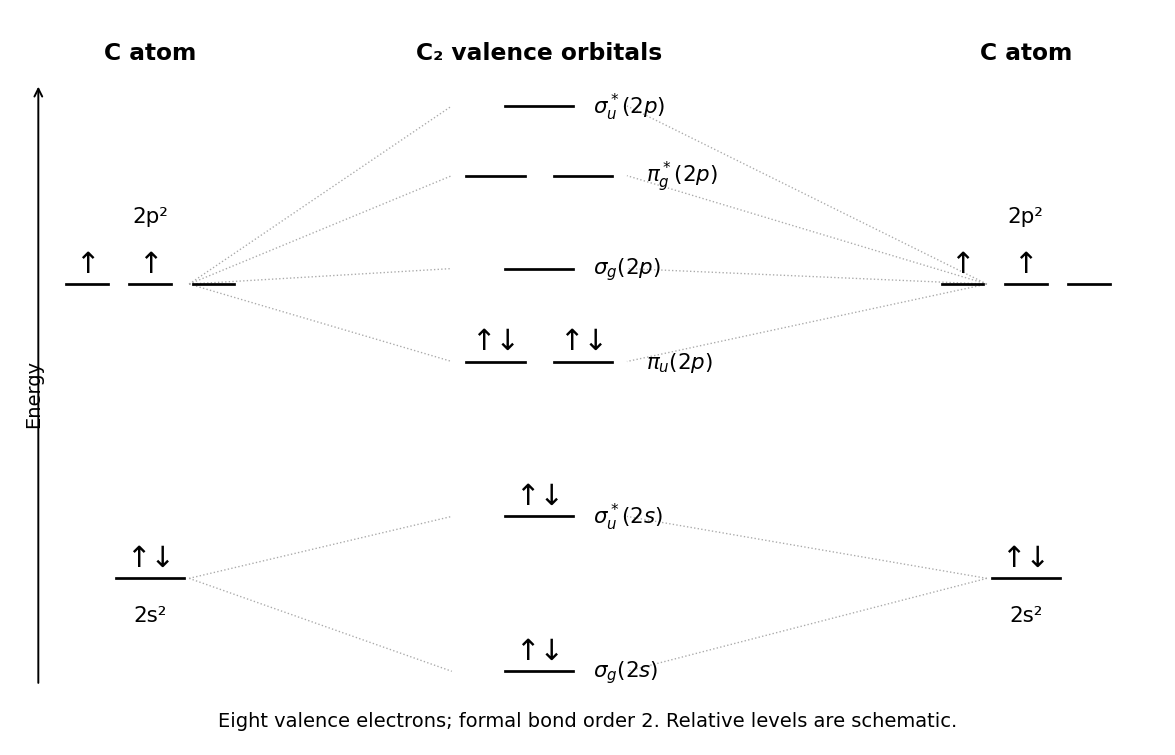
Original valence molecular orbital energy diagram for carbon dimer, with atomic inputs and symmetry labels
. Details. 
The omitted orbitals form filled and levels. Their contributions to the formal bond order cancel, and their low energies and small spatial extent make them largely core-like. Omitting them simplifies this valence diagram without claiming they do not exist or have exactly no effect on molecular energies.
New to topics? Read the docs here!