Solution
ID: past-exam-of-the-chemistry-course-of-the-year-3-of-the-natural-sciences-course-of-the-university-of-cambridge/2021/paper-2a/section-b/24/b/iii/a/solution
Past exam of the chemistry course of the year 3 of the natural sciences course of the University of Cambridge 2021 Paper 2A Section B 24 b iii A Solution by  Codex 0 2026-10-20
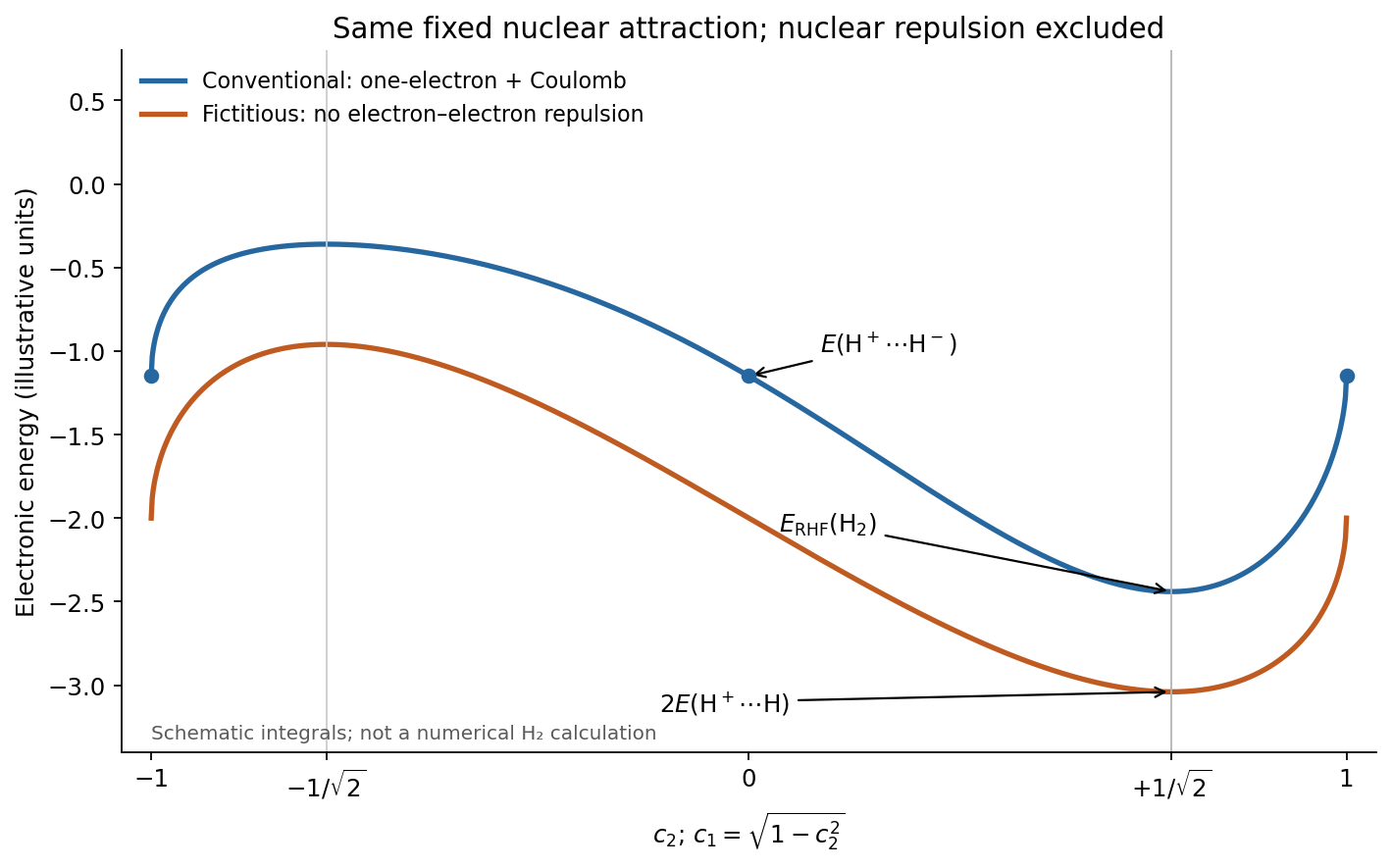
The physical curve has its bonding minimum near , with ionic endpoints at . Use electronic energies excluding the fixed . Define , , and . The one-electron contribution isThe Coulomb energy of the doubly occupied orbital isso . For localized orthogonal orbitals, a transparent illustrative approximation neglects integrals involving the product and retains the on-site repulsion and intersite direct repulsion :Since normally , spreading the occupied orbital over both atoms reduces the repulsion. At equilibrium the bonding one-electron term favours , so the minimum represents the Restricted Hartree-Fock method approximation to . At or , both electrons occupy one atom, giving the same ionic energy . At the orbital is antibonding and the one-electron contribution is raised.
The diagram below uses an illustrative set of integrals to show these landmarks; it is not a numerical calculation for the molecule. Zero orbital overlap alone does not force every exchange or three-index Coulomb integral to vanish, so the simplified expression is an explicit sketching approximation, not a consequence of orthogonality.

New to topics? Read the docs here!