Solution
ID: past-exam-of-the-chemistry-course-of-the-year-3-of-the-natural-sciences-course-of-the-university-of-cambridge/2022/paper-1/10/a/ii/solution
Past exam of the chemistry course of the year 3 of the natural sciences course of the University of Cambridge 2022 Paper 1 10 a ii Solution by  Codex 0 2026-10-20
chromium is the characteristic assignment, giving Cr(I)–Cr(I) with a formal quintuple bond. Each formamidinate is monoanionic, so gives . chromium(I) is and the pair supplies ten d electrons. Relative to a metal–metal axis, the idealized bonding combinations are sigma, pi and delta:End-on sigma overlap gives the largest splitting, pi overlap a smaller splitting, and delta overlap the weakest. A useful qualitative ordering places bonding sigma lowest, then the two pi combinations, then the two delta combinations; all are occupied. Their antibonding partners are empty, with the weakly split delta-star levels nearest their bonding counterparts. The actual three-bridge ligand field can mix and split symmetry-compatible levels, so the diagram is a bond-axis model rather than five perfectly degenerate metal d levels in the molecular complex.
The identified lantern-type anion has an experimentally determined Cr–Cr distance near Å; reduction of its nine-bonding-electron precursor supplies the tenth electron. This corroborates the model more specifically than citing “short bonds” in an unrelated framework.[ref]
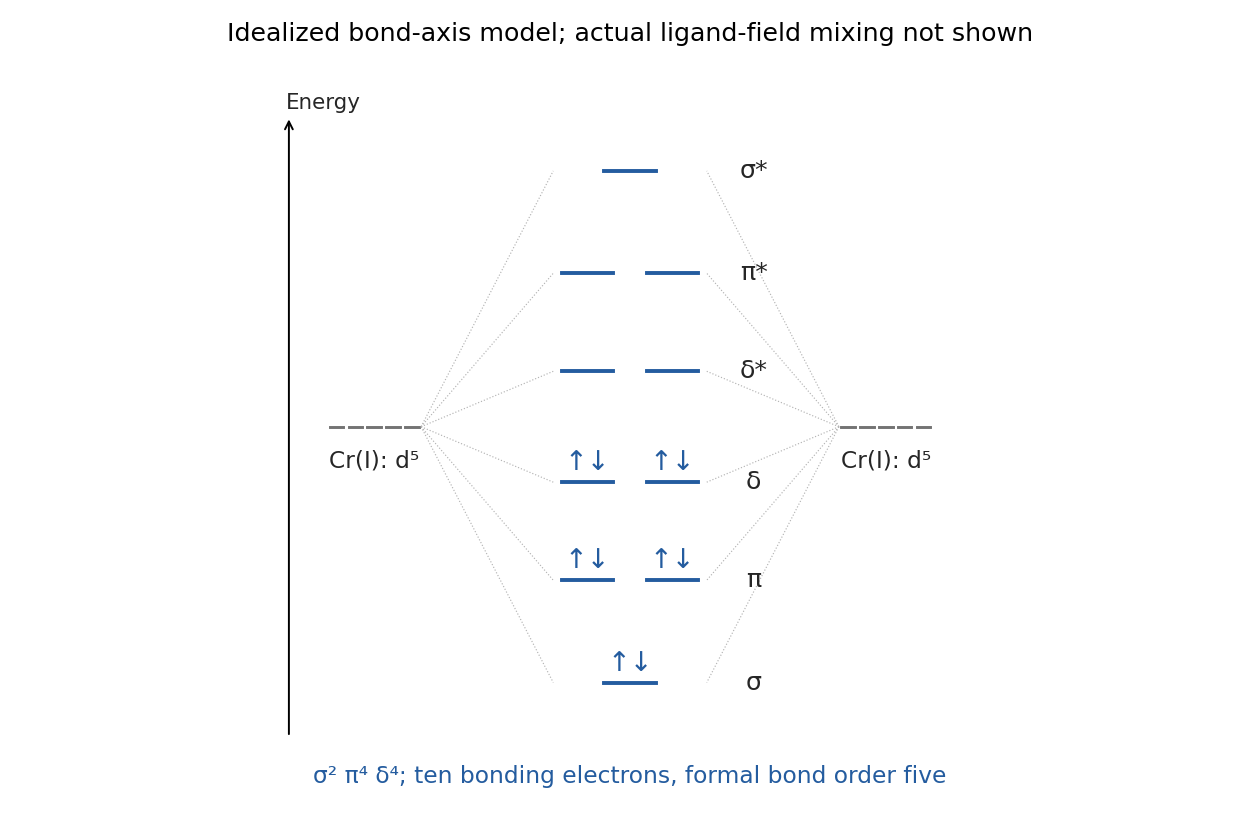
Original idealized d-orbital combinations and ten-electron occupancy for a sigma-two-pi-two-delta quintuple bond
. Details. 
New to topics? Read the docs here!